
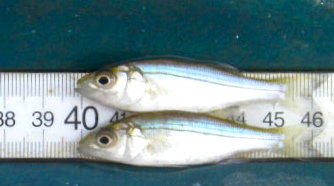
Researchers at the Virginia Institute of Marine Science (VIMS) have announced that preliminary results from their 2011 survey suggest the production of a strong class of young-of-year striped bass in the Virginia portion of Chesapeake Bay. This is fantastic news for the striped bass population (and striper fishermen!).

The 2011 study, formally known as the Juvenile Striped Bass Seine Survey, recorded more than 27 fish per seine haul, significantly higher than the historic average of 7.5 fish per seine haul. This is a significant increase from recent years, during which catches of young fish were average.
It will be interesting to see if a similar study conducted in the Maryland portion of Chesapeake Bay returns positive results as well. UPDATE – October 18, 2011 – The Maryland Department of Natural Resources (DNR) today announced that the 2011 Young of the Year (YOY) Striped Bass Survey is 34.6, well above the long-term average of 11.9, and exceedingly higher than 2010’s results of 5.9. This is the fourth highest measure of striped bass spawning success in the Chesapeake Bay in the survey’s 58-year history.
Striped bass populations depend on the availability of strong year classes to mitigate the effect of less productive years. The 2011 year-class of striped bass will grow to a catchable size, about 15-18 inches long, in three years.
For a little more background on the importance of a successful Chesapeake striper spawn, I’ve posted my June Editor’s Letter below.

Editor’s Letter – June 2011
by Kevin Blinkoff
After a particularly brutal winter, it seems like spring has come on especially strong. The sound of birds at first light, sorting out their courtship issues, has been loud enough to wake me before my alarm clock. And bumblebees, groggy from the nighttime cold, are weaving through the air looking for the right spot to start a new hive. All this activity among the birds and the bees is a clear sign of what Mother Nature has on her mind in spring.
As I’ve starting chasing the early-season striped bass and noticed, like many other anglers, that there simply aren’t as many small stripers around as in seasons past, my thoughts are on certain procreative activities that have been playing out down in Chesapeake Bay. In the spring, most of the mature stripers along the East Coast pile into the Bay, driven by the instinct to spawn. Female striped bass make their way into rivers, surrounded by a half-dozen or so smaller males. Seven or eight of these smaller males surround a single large female and push her toward the water’s surface, stimulating her to release ripe eggs that disperse in the currents along with a cloud of the males’ milt.
Striped bass aren’t what you’d call devoted parents. Those millions and millions of fertilized eggs are left on their own to drift in the current, at the mercy of predators, pollution and weather. A small percentage of those eggs will hatch, and a tiny percentage of those larval striped bass will survive and grow big enough in the nursery waters of the Bay to join the spring migration up the coast to Northeast waters.
In fishery science speak, an above-average number of those “young-of-year” stripers survived to be “recruited” into the striper “stock” in 1993, 1999, 2001 and 2003, creating impressive “year-classes” of stripers. In angler speak, those successful spawns created a phenomenal striped bass fishery with an abundance of striped bass that have returned a little larger every year.
We’ve been enjoying a high-quality striped bass fishery for over 15 years now, but unfortunately, we haven’t had an exceptional year-class of stripers come out of the Chesapeake since 2005. And it’s confounding fisheries scientists because there are certainly plenty of mature striped bass, born from those impressive year-classes, capable of spawning.
The poor spawns could be due to something out of our control, like rainfall, climate and ocean currents, or it could be some combination of factors that are at least partially caused by human actions but difficult to quickly correct, like water pollution, a depleted food source, or stress-related disease. While scientists try to figure out what causes these below-average spawning events, anglers are left feeling frustrated and helpless, watching as numbers of striped bass, particular the sub-legal schoolie stripers, slowly decrease.
One thing we can do is maintain a robust number of spawning-age bass in the population by encouraging regulators to lower the coastwide striped bass quota and tighten regulations – something that they are considering for the 2012 season, based on the results of a stock assessment due to be released this summer – so that we improve the odds of another superior spawn occurring in the near future.
When it’s time to give input, we must all make our voices heard and support such an action. For now, we wait with fingers crossed, our thoughts with those stripers in the Chesapeake tributaries, hoping that things went right in the rivers this year.
There are other alternatives to tighter regulations and restrictions on commercial removal. You would think that it’s impossible to have a healthy fishery after all the commercial guys are removing up to 30 fish/day tuesday, wednesday and thursday in mass. alone. The one million pound quota in Massachusetts was caught in 4 weeks this year. In past years it usually ran anywhere from 6-9 weeks if I remember correctly.
The reason for this is probably not that there are that many more or better fishermen but perhaps another reason.
I came down from NH to hit the Chatham bite this july and saw, marked and observed an incredible biomass of morone saxatilis, (along with bruiser blues) spanning the 30-45′ depths along nauset to chathmam.
Are all the seals eating the fish off monomoy? I don’t think so. I was trolling up fish with 30 feet of a seal during a hot summer day.
Great news about the large recruitment class Kevin that’s great to see. Now hopefully we have a run of adult menhaden (gotta love that latin name: brevortia tyrannus) the likes of yesteryear.
Cheers
Thanks for the comment Mike – I’m suggesting a more conservative total quota (which would affect commercial and recreational regs. by state). Definitely not singling out commercial fishermen. The biomass of Chatham was incredible and attracted a lot of commercial and recreational fishermen, but a large number of fish in one particular area does not necessarily reflect on the total health of the coastwide population – in the same way an absence of fish from an area at a particular time does not necessarily reflect the population health. Seals may not be eating healthy stripers, but they are competing for food, they do eat hooked fish, and they seem to keep the bass in deeper water and away from the beaches (where perhaps they’d be easy pickings for the seals).
I agree, yet disagree, with some of the reflections that you have drawn. Drawing from firsthand experience I can attest that fishing, both commercial and recreational, is a dynamic pursuit that is not easily defined. One captain I know said, “Success is made of many previous failures.” That seems to ring true; especially to hook and line fishing. Here one day, gone the next?
The population of striped bass off of nauset and chatham were in 30-45′ of water but I’m sure moved depending on tide, wind, water temp., and presence of bait. I saw a large shark jump clean out of the water chasing something. If I was a striper i’d peace out.
NMFS has gone through several recent major regulatory changes. Days at sea are still available, yet most comm. guys are in the sectors. Each sector is broken down into a specific geographical area with each fisherman having a “piece” of the pie. The pie being all of the commercially viable species that they have permits to sell.
I think there’s a problem with state by state regulation, varying keeper limit sizes and the fact that you can drag, gillnet and spearfish for stripers in some states yet not in others. Where’s the consistency? Make it simple for the outdoorsman and general public.
I’ve talked with the head striped bass expert in Woods Hole and what he said about the status of the fish was interesting. 4-5 years there was a fantastic year-class of fish that were mature. Everyone was a pro because the fish were thick, aggressive and ranged far and wide. I remember seeing huge bass off of gloucester that would come up to the surface in 180 feet of water in a chum slick.
Since then every year has been different. Water temperatures, the presence of bait (mackerel), the presence and absence of predators (spiny dogfish), and especially how many stripers we saw. Last year spike macks rolled in and the big ones took off. This year there’s an incredible amount of bait around. Especially halfbeaks and illex squid.
Ecology based fisheries management should be used for this fish specie that we’re all admired with and spend countless hours chasing.
What you mentioned about their recruitment this year is great!
There are significant problems in the Chesapeake Bay right now i.e. dead zones. Signs of death spreading through the substrate.
I don’t think there’s that much of a seal problem. Sure worms in the meat of cod can be linked to seals and they do steal struggling fish from a line, but if they were terrorizing the fish that much there wouldn’t be thousands of stripers in a small area off the outer cape.
I’m interested to see the gut contents of these fish during that time period.
Also, how long were those fish feeding there? Locals have a better idea of the daily fluctuations than some of the scientists.
In your reports you mentioned sand eels and tinker macks but I’m curious what was found in the bellies of the beast. I had blues spitting up sand eels but they were crushing trolling plugs, sebile plugs and bucktail jigs trolled on wireline.
What do you think will happen next year?
With great news of a banner YOY in 2011, let’s hope that the fisheries managers up and down the coast react positively and not see this as “business as usual” and do nothing to protect the spawning/ mature stripers. It is even more important to protect these large stripers so that we continue to observe above average spawn cycles going forward. It is not a “green light” for managers to allow for a continued recreational and commercial harvest to remain at current levels, but rather a cautionary “yellow light” with optimism that we are entering an uptick in spawning cycles and reduce the kill rate until we see more positive data.
This is awesome news. Nature is such an interesting, cyclical creature. A few poor years of spawning occur, we all begin to get nervous, and then surprise!-a banner year for striped bass recruitment. Go figure.
Whether it’s predicting where striped bass will be on the next tide, or deciphering their spawning habits, one thing is for sure-bass are very fickle animals that are extremely difficult to figure out.
Being an active participant in both the recreational and commercial sector, I firmly believe that we can all benefit from aligning our interests and goals together. Can you imagine the impact we could have on fisheries management if we commercial and recreational fishermen come together, as one voice with a streamlined agenda and common goals?
There are many things other than simply reducing size limits and daily quotas that can have a positive impact on the striped bass population. Protecting critical habitat, reducing commercial bycatch, and taking steps to improve the bait situation (pogies etc.) – to name just a few.
Addressing “big” issues like the aforementioned, will be much easier when recreational and commercial fishermen realize that we are on the same team.
The odds of creating a sustainable, healthy striped bass population for years to come will increase when recreational and commercial fishermen being working together towards a common goal.
Just my two cents!
Tight lines and good luck,