

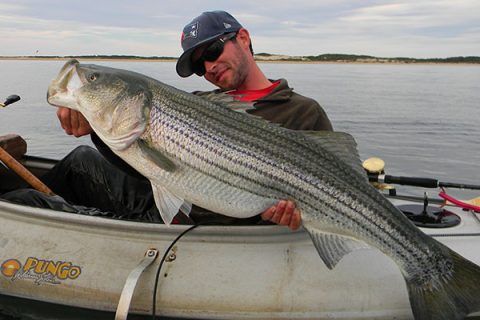
Follow these 10 tips 10 Tips for making sure the big one doesn’t get away.
“The one that got away” is a phrase we hear all too often in the fishing world. It seems like all anglers have, at one point or another, met their match and been humiliated by a seemingly feeble-minded fish. For many of us, the vision of a trophy fish breaking the line or shaking the hook and swimming away is engraved deep in our memories. It keeps us fishing long after we should have gone home, and it drives us to try even harder to land the fish of a lifetime.
There are many things that can go wrong when you are trying to land a big fish. There will always be times when fate wins out over preparation, but there are a few simple things that all anglers can do to tip the odds in their favor. I’ve seen many big fish get away, for many different reasons, but most of those fish could have been landed if the angler had followed these 10 basic tips.
When it comes to landing a big fish, you don’t necessarily need to have a top-of-the-line rod and reel. It certainly can help, but what’s even more important is using quality line. All fishing line deteriorates over time. If you are using monofilament, you must change your line at least once a year, and if you do a lot of fishing, you may want to switch it out several times over the course of the season. Monofilament has the tendency to weaken if it is exposed to direct sunlight for long periods of time, so always store your reels in a dark place, if possible. It can also deteriorate when exposed to certain chemicals, so avoid letting the line come in contact with bug spray or sunscreen.
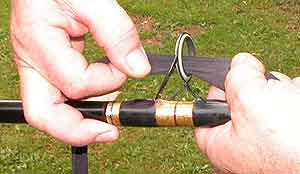
Braided lines tend to be more durable than monofilament, but they too will weaken over time. Braided line is much more expensive than mono, but if treated properly, it will long outlast it. I’ve had reels with the same spool of braid for more than five years. Braided line, however, is not invincible and is prone to fraying, especially if you fish in rocky areas.
The condition of your rod and reel will also affect your line. A small amount of corrosion on the bail of a spinning reel could weaken your line and lead to a break-off. A hairline crack in one of your rod guides can also lead to line failure. Make it a habit to inspect your gear before every trip and to check your line regularly.
Of all the big fish I’ve seen lost, a poorly tied knot was to blame more often than not. All knots will slightly weaken the breaking strength of your line, and a bad knot can weaken it by more than 50 percent. If you don’t already know how to properly tie a uni, palomar, or improved clinch knot (my personal favorite), then take the time to learn at least one of them. These are all simple and solid knots that, if tied correctly, will retain 90 percent or more of your line’s breaking strength.

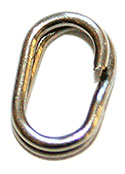
Even if you are using the proper knot, it’s critical to check every one you tie. After you tie on a hook or lure, give it a good pull and put it to the test. This is especially important if you are attaching your line to a split ring on a lure. Sometimes, the knot will get buried in the gap of the split ring, and this can lead to disaster.
A small amount of rust on a hook, lure or swivel can also lead to broken knots, and if you double-check your knot before casting, you should be able to detect any imperfections. I try to avoid using old swivels and hooks for this very reason, especially in saltwater. Terminal tackle is relatively cheap, and just like fishing line, it’s not the place to cut corners.
I’m always amazed by how hard it is to break my line off when I get snagged on the bottom. Fishing line is stronger than you think, and it can be tough to break under steady pressure. Every now and then, I’ll intentionally try to break my line just to see how much pressure I can apply with a certain rod and reel. Tie your line off to a sturdy object, get about 30 yards away and experiment with how much force you can apply without the line breaking. It’s important to get a feel for how much pressure you can apply without breaking your gear and to become comfortable with the limitations of your tackle.

Many anglers have the tendency to get overexcited when they hook a big fish, and they will try to haul it in as fast as possible. This is a bad idea. Trust your line, knots, and tackle, and use the drag to tire a fish out. If your reel is fully spooled with quality line and you play your cards right, you will turn the fish long before you run out of line. Putting too much pressure on a fish can cause the hook to open up a hole in its mouth and pull out.
Every now and then, however, you will have no choice but to apply maximum pressure on a fish, such as when a largemouth bass charges for a brushpile or a big tautog tries to bury into the rocks. This is when you really need to know the breaking point of your tackle. As a general rule, if you are in open water with plenty of room to fight the fish, keep your drag light and let the fish tire itself out. If you are in a tight spot or there’s a lot of nearby structure, tighten the drag and put the wood to it.
Never—I repeat, NEVER—point your rod tip right at a fish. Keep your rod tip up and make the fish bend the rod before it takes drag. The flex in your fishing rod absorbs the shock of the fish’s sudden movements, which could otherwise snap your line. Maintaining a bend in the rod is also crucial in keeping tension on the hook so it won’t slip out of the fish’s mouth.

This is perhaps the most important tip on the list. ALWAYS keep your line tight to the fish and never give it slack. This is sometimes easier said than done, such as when a false albacore turns and decides to swim right at you. However, do whatever it takes to keep tension on your line. If the fish has some slack, it can shake out the hook much easier than if there is tension on it.
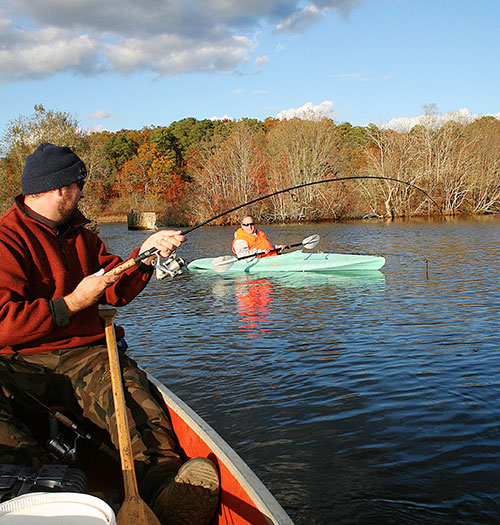
photo: Dre Travers
I don’t know a whole lot about physics, but I do know that playing the right angles can help you land a big fish. Whether you are on land or in a boat, if the fish runs left, move your rod to the right, and vice versa. If a big fish is gaining steam and taking too much line, simply changing the angle from which you are applying pressure can cause the fish to turn and head in another direction. This works to your advantage, as it allows you to gain back some line.
Sometimes, the angle of the rod can affect how a fish reacts to pressure. With salmon and steelhead, keeping the rod at a high angle during the fight pulls the fish’s head toward the surface and will cause it to freak out and run downstream. By keeping the rod at a low angle, the fish will be easier to control and can be steered toward the net.
I’ve never been good at fixing things, and I’m a bit mechanically challenged. I’ve ruined several perfectly good reels by taking them apart and not being able to get them back together. I’ve learned my lesson, and I leave the major repairs to the professionals at the tackle shop. The one thing I do have a grasp on, though, is how to clean the drag washers in my reels.
 Check out our guide to Maintaining A Smooth Drag On A Spinning Reel
The drag in most reels is controlled by a series of stacked washers. When sand, salt or dirt gets between the washers, you get a “sticky” drag. In most reels, the washers are easy to access. Make sure you keep them in the right order, and all you’ll need to do is wipe off each washer with a paper towel and then reassemble. Give them a thorough cleaning at least two times a season. If you didn’t save the owner’s manual, you can find cleaning instructions for most reels online. It’s worth reading up on before you start, as every reel is different. Most reels have a “dry” drag system, which means you should not put any oil or grease on them, but always defer to the manufacturer’s recommendations.
Make sure to store your reels with the drag loosened. If you clamp down the drag and then store the reel for a long period of time, it can compact the washers and make the drag sticky. Another good habit to get in is to test your drag setting at the beginning of your outing. Don’t test it by only pulling off a few inches of line; strip off four or five feet of line to make sure that your drag is operating properly.

In most circumstances, when you break off a fish, the line will part either at the knot or within a few feet of your hook or lure. The last three feet of your line receive the most wear and tear, either from a fish’s mouth, its tail, or from being dragged around on a rough bottom. By using a monofilament or fluorocarbon leader that is heavier than your main line, you greatly decrease the odds of a break-off near the end of your line.
Remember to check your leader regularly while fishing. Run the line between your fingers to check for signs of wear, and if you feel any small nicks, cut it off and retie.

The biggest fluke I ever had on the line was lost right at the side of the boat. We were in a rush to get out that day, and in our haste I left the landing net in the back of my truck. By the time we realized our misfortune, it was too late. Flipping a 3-pound fluke into the boat without a net is no problem, but this fish was pushing the 10-pound mark and getting it in the boat was quite a predicament. As the fish flailed at the surface, we all looked around with a blank stare, desperate for anything that might be usable as a makeshift net or gaff. There was nothing. My only option was to grab the leader and try to swing it over the gunwale—a bad idea. As soon as I grabbed it, the big fluke flipped out, shook the hook, and glided back to the depths.
A small lip-gripper or hand gaff takes up very little space on a boat. Next time you’re at the tackle shop, pick one up and leave it on your boat, just in case.
Don’t let the guy next to you grab ur line.
It was noon on a work day and I was having my lunch in my truck conveniently parked to give me a view of Manchester harbor. Where my focuse was split on the buitful scenic veiw of the harbor, boats and to guys fishin the marshy section to my left. One of them hooked in and as the fight progressed I realized the fish had some real size. I abandoned my lunch and walked over to get a better look. As I was approaching the over sized striper took a run straight torwds the angler. When the fish was 10 feet or less from shore it haulted but did not run. The anglers partner thinking the fish had enough grabbed his friends line to hourse it on to land. The crafty bass maybe senseing his chance took that moment to roll, thrash, and quickly break off and with no real energy spent took off for deeper pastures.
My nephew David is an avid fisherman. He doesn’t catch fish by luck it’s all about skill. The striper he is holding is just one of many that I’ve seen him catch. I can’t wait so see him catch many more. Cape Cod 2016 here we come…………