
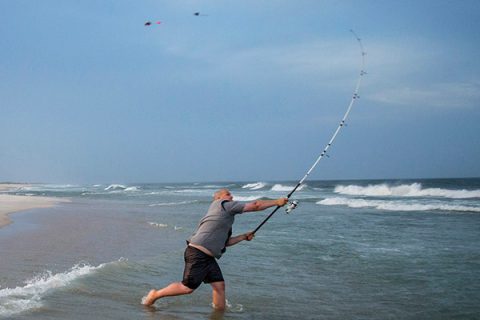
Pictured above: Fresh-cut bunker is one of the best ways to put big bass on the beach all season long. photo: Tom Lynch/angryfish.tv
Chunking bunker is one of the best ways to catch a trophy striper in the surf. Big bass get a whiff of a slab of bunker and can’t help but eat it. Part of the beauty of chunking is its simplicity—a rod, some hooks and sinkers, a sand spike and some fresh bait provide a better-than-average shot at catching a striper of 40 inches or more. Without complicating things too much, fishermen can take a few steps to further improve their odds of catching cow stripers on chunks.
The Eyes Have It
Good chunking starts with good bait. There is no substitute for fresh bunker. Frozen, vacuum-packed or otherwise, will not pass muster with a big striper.

Some fishermen catch their own, heading to a harbor or bay with a snagging hook and filling a bait cooler with kicking bunker. Most of us buy our bunker at bait and tackle shops. During the height of the season, many shops restock their bunker supply several times a week. If at all possible, get your bunker within a day or two of it arriving at the shop. You’ll be able to tell the fresh bunker by their eyes. Old bunker will have red eyes and soft bellies. Fresh bunker have clear eyes with little or no red in them. The baits themselves should look bright and silver, not washed out and cooler-burned.
Keep It Fresh


When storing bait in the cooler, remember that freshwater is the enemy of your chunk baits. Melting ice will wash away the slime and oils that make bunker such an attractive bait to big stripers. Ice is essential for keeping your bunker sushi-fresh, but keep the baits from directly touching the ice. Simply place the baits into one-gallon zipper bags before placing them in the cooler. This way, the bunker will stay cool and retain its slime and bass-attracting smell.
Hooks: The Bigger, The Better
Chunking bunker is a big-fish tactic, so keep that in mind when selecting hooks. Hooks must have a wide gap to accommodate the large baits. I like the 9/0 or 10/0 Gamakatsu octopus-style hook. The Gamakatsu Big River hook, a hook designed for catching massive white sturgeon in the Columbia River, is also effective for chunking.
When using bait and J-hooks, deep-hooking fish is a concern, and for this reason, many fishermen use circle hooks. When a circle hook sets, it is almost always in the corner of the bass’ jaw. A fisherman can reduce the risk of deep-hooking a striper with a J-hook by holding the rod so he can set the hook as soon as the bass takes the bait.
Keep The Leader Short And the Rig Simple
Fishermen who use lures or eels are used to leaders of 3 to 4 feet, but for chunking, a much shorter leader is more effective. A shorter distance between the weight and bait is more aerodynamic, and will prevent the rig from “helicoptering” during the cast, potentially twisting or tangling.

When chunking bunker in the surf, a fish-finder rig is the only way to go. When throwing weights of 5 ounces or less, a fish-finder sinker slide is fine, but for heavier weights, a snap-swivel sandwiched between two beads is a better option. Adding an 8- to 15-foot shock leader to your main line with an Albright knot will help with casting and the end game.
Think About Your Sinker
Keeping your bait in place on the bottom is essential to getting bites and avoiding tangles. To best achieve this, choose the right sinker for the bottom you are fishing.
The pyramid sinker is a good all around choice. It sticks pretty well in sand or mud bottoms, but is easily dislodged and can roll in heavy current or surf.

The Hatteras-style sinker gets a good foothold into sandy bottoms, but for the best hold in sand, I turn to a wedge-style sinker. It digs into the sand nicely and the concave top keeps it from pulling.
On mud bottoms in rivers or bays, a Sputnik-style sinker is best. The metal arms anchor the rig to the bottom—until a big bass comes by and takes it for a ride.
Slice and Dice
You will get three to four baits out of an average-size bunker, including the head. Make the first cut behind the head at the pectoral fin, and space out the following cuts by two fingers. The pieces that include the body cavity (and some of the guts) seem to work best. Discard the tail into the surf.
Heads Up
Without a doubt, the best part of the bunker for tempting big stripers—and only big stripers—is the head. If skates, dogfish, schoolies or blues are threatening your bait supply, then a bunker head is the best way to weed out these nuisance fish and target a trophy.
When using a bunker head, place the hook through the meat at the back of the head, not through the lips or eyes. This way, when setting the hook, it will tear through the bait and into the striper’s jaw, giving a better hookset.
Spike It Right
A quality sand spike will help you catch more fish and keep your reels out of the sand. Leave the short PVC sand spikes for kingfish and small blues—they have no place when chunking for striped bass. It took me two frantic sprints after surf-bound rods and tipped-over PVC tubes to learn that lesson. A big metal sand spike is beneficial because it stays firmly planted in the sand and its extra height keeps the line above the waves.
Multi-Task
One my favorite parts of chunking is that it allows me to double my chances of catching by using two rods at once.
Done wrong, fishing multiple rods can work against you and result in little more than tangles and missed fish; done right, fishing more than one rod will help you find the fish faster.
Fishing two rods means twice the work. When I have two rods in spikes, I’m constantly running between them, removing weeds, replacing crab-picked baits and casting to new areas.
When setting the rods, cast them different distances from the beach. Stripers feeding in the surf move parallel to the beach, so by staggering your baits, you’re more likely to encounter a cruising striper.

Keep A Bait Close
One night I was chunking a dropping tide, and for the first 5 hours of the tide the only bites were from the ravenous crabs that were rapidly depleting my bait supply. An hour before dead low, one of my rods doubled over, and after an exciting fight, a big wave deposited a 43-pound striper on the sand. As the fish thrashed in the shallows, it spit up a perfectly cut bunker tail, one of the tails I’d flipped into the wash after cutting the more desirable parts of the bunker for bait. While I was putting everything I had into casting over the sandbar, the fish were at my feet. It was only after the tide got too low for the bass to stay in the trough that one swam over the sandbar and saw my bait. I shudder to think how many big stripers were feeding in the trough that night as I cast way over their heads.
Lesson learned. Since then, when I fish two rods, I cast one bait in the trough right next to shore. More often than not, that’s the one that gets hit—especially after dark.
Get Ready, Get Set…
When a bass picks up a chunk, the hit usually feels like a solid thump followed by slack in the line. If you are holding the rod, lower it until it’s parallel with the water, reeling slowly to get the line tight. When the line comes tight and you feel the weight of the fish, set.
Let the Waves Work for You
More big stripers are lost in the last 10 feet of the fight than at any other point. The powerful undertow at the lip of the beach puts a sudden strain on the rod and can break the line or tear the hook free. I still have nightmares about a giant striper my dad lost just feet from the sand when he failed to “bow to the cow” as the fish bolted into a building wave.

When nearing the end of the fight with a big chunk-caught striper, back up onto the beach to keep the rod and line at a low angle to the fish. This will give you more power over the bass and help you avoid high-sticking. With a short connection between you and the fish, this is when the stretch in the monofilament shock leader comes into play. The forgiveness of the mono cushions the knots and the hookset when a building wave sucks the bass back out into the trough. Lightening up the drag can also be a good idea, though I personally believe that touching the drag during a fight is one of the seven deadly sins of striper fishing.
Eventually, the fish will run out of steam, and you’ll be able to apply a little extra pressure just as a wave is about to break. The fish will get tripped up by the wave and will wash right onto the sand. At this point, you’ll need to run down, or have a buddy run down, and secure your catch before the next wave drags it out to sea.
Never toss the tail.
The Also will take big fish too….
Never feed the fish unless it has a hook in it.
Big deal do it spins….
That’s why one needs a quality swivel attached to the leader.
Float bait too….no more crabs it skates…
Plus works great in the surf.
Oops wasn’t done…
But great article btw…
And so sorry for fat finger syndrome and auto correct….
Great information!!!!!!
Excellent information and the reasons for each. SWEET!
a solid thump and then slack in the line? The bass Herring Cove Beach start with a thump and immediate retreat at a high rates of speed…..no slack line….just a screaming reel and the battle is on!
So true…. you can have the bass bumping your legs and if you throw past the breakers you threw past the fish
Really good information, well and clearly written. Thank you.
Hey guys. I was wondering what you think when it comes to setting the drag while chunking from three beach. Are you light drag, let the fish run then tighten and set? Or are you at the proper drag for fighting the fish the whole time?
I use reels with bait runners for chunking. Sets light drag for the initial hit, then the “fighting” drag after I set the hook
These suggestions are based on long-term (over a decade), of daily, very productive, bunker fishing for stripers experience: They come from a time, back in the days before fresh bunker was available in local bait shops and you would have to take the time to go out and snag your own daily. In the Spring and Fall, when the water temps are cool, if you’re using fresh bunker that you snagged or netted within a few hours, don’t use ice. Instead, fill a smaller cooler, the type you can carry with one hand, with saltwater and change it about every half hour to hour, dumping the old water with bunker slim and blood into the water in front of your rod. The smaller hand held cooler can hold up to about ten full sized bunker. After you cut off a chunk of bait, return the rest of the bunker immediately back into the saltwater in the cooler. The bunker will stay firm for about a full tide cycle and a little bit of the turn and the slick created by the oiled up water you dumped, will draw fish to area and your bait. When using the tail section, always cut off the tail fins.
Also, take a few of the heads and cut off the “face,” directly at the eyes and with a serrated knife, shred the “face” (everything from the eyes forward, into tiny pieces and again toss them in the water directly in front of your rod. This will cause fish that have been drawn in by your slick, to stay in the area. They will come across the small bits of chum, but there will really be nothing for them to feed upon. This is refereed to as “feeding the hole.” You can still use the part of the head that includes a small bit of meat behind the gill plate and part of the gills themselves as your “head” offering. Holds on the hook the same as the head, because you are basically putting the hook in the same place as if you used the entire head, but the streamlined piece casts far better.
If possible, do this routine in the same spot , at the same time of day, or tide, daily; or as regularly as possible depending on your schedule. As the season progresses, by establishing a routine in the same spot, you will slowly create your own honey hole and you will find that almost like clockwork, you will start getting hits just about every day, around the same time and the opportunity to land at least one or two stripers an outing.
Awesome article. Just what I needed to know. Thank you
Fishing Long Island
Good read I surf at regularly and always willing to take advice Ann’s read up on tips . Thank you
good tutorial and i caught a cownose ray using a bunker chunk they give of a good fight and i released it