
Last week, I posted about how I find it challenging to stick with a fishing log throughout the season, and asked for suggestions and tips from the readers on how they manage to keep up with their own fishing logs.
Keep it in the Cloud
Nate Bent keeps his fishing logs in a Google Doc Excel Spreadsheet, which allows him to access and update it from anywhere – including his phone.
Coffee Table Logbook.
Scott Lehto suggested leaving your fishing log it somewhere you’ll see it every day, like a coffee table. A waterproof notebook is also not a bad idea, to protect your priceless fishing data from the elements, and spills.


Captain’s Log
Marlon Violette uses his phone to make voice recordings of his latest trips, and then transcribes them to his blog at his convenience. I thought this was an excellent idea and plan on trying it this season, but I had to laugh because it reminded me of the old Star Trek Captain’s Log segments. I can hear it now:
Fee’s Log….May 22nd. The striped bass have invaded…the Cape Cod Canal. Attempts to initiate contact with pencil poppers…have failed.
Not only does Marlon keep an up to date fishing log, but he puts it online. Good stuff Marlon. Check out his blog HERE.
FishersLog
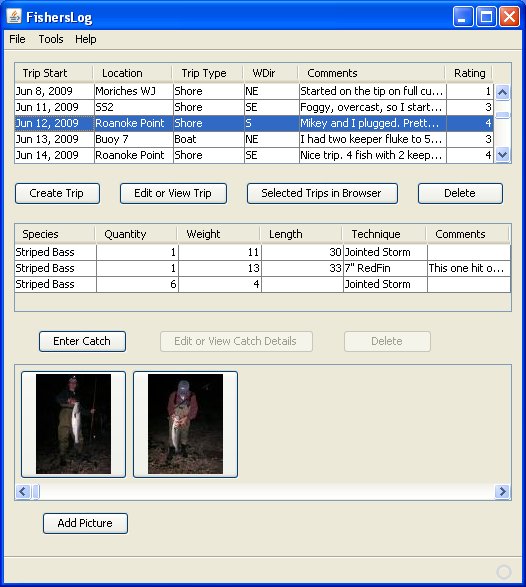
Last but not least is FishersLog, suggested by Brian Coombs. FishersLog is a computer program that allows anglers to simply input their data. They can then analyze their results through the program and show trends in the fishing. FishersLog is the brainchild of OTW contributor and dedicated fisherman, John Skinner.
No matter how you keep your log, you’ll find it will eliminate the guesswork over time, and help you put you in the right place at the right time to catch more fish.
I have used the Fisherslog for two years now . I fished 92 days in 2010, and 98 days in 2011 and have logged every one of those days. Even the Skunk days. I feel that it has helped me immensely
Jimmy there is also an eLogbook that helps the state and feds determine recereation impact on certain species.
The Massachusetts Division of Marine Fisheries (MA DMF) in conjunction with the Atlantic Coastal Cooperative Statistics Program (ACCSP) announces a new electronic angler logbook (eLogbook) for recreational anglers willing to provide data useful for management of marine fishes in Massachusetts. The eLogbook is a web database designed for recreational anglers to enter daily trip information on general location, gear used, and sizes of fish species that are harvested or released. Participating anglers can access and summarize their fishing data in tabular or graphical forms at anytime which is useful for tracking fishing successes (see Figures).
Access is from teh MA DMF wbesite