
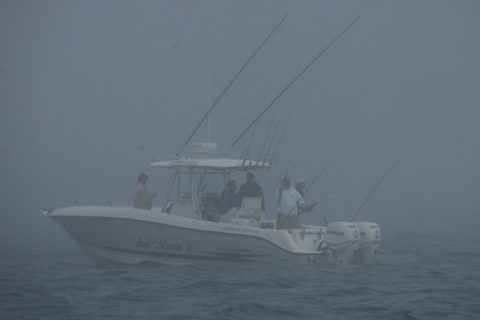
Fog can develop quickly, and limited visibility raises the risk of a collision. Here are 4 steps to remember when the weather closes in.
1. Slow Down or Stop
If necessary, you should be able to stop in half the distance of visibility.
2. Make Your Presence Known
Fog signals must be sounded, and the time interval specified in the Navigation Rules is the minimum.
3. Post a Lookout
Post a crew member on the bow and, if possible, the stern as well. Have them swap locations periodically to keep them sharp.
4. Stop and Listen
Boats, buoys and lighthouses all make noise, and you’ll hear them before you see them. The transmission of sound in foggy conditions is tricky. If you hear something, don’t jump to a quick conclusion about its direction and distance, listen some more.
These boating tips are brought to you by Kingman Yacht Center in Pocasset, MA.
RULE 19
Conduct of Vessels in Restricted Visibility
(a) This Rule applies to vessels not in sight of one another when
navigating in or near an area of restricted visibility.
(b) Every vessel shall proceed at a safe speed adapted to the prevailing
circumstances and conditions of restricted visibility. A power-driven vessel
shall have her engines ready for immediate maneuver.
(c) Every vessel shall have due regard to the prevailing circumstances and
conditions of restricted visibility when complying with the Rules of Section I
of this Part.
(d) A vessel which detects by radar alone the presence of another vessel
shall determine if a close-quarters situation is developing and/or risk of
collision exists. If so, she shall take avoiding action in ample time, provided
that when such action consists of an alteration of course, so far as possible
the following shall be avoided:
(i) an alteration of course to port for a vessel forward of the beam, other
than for a vessel being overtaken;
(ii) an alteration of course towards a vessel abeam or abaft the beam.
(e) Except where it has been determined that a risk of collision does not
exist, every vessel which hears apparently forward of her beam the fog
signal of another vessel, or which cannot avoid a close-quarters situation
with another vessel forward of her beam, shall reduce her speed to the
minimum at which she can be kept on her course. She shall if necessary
take all her way off and in any event navigate with extreme caution until
danger of collision is over.
Dont forget to use all available means , Radar, AIS and your VHF radio to make Security calls if you are in doubt.
Captain Mike Littlefield
http://www.archangelcharters.com