

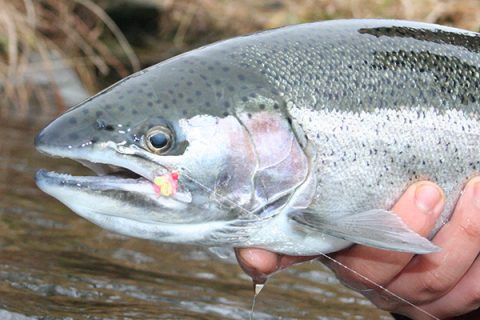
Making your first trip to Upstate New York this fall? Use these six tips to help you connect with your first-ever steelhead.
Keep Your Rig Simple
You’ll see all manners of gear and rigs put into use on the Lake Ontario tributaries—Spey rods, centerpins, elaborate float-fishing setups—but for the first-timer new to steelhead fishermen, the simplest rig is best. A 9- to 10-foot light-action spinning rod rigged with four-foot leader of 4- to 8-pound fluorocarbon attached to the main line with a small barrel swivel is all you need. Attach the split shot to the tag end of the knot to the swivel, so that you only lose the weight to a snag and start fishing. With this rig you can fish egg sacs, trout beads, and even flies.
Fish Low Water

During higher water, fish will spread out to more areas of the river, while in lower water, fish will concentrate in deeper holes and pools. Time your first steelhead trip during a low-water period. While fish don’t always bite best in low water, they will hold in more predictable locations. Plus, the river will be easier to navigate, allowing you to get a lay of the land for future trips.
Stay On The Bottom
Add enough weight to your rig so that you tick bottom a 2 or 3 times during your drift. Steelhead sit with their bellies on the bottom, so if your rig is drifting too high, it will be ignored by the fish. You don’t want your rig to drag on the bottom, otherwise, you’ll be snagging every other cast.
Change Colors Constantly

Steelhead will key in on certain colors, and those preferences can change by the hour. Whether using flies, egg sacs, or beads, regularly change up your offering to show the fish something different.
Keep The Rod High When Drifting

More important than bait selection or color is making sure your offering drifts as naturally as possible with the current. To do this, hold the rod high over the water to give a direct connection to your bait and prevent the current from grabbing your line and dragging your rig unnaturally.
Keep The Rod Low When Fighting fish

When you hook your steelhead, after the initial run, when you are working the fish back to you, keep the rod low. A steelhead will be more easily steered toward the net by a rod that is kept parallel to the water. By keeping the rod high, you pull the fish’s head toward the surface, often causing it to jump and go on another run, making it more likely to spit the hook or break the leader.
Great article on steel head fishing. I use a very similar method on rainbows eating the landlocked salmon and Brown trout eggs. Slinky sinkers made from parachute cord with BBC weight. Hardly ever lose a rig. However when it happens the rig is gone.