
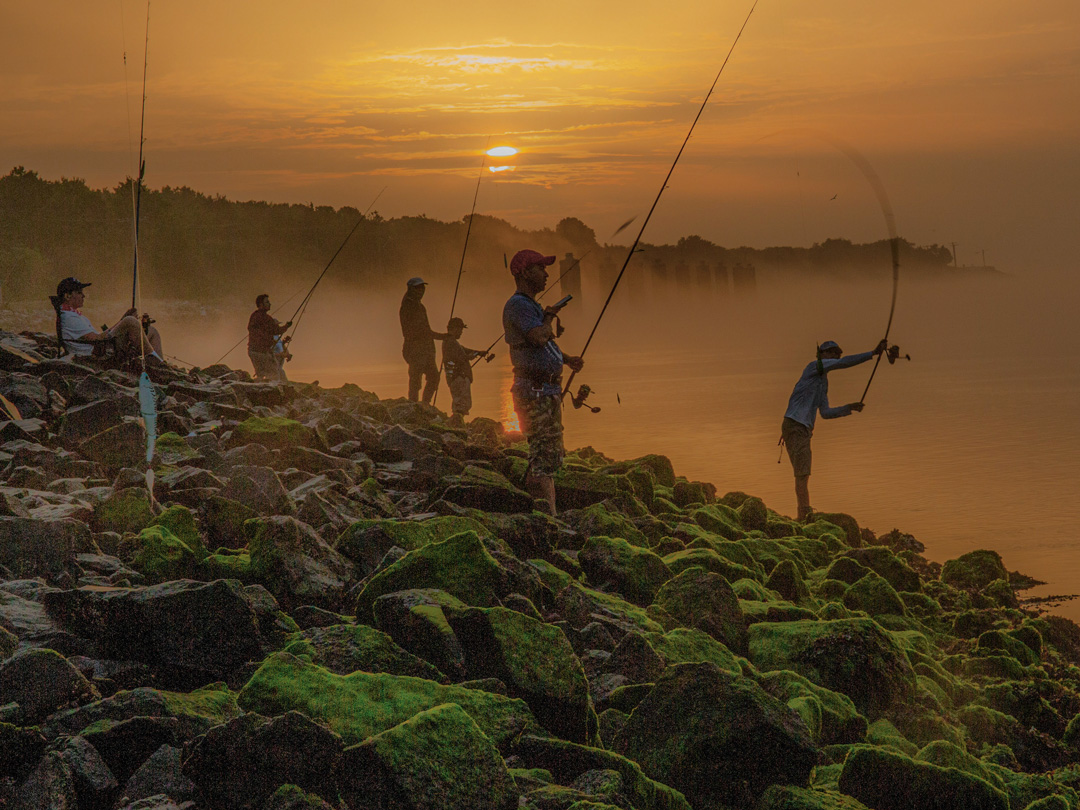
“I hate fishing here!” my brother Jack bellowed after he lost his third $15 paddletail jig on the bottom of the Cape Cod Canal. His fury didn’t surprise me. As much as I love the canal, it’s not an easy place to fish. The current can reach up to 6 knots in either direction. The shoreline is dominated by jagged, uneven rocks covered in bubble weed. The bottom is made up of deep holes, shelves, rips, eddies, drifting seaweed, and even lobster traps. There are marauding, fish-stealing seals, nearsighted cormorants, and diving ospreys. Barges, tugboats, and yachts send out swamping waves every few minutes. On many days, there’s a biting wind. Crossed lines and cross tempers abound. I mean, what’s not to love?
Fishing the Cape Cod Canal is an acquired taste. Even more so, it’s an acquired skill. Sure, you can sometimes catch striped bass and bluefish (the most targeted species) the easy way, with swimbaits and other mid-water lures. If conditions are right, you might find success lobbing topwater plugs. In some spots, drifting live sand eels might ring the dinner bell. But to really be productive, to consistently catch fish, you’ve got to master the bottom.
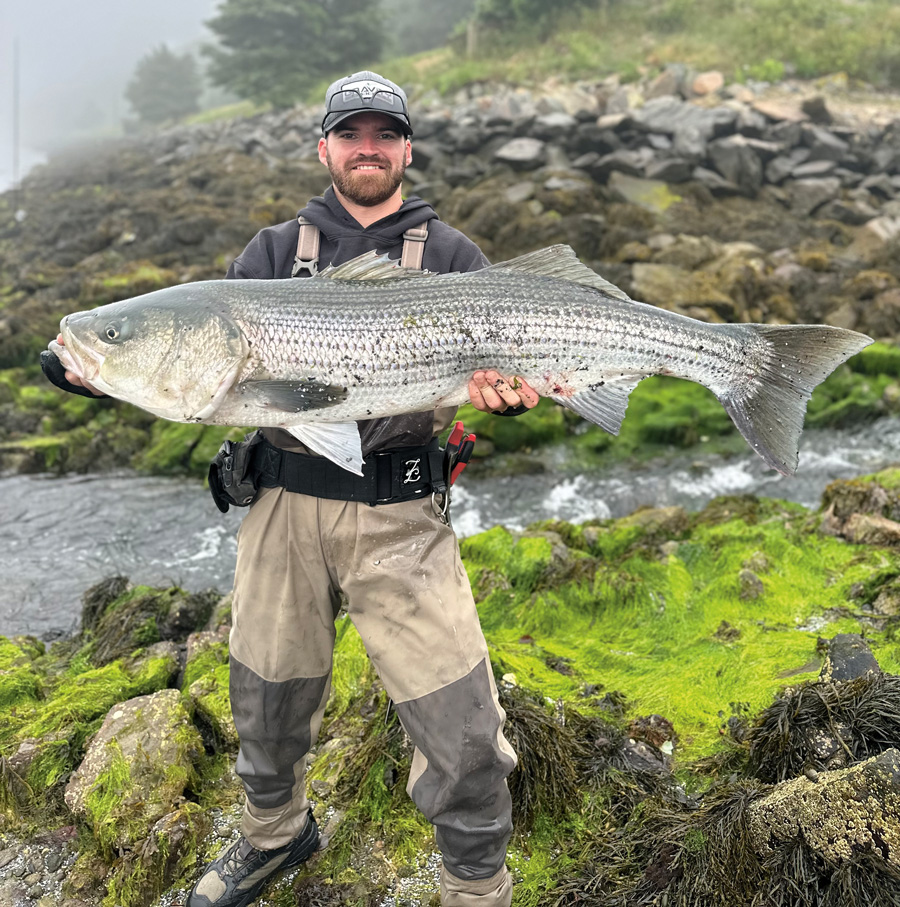
In principle, the technique is simple: cast your 5- or 6-ounce paddletail or bucktail up-current, allow it to sink to the bottom, then start jigging. Jerk the rod tip up, give a bit of slack, feel the bounce when the jig returns to the bottom, then repeat. For current flowing to the left, cast to 2 o’clock, jig until 10 o’clock, then rip it in. It’s the opposite for current flowing right.
Simple, if it weren’t for the aforementioned minefield that is the Cape Cod Canal. Throw too far up-current, and you’ll likely miss the channel and be swept into sluggish water near the bank. Wait too long at the end of your drift (as did my unhappy brother Jack), and your bait will fall to the siren song of the down-current rocks faster than Odysseus. And then, there’s the funhouse of the bottom where snags lurk in unexpected places. I have a theory about a sunken WWII sub lodged in the depths of Pip’s Rip that’s decorated with a sultan’s fortune of brightly-colored jigs, a few dozen of which were once mine.
As tricky as it sounds, all of this can be mastered with practice. You will lose lures, leaders, clips, and—in the worst cases—precious braid. The local tackle shops will come to know you by name. Budget for it and suck it up. Eventually, you will master the timing and be able to keep your jig in play long enough to tempt a few hungry stripers, waiting nose-up in the current for unsuspecting prey to drift their way.
Sounds like it can be done, right? Now try doing it with five or six people to your left, and as many or more to your right, each less than a rod-length apart. In close-proximity fishing—at the Cape Cod Canal, or anywhere—the “how” is only 10% of the equation. The more important factor, the other 90%, comes from your fellow angler, the “who”.
Unless you can find an isolated spot along the 7 miles of water (14 if you count both sides), you will likely be fishing near other fishermen. The best spots are always crowded. Most are common knowledge (the extreme west and extreme east ends are consistently busy), but in these days of social media, word travels faster than a mackerel fleeing a bluefish. I remember one very productive outing last year, the photos of which made it onto a Facebook fishing page. The following morning, I couldn’t find a parking spot.
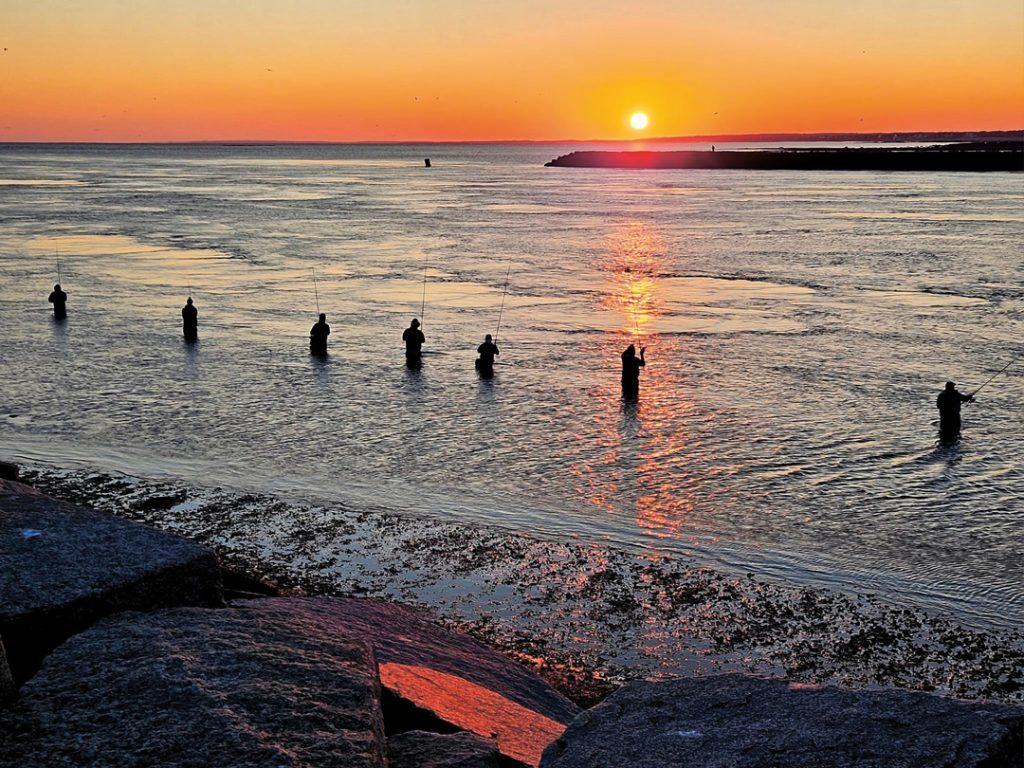
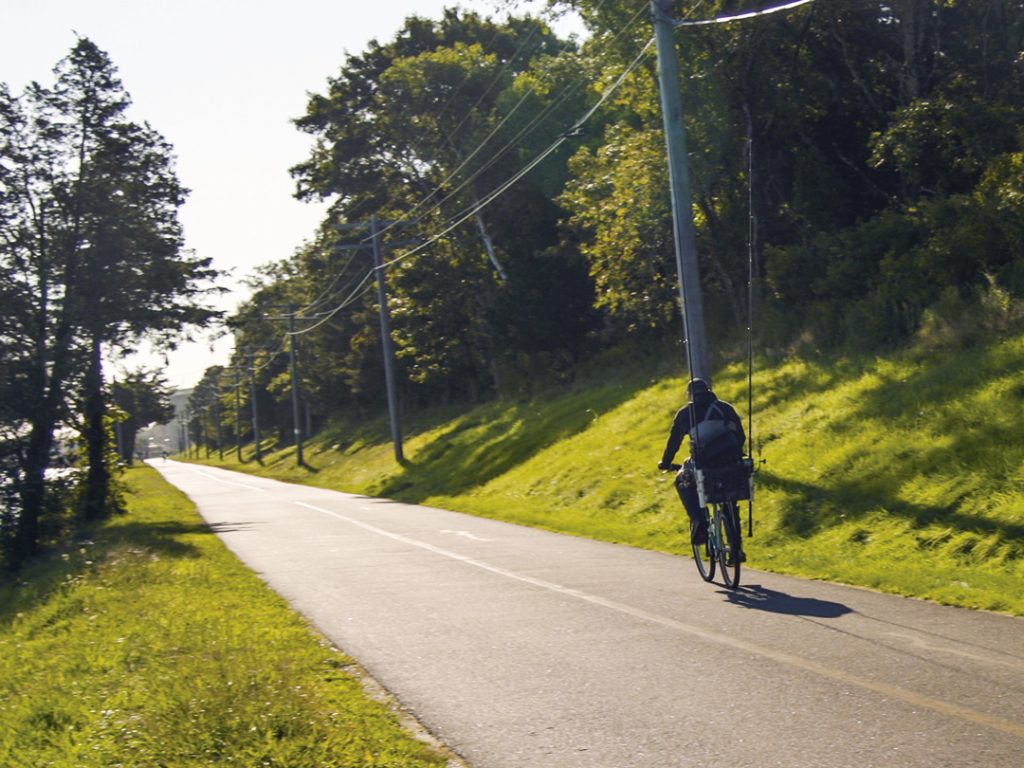
When I first began fishing the Canal a few years ago, I didn’t know anyone. I’d spent many a youthful summer camping at Bourne Scenic Park, biking and fishing with my cousins. But now, with the kids grown and retirement looming, I felt the calling again. This was boosted by a photo of a fat striper my nephew JC had landed at the Railroad Bridge. I sprinted to the local hardware store, bought a combo and a couple of Rapalas, then set out to pursue my relaxing hobby.
I quickly learned that this was not the canal of my carefree youth. This was serious fishing; maybe not “Wicked Tuna” serious, but people weren’t messing around. Guys in chest waders were hurling giant plugs with 11-foot surf rods. Most had space-age titanium reels and enormous tackle bags sprouting lures I had never even heard of. Rows of people were fishing elbow-to-elbow along the bank.
Nothing ventured, nothing gained, so I jumped in, and made a complete nuisance of myself. My bright white, hardware-store Shakespeare combo was like a beacon announcing my inexperience. It wasn’t long before I found out what not to do. This was made abundantly clear by the other fishermen. At this point, I began considering bingo as a retirement hobby. However, I persevered, and something magical started to happen. I began to meet people—good people. Over the course of a professional career ranging from plumber to computer engineer to a professional musician, I had learned at least two valuable skills: be courteous and defer to those with more experience. This turned out to be my ace in the hole, and it changed everything. I made friends, and fishing gradually became fun again. The chest-wader crowd turned out to be decent guys, and I eventually became one of them.
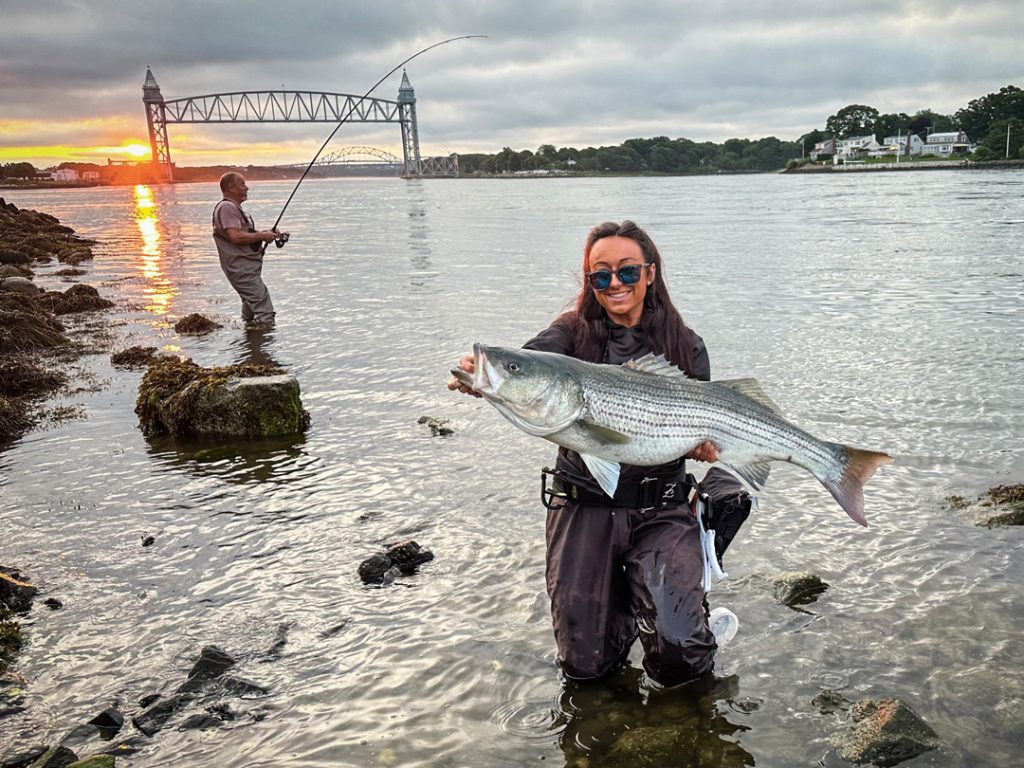
I learned how to cast “in order.” This entails watching your down-current neighbor’s cast, waiting for a few seconds, then casting up-current from wherever his jig landed. Since he has already waited for everyone below him to cast, you must maintain the hallowed order. The fast water swallows your jig, sucks it toward the bottom, and sweeps it away like an umbrella in a windstorm. After your cast, the next up-current angler makes the toss, and so it goes. If executed properly, there is nary a crossed line. Botch it, and you might pick up a few new curse words for your lexicon. If the furthest guy down-current is sleeping on the job after the cycle, you might hear a shouted, “Number one!” (common at the East End), at which point he will get with it and throw, and the whole circus act starts again. If normal fishing can be compared to a solo sport like golf, Canal fishing is closer to ice hockey without the fights (for the most part). Teamwork and timing are necessary.
Generally speaking, this is common knowledge at the Canal. It is gratifying to step into a group of complete strangers and find that those to your left and right possess this intel. When I show up at a spot where anglers are already casting, I greet everyone with a “Good morning.” This is the point when I learn what I need to know. If I get a silent, “It-was-until-you-showed-up” vibe, I usually move on and find a new spot. But far more often, I get a “Good morning” in return, slip into the rotation, and get casting. I’ve had many satisfying outings fishing in close quarters with people I had never met, everyone casting in order and having a good time.
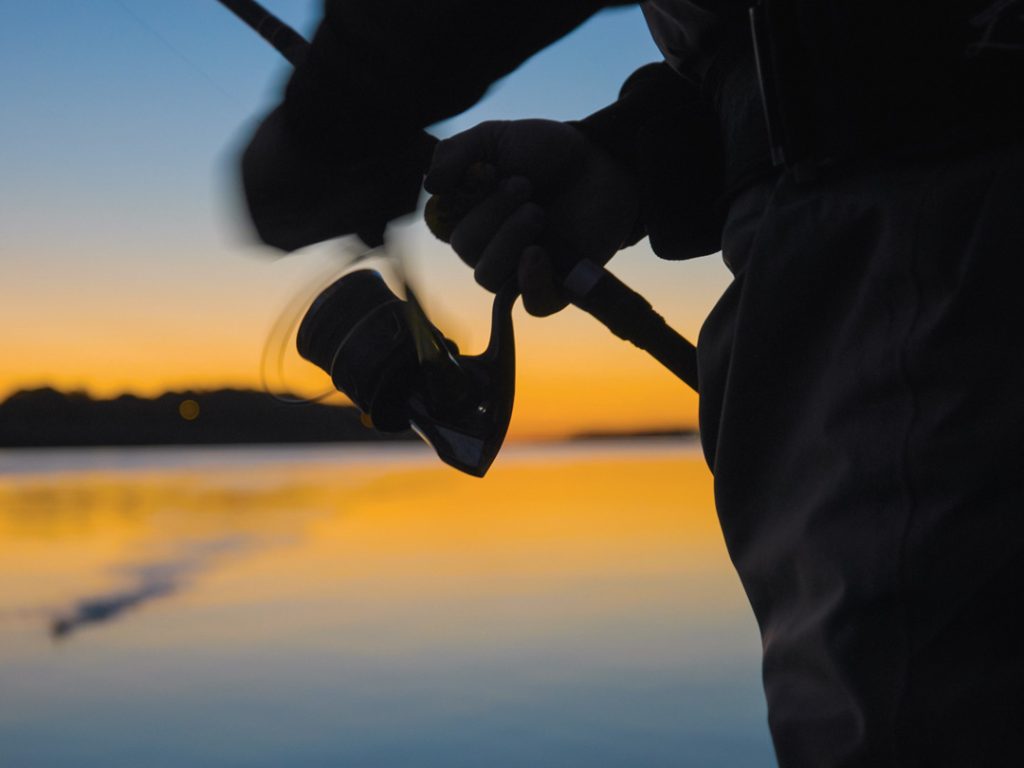
Then there are those special outings, when the tide is right during my brief two hours before work and I get to wade beside the people I have come to know. We all recognize each other by voice, even in the predawn darkness. We cast in sequence, an unspoken, synchronized ballet of whipping rods and soaring lures—a dozen braids glistening against an all-too-brief sunrise, drifting in unison, waiting for that sudden arc of rod and screech of drag. Then the emotional roller coaster begins. That pang of jealousy when the guy eight feet to my left catches his third fish on the same lure I’m throwing while I can’t get a bump. The guilty thrill when the gods have decided it’s my day. The ribbing about the minnow-sized striper someone caught, and the back-slapping for the guy who muscled in a 40-incher. Maybe I end up beside Tom, who, back when I started, instantly recognized my naivete, but nevertheless took the high road and provided guidance. Or Joe, a Canal fisherman for decades, who taught me the ins and outs of sand-eel fishing and later became a good friend. Or Nikolay, Jack, Mark, Dave, Eric, and a host of others I came to know—plain and honest straight-shooters who work hard and play hard—they are an absolute pleasure to be around. This year, I was even fortunate enough to find myself fishing beside East End Eddie Doherty, Canal legend and author of the book, Seven Miles After Sundown, which I had devoured a couple of years earlier.
I won’t pretend it is all cotton candy and puffy clouds at the Canal. There are some places or situations I avoid like a bad street. Cliques of people who treat outsiders with disdain or hostility. Anglers casting lures with 9/0 hooks from the top of the bank over your head. People cutting each other’s lines if they get crossed. They are few and far between, but if you fish often enough—at the Canal, or anywhere else—you’ll turn up a few bad apples. I let them be. At 65, I’ve figured out that life is too short.
• Learn More: Cape Cod Canal Fishing Cheat Sheet
Overall, the Canal is an excellent place to fish, with the good exponentially outweighing the bad. Recreation areas with free parking can be found on both sides. There are 14 miles of shoreline with plenty of places to stand (if you are surefooted), and even wade. There’s a pier, a bulkhead, and a tidal flat; two campgrounds, two jetties, and spectacular sunrises. There’s 30- to 50-foot water that serves as a shortcut between Cape Cod Bay and Buzzards Bay for fish of all sizes, all within casting distance from shore. But most importantly, there are some great people—those who welcome newcomers in the true spirit of the sport, who understand that we’re all just out here to get a break from the grind and have some fun.
My advice for anyone trying the Cape Cod Canal for the first time: go in with a deferential attitude, listen, be courteous and friendly, and seek out the good people. If you break down that all-important 90% “who,” you will find that nearly all of them are the good ones. They are everywhere, and they make even skunk days worth getting out of bed for.
Great and spot on article. I’ll add that some of my favorite times to fish the Ditch are during daylight when the crowds are thin… Maybe not the best time to catch, but a great time to fish. Plus my biggest striper was caught at slack tide at 10:30 in the morning on a warm day. And thanks to the stranger that jumped in (literally) to help land that fish as soon as we saw it was lightly hooked. Good people.
Yikes, I had been considering giving it a try there. And I’m glad that you shared this. It was a great article, but I surely don’t want to be near that many people!