

Above: Through collecting location-specific length and age information for recreationally caught cod, for-hire captains participating in the RecBio pilot study can help fisheries scientists better assess the status of cod within recently redefined stock units (Photo courtesy of Capt. Andy Dangelo)
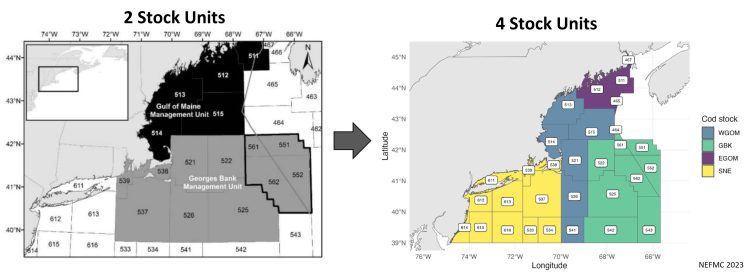
Recently, there have been some important and exciting new developments toward improving the management of our beloved—but beleaguered—Atlantic cod fishery in the Northeast. After a five-year review of scientific data on genetics, tagging, and biological and physical characteristics, the Atlantic Cod Stock Structure Working Group identified five biologically distinct populations of cod that exist from New Jersey to Canada. Since two of the newly identified populations in the Western Gulf of Maine were found to overlap spatially (but spawn at different times), they were combined for management purposes. In 2024, fisheries scientists at NOAA Fisheries’ Northeast Fisheries Science Center will complete the first ever stock assessments for each of these four new stock units:
- Eastern Gulf of Maine
- Western Gulf of Maine (both winter and spring spawners)
- Georges Bank
- Southern New England
This new assessment approach represents a significant change from the previous two-stock approach —consisting of only Georges Bank and the Gulf of Maine—that had been used as the basis of cod stock assessment and management since the 1970s. The new four-stock approach will enable managers to better tailor management approaches to the status and needs of each unique stock unit.
However, with this definition of additional stock units comes the need for more location-specific data from each stock area, including data on the biology (such as age and length) and the overall catch of cod. This sort of detailed spatial information is already collected through existing programs for the commercial sector but is largely lacking for recreationally caught cod—especially for fish that are released. Since recreational fishermen differ from commercial fishermen in where they fish, the gear they use, and the regulations they’re subject to, obtaining this information is key for ensuring that scientists gain a complete picture of the species’ stock-specific biology and status.
There’s an App for That
Recognizing the need for more detailed biological and catch data from the recreational fleet and with support from NOAA Fisheries, members of the for-hire groundfish community have teamed up with fisheries scientists to launch a pilot study called the Recreational Biological Sampling Program, or RecBio. Leading the charge on the for-hire side are Capt. Mike Pierdinock and Capt. Rick Bellavance, who serve as the presidents of the Stellwagen Bank Charter Boat Association and Rhode Island Party and Charter Boat Association, respectively. In addition, both are members of the New England Fishery Management Council, providing them with a front-row seat to the changing cod assessment/management paradigm and ongoing recreational data needs.
On the science side, Dr. Willy Goldsmith of Pelagic Strategies, Dr. Jeff Kneebone of the New England Aquarium, and Dr. Anna Mercer of NOAA Fisheries will work closely with for-hire captains to manage the project and ensure that all collected data can be integrated into the stock assessment process.
To collect the data, the team has enlisted the services of Harbor Light Software who, with additional support from The Nature Conservancy, modified its existing AnglerCatch app (originally designed for private Rhode Island anglers) to meet the specific needs of RecBio. Through AnglerCatch, participating captains will collect and report information on fish length, disposition (kept or released), date/time, and location, the latter of which is essential to link catches to a specific stock area. For cod that are harvested, captains will zip-tie an envelope with a unique barcode to each head/rack and deposit those racks in a nearby freezer at the end of each trip. Periodically, the science team will collect the racks and extract the otoliths—ear bones that contain growth rings—which will then be passed onto the Northeast Fisheries Science Center for aging.

From Design to Implementation
Working with Pierdinock and Bellavance, the team has already identified about a dozen for-hire captains who regularly fish in the Western Gulf of Maine and Southern New England stock areas who have agreed to assist with this initial pilot round of data collection through August 2024. A few of the Southern New England participants began collecting data in December 2023, and that information will soon be shared with stock assessment scientists. With the arrival of spring, Gulf of Maine participants targeting groundfish will ramp up their data collection efforts as well.
The team is looking forward to a productive pilot study and will share results as they become available. If successful, the team hopes to expand this effort into a long-term data source to inform effective cod assessment and management going forward. Eventually, this program could be used as a model to fill similar data gaps for other recreationally important species.
Interested in learning more about the program? Contact Willy Goldsmith at wgoldsmith@pelagicstrategies.com.