
Swordfish and swordfishing have become my passion over the past 5 years. What started as a bucket-list dream catch 14 years ago has turned into a full-time obsession with all things swordfish! When I am not preparing for (or recovering from) a 48-hour New England swordfish trip in our short six-month season, I am reading, researching, and trying to learn more about this magnificent, top-of-the-food-chain pelagic predator. There are plenty of articles about the physiology, location, and behavior of swordfish, but this is about my personal journey and passion.
Where and when did it all start? I have dim memories from the 1960s of monstrous swordfish hanging from scales at fish docks in both Chatham and Falmouth as part of childhood Cape Cod vacations. I recall the sight of a massive fish being steaked at the Faneuil Hall fish market in the 70s. I heard stories of swordfish finning on the surface behind the Vineyard and dreamed of seeing one myself someday. Then came a long gap when swordfish became endangered, I became a parent, and fatherhood intervened for 20 years.
Fast-forward to August 2004. I was a fledgling Northeast canyon fisherman. I knew how to catch tuna by trolling and had some minimal experience with marlin, but I had never seen a swordfish; in fact, I didn’t believe they existed in the Northeast anymore. I had heard the dock stories and seen the odd picture of one, but I had no idea where they lived or how to catch them. Earlier that summer, I saw one basking on the surface at dawn, but with my limited knowledge and experience, I wrongly declared it a sleeping blue marlin. It took 10 years to realize my mistake!
On a calm, sticky August night on the 100-fathom curve east of Veatch Canyon in a spot that, 15 years later, I would know as well as my neighborhood side street. My Carolina Classic could get me to 100 fathoms and was a great trolling boat, but it was brutally bad for drifting at night due to its deep V bottom. Its roll was so uncomfortable that sleep was little more than a cockpit catnap for me. I was alone on the deck at 2 a.m. with 3 of 4 baits drifted out haphazardly for tuna.

A clicker went off—a bite at long last! Looking back from 16 years later and a few hundred trips of experience, I realize that I did everything wrong that night. The balloon attached to the line as a float was ripping forward of the boat, and rather than call for help from my crew, I tried to muscle my way out of a mess. I saw a flash of silver up near the surface in front of the boat, then suddenly the line was receding straight down at a high rate. Still solo, not wanting to wake my sleeping crew, I dug in and stopped the fish, no doubt with excessive drag and additional hand pressure, and started cranking it upward, assuming it was a tuna. I eventually saw a long, lithe shape, greenlit by the Hydroglow light, racing this way and that. What was it? I had no idea what I was dealing with.
After three or four lifts and cranks, that long shape had a bill. Marlin. No…it’s a SWORDFISH! “GET UP! GET A GAFF, GET A GAFF!” I shouted.
As the crew stumbled up on deck, I tried to muscle the fish and pulled the hook. It was gone. The worst part of the story was that my crew didn’t believe me and decided I had been fighting a blue shark. but I knew what I’d seen.
Fast-forward again to 2014. I had over 100 canyon trips under my belt, and over those 10 years, had probably caught a few dozen swordfish at night. Most of them were small, 50-pounders that were a few inches longer than the 47-inch legal size. By then, I had put together the data that the best shots at nighttime swords occurred later in the season, in August or September. I was also quickly learning, with a new and more seaworthy boat, that October swordfishing could be lights out. Over those 10 years, I recall a pair of three-swordfish nights, and one in October 2012 when we landed six swordfish, most of them well under the 47-inch limit. On that trip, there was one 150-pound fish that ate a chunk bait in the lights on a bass rod with 40-pound-test leader, giving the angler a two-hour battle for the ages before we got a gaff in it.

It was clear swordfish were coming back in New England, and a reasonable effort at night might give us a fair chance at landing one. 2014 was the year it all changed for both the crew and me.
Dr. Jon Pilcher, a good friend who had recently sold his own boat, was (and still is) a fish nut and, like me, has a passion for nighttime swordfishing the edge. Jon had done several charters out of Miami during the previous few years, and had slowly learned the complex technical dance that is daytime swordfishing. I had the right boat platform, he had the experience and reel needed, and after much winter talk, we decided to see what lay on the bottom in 1,500 feet in the Northeast canyons. I had my doubts about bottom fishing that deep, but why not try? Canyon trolling in the middle of the day was always slow, and this seemed an interesting way to pass a few hours. If nothing else, I could take an air-conditioned, midday boat nap.
On June 5, 2014, fishing 70-degree blue water in Atlantis Canyon, we had tuna in the box by 10 a.m. so we trolled way out to a likely spot, stopped the boat, and I turned the show over to Jon. Five minutes later, he declared we had a bite. I didn’t see it and didn’t really believe it, but his insistence stuck with me for the next trip on June 28.
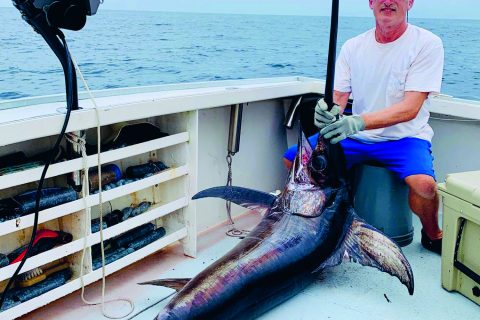
It was the same drill as the last time. We had a good catch of tuna by mid-morning, so we shuffled back out to the deep. Jon set up the reel and bait, and down we went, as he taught our whole crew how to make a successful deep drop. Once again, 5 minutes in, he declared a bite. Others also saw the rod tip move, so Jon put the reel in gear, and we were tight. (I often give thanks that this first real hookup stayed tight.) The big reel made short work of the 1,500 feet, and within 10 minutes, we removed the weight from the leader, and there, 50 feet down, was the blue-silver shine of a fish. A swordfish! Again, with zero experience, luck was on our side that day. We were not prepared and had the fish on the wrong side of the boat, but this one came in easily. A few minutes later, it was gaffed and coming over the side, a 100-pound marker swordfish, purple and brown in the bright sun, lit up as I had only imagined before this moment. I was hooked forever!
That summer was the year of the Fishtales yellowfin bite, as well as the discovery of the Ocean Observatory buoys. We tried deep-dropping on a few more trips, but the tuna and marlin fishing that summer was out of this world and took precedence.

June 2015 couldn’t come soon enough. We jointly decided that on each trip, we would dedicate a solid six hours to deep-dropping and really focus on learning both the technique as well as how to locate swords in the vast structure of the Northeast canyons. My trip planning now consisted of hours of studying bathymetry charts, hours of visualizing current flows, and much time reading scientific papers on swordfish behavior. I was not just hooked, I was addicted, as was all of the extended crew.
We started with a couple of heartbreak trips where we got the bites but did not come tight; or we got the hookup but the fish fell off 1,000 feet down; or we got the hookup and brought the fish within 200 feet, then pulled the hook. I have a spot on my GPS marked “Toad Ridge,” where we had three big-fish hook-ups one day in June. We broke one off and pulled the hook on the other two. It also could have been named Heartbreak Ridge, though we learned from our mistakes on each trip. Where we were once alone, there was now a group of four or five boats all working together, all of us dropping three out of four fish, all of us learning from our mistakes.
As the season went on, our skills got better. During one trip with the Howd boys, when their boat, Tokatomist, was down with an engine problem, we were in dying 4- to 5-foot seas and Steve Howd had a good one on. It was straight up and down and we were still learning, so we didn’t yet understand the power and fluidity of a large sword. We got the weight off with 100 feet to go, and Steve kept it coming, getting it to 50 feet. At 40 feet, we saw its shape and size. The fish turned down, the boat rose on a 5-foot sea, and it was gone. Hard luck, but a valuable lesson learned about vertical fish on a short leash!
Late in the 2015 season, we had our first real view of the migration. We were still losing three out of four fish to a variety of challenges and mistakes, but we had our moments. We learned about the heavy wallowing jump of a big sword 300 yards out and saw the incredible combination of agility and power a couple hundred-pound sword could put on boatside to break our hearts. We learned about the supersoft mouth and face tissue of a swordfish, which played a part in landing a foul-hooked sword. We saw the top-of-the-food-chain attitude of a sword, and that they really would attack a boat.
We set up for a drift off the ledge and put the first bait down. It never even made it to the bottom before we were tight! The sword came off the bottom like a rocket and was thrashing 300 yards out on the surface with angry half-leaps within minutes. We probably had 200 yards of belly in the line as this happened. It came at the boat before we were ready, and a royal battle ensued over the last 200 feet. After a few missed opportunities, we finally got a dart and two gaffs into an 80-inch fish that was probably in the 250-pound range. It was 9:30 in the morning and our trip was made.
I went back to the ledge and set up a second drift. As an experiment, one crew member dropped down a 16-inch Spanish mackerel trolling bait he had rerigged as a sword bait. It made it to the bottom and lasted there a minute or so before the rod doubled over, and line started peeling off. We had a big, angry fish 1,500 feet down. Unfortunately, it popped off in short order and we retrieved a slashed and torn bait.

By 10 a.m., we were back at the ledge for another drift, this time with a shorter and more compact mahi belly bait. It hit bottom, and nothing. The drift was perfect as we slid southeast off the edge. Still nothing. One angler worked the bait up and down as we drifted deeper off the canyon wall into 2,000 feet of water. Again, nothing. As the bottom continued to drop off, we had over a half mile of line out, and started to retrieve it back 100 feet at a time, letting it free float a minute or two after each short retrieve. Then, 400 feet off the bottom in 2,200 feet of water, we got crushed again. The rod bent over, and line began paying out against 24 pounds of drag. Once more, we found ourselves with a fish racing up from the depths, this one jumping almost 600 yards off the boat before going back down again.
We worked hard against what was clearly a large swordfish that was doing what it wanted. It dogged down again and stayed deep for close to an hour before swimming back up. This time, the jumps were 100 yards out and it stayed near the surface. After the end-game chaos of the last fish, we decided to treat this fish a bit differently. We acted as if it was a blue marlin and used both the boat and a leader man once we got the weight off and the fish was 75 feet from the boat.
When you try something new, sometimes you’re a hero, or sometimes you’re a zero. That day, we were all heroes! The weight came off cleanly as I bumped the boat to keep pressure on the hook once it was removed. The leaderman kept steady tension, kept the head up and the fish swimming with the boat. Less than a minute after removing the lead, the fish was boatside, 20 feet down, with the boat’s motion and steady leadering keeping it predictable. One harpoon shot, a second, one gaff, a second, and surprise – we had our first monster of a swordfish at the side of the boat.
My boat does not have a tuna door, so this was the day I learned I needed a block and tackle. After some serious heavy lifting, we found ourselves with an 89-inch, 300-pound-plus, size XL swordfish trying to kill us on deck. An angry swordfish with a 4-foot bill makes a life-sized mako look like a golden retriever.
It has been 5 years since that day and 60-odd trips to the swordfish grounds. We’ve gotten a few hundred solid swordfish bites day and night, and plenty of swords in the boat. It’s my passion. I spend the winter preparing the boat and tackle for about a dozen trips, and I spend my weeks from June to November looking at weather windows and blue water masses. Almost all focus and energy are on putting the boat and crew in a position to succeed at swordfishing. The catch, when it happens is icing on the cake. The planning, the chase, the strategy, and the teamwork are what keeps me excited, even in the cold depths of mid-winter.
All you need is a bass rod with a folded chunk of squid on a 6/0 gamu livebait and 60lb flouro ; ) To this day I still have that hook/leader on the dash of my truck for good luck!
Catch-and-release please
Sport fishing isn’t sport, it’s simply killing fish to make a jerk feel like a man….
Congratulations, very intense and emotional story.