
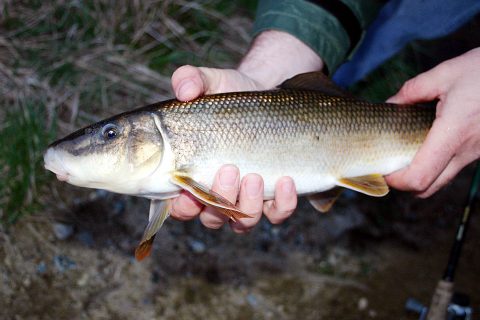
Only a mile from our office on Cape Cod, there’s a pool just above a small dam and herring ladder that gets a lot of attention this time of year. Dog walkers, herring watchers, and fishermen who peer into the water are often surprised to see a half-dozen large fish milling around on the sandy bottom. The fish are white suckers, a disappointment to anglers thinking they’ve spotted a school of trophy-sized trout or bass, and they are grouped up by the dam to do one thing and one thing only: spawn more suckers. Try as you might (and we certainly have) to tempt them with nightcrawlers, breadballs, or any of the other natural baits that suckers usually suck up, and they wont pay it a bit of attention. It’s spring, and the suckers are only interested in spawning.
We dropped down a GoPro camera this week and captured a little bit of “fish porn.” Notice in the video that the male suckers have developed their spawning coloration, which includes horizontal stripes on their flanks and hard white bumps (tubercules) on their tail fins.
Myth Busters: Sucker Edition
Suckers are sadly misunderstood by many anglers who think that they are invasive species (they’re not), a sign of polluted water (quite the opposite) or that they destroy trout populations by devouring their eggs (also untrue). You can learn more about the suckers of North America in this excellent article by Matt Miller for the Nature Conservancy, and find out about how to fish for them on this site celebrating “rough fish.”
where can i catch those fish?
sevittae, you can find them in most bodies of fresh water in the northeast (where carp have not displaced them.)
just caught my first yesterday while fishing for trout they are indeed a neat fish and fight pretty hard. you can find them in just about ant river this time of year that connects to a pond that has them which most ponds do.
We used to gig them in abundance in eastern (Poland) Ohio after ice off on our Yellow Creek. White and Redhorse suckers are tasty coming out of cold water. They are bony so we just filet the top or the “loin”. Great whole in the smoker. On rod and reel we would fish deeper (4′ to 6′) slacker water pools ,usually below rapids or “riffles”. The technique is basic, 6′ medium light spinning rod,6lb line slip/barrel sinker stopped by a small split shot about 2′ up with a #2 eagle claw barbed hook. Cast out tighten line then strip about 2′ of slack. watch the line,a delicate bite. If you tight line them and watch your rod tip, when it dances that is the sucker saying “goodbye”. Use lively Red Wigglers, or dug worms. the redhorse feeds well at dusk and into the night. Fishing suckers is an exciting experience and a lost art. Many childhood memories down at “the creek” , I learned so much !
We have caught several white suckers over the years while fishing for shad with willow leafs or flutter spoons what ever you care to call them, also on soft plastics in the Farmington river in CT.
Usually only one or two a year but they will hit a lure.
I am not talking about snagging them either, hooked in the mouth.
I caught 2 White Sucker up in the Nissitissit River in New Hampshire on April 14th 2018 and I ate them.
I’m planning to catch them in either the Neponset River in Canton Massachusetts or Beaver Brook in Sharon Massachusetts in Spring of 2019.
But I need to know when the spawning time begins and ends for them in Massachusetts.