
CJ Davitt’s rustic bobber paintings resonate with the kid in every angler. Maybe it’s the bobbers’ chipped wood or imperfect paint jobs, indicative of the wear and tear that salt water has on objects (and people) over time. They brought back my earliest fishing memories of a tackle box riddled with old snapper rigs and my grandfather huffing and puffing his way through another bird’s nest in my monofilament. Davitt shared similar childhood experiences on the water. “I started painting bobbers because, when I was young, that’s what we did at the shore,” he said. “We fished for snappers with bobber rigs in the bay.”

The bay, in Davitt’s case, refers to the upper reaches of Barnegat Bay. The Garden State native has spent most of his life within sight or sound of the surf. Growing up, his family summered in Lavallette, where his love for life by the sea was born through fishing and crabbing trips on the family’s old Dixie.
Davitt is a physician’s assistant in orthopedic surgery and resides near Sandy Hook with his wife and two kids. “I love being by the water,” said Davitt. “The small-town feel, the boats all around. My home and my family have always been close to the ocean, so the atmosphere is a huge influence.”

His body of work is a confluence of coastal subject matter that reflects his place, passions, and interests, so he enjoys immersing himself in the creative process because painting—like fishing—is a therapeutic exercise. “My job is very stressful. I come home and even though I’m exhausted, I can’t turn off my brain,” he said. “I’m the type of person who needs to be doing something, so rather than just flip on the TV, I’ll sit down and paint for an hour. It forces me to think about only what’s right in front of me, and I need that outlet in my line of work.” Weathered bobbers, bushels of blue crabs, fishermen, shark teeth, surfers, tunas, and seaside shops and restaurants … they’re all expressions of his personality and nautical lifestyle. “Everything I paint is a product of where I was raised and where I live.”

Davitt, like his father, is a skilled illustrator with colored pencils, and that natural talent blossomed into oil painting during the pandemic. “I was already drawing designs for my fishing buddies to use on hats or logos, and it developed from there.”
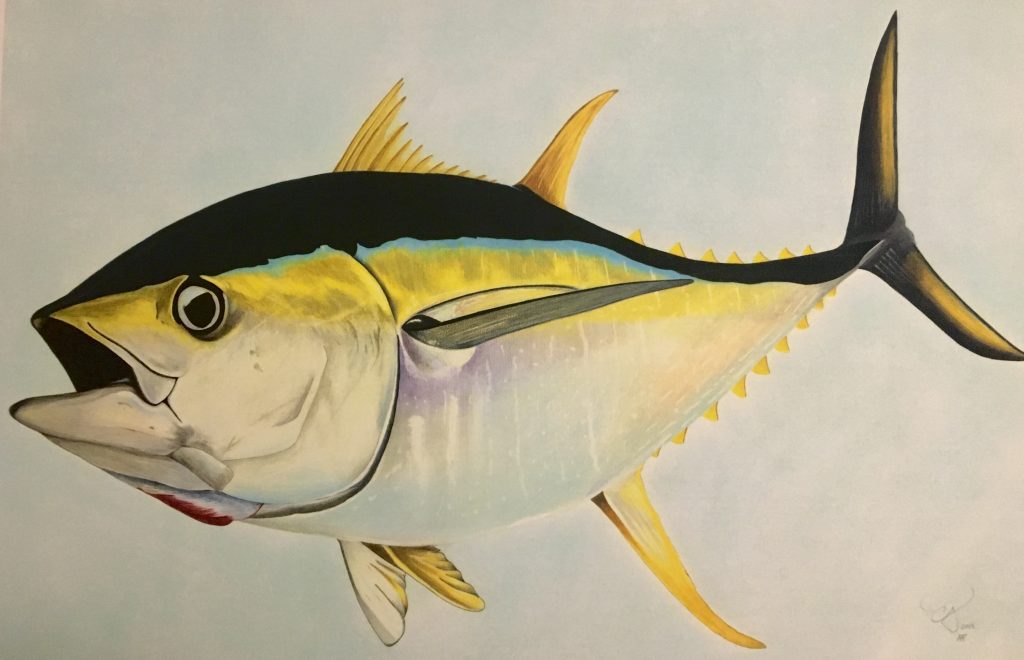
Hungry for a challenge and with more free time at home, he decided to step outside of his comfort zone and experiment with a brush and canvas. “Painting,” he said, “is a different animal, and learning to paint with oil is much more difficult than learning with acrylic.” Oil paint stays wet longer, so while it’s easier to make quick corrections, completing a piece takes more time and often requires walking away from the easel to avoid mistakes, like unintentionally blending colors. “It’s a double-edged sword,” Davitt said.
Working with oil paint does sometimes lead to happy accidents. During the pandemic, while painting in seclusion at his Lavallette beach home, Davitt accidentally brushed a wide, white “V” onto the ominous, dark background. “That looks like a seagull,” he thought, and proceeded to add a flock of gulls to the painting, which includes an old, battered wooden ship returning to port through high seas. “That minor slip really brought the whole piece together.”

It took some time for Davitt to understand how different oil colors interact in order to minimize slip-ups and develop his own style, which places heavy emphasis on shadows, texture, and depth. “I like trying to make my subjects look as real as possible, which is also one of my downfalls—I am sometimes too focused on fine details.” To combat that hyperfocus, he occasionally uses a palette knife, which allows him to scrape and smear paint like spackle rather than get caught up in making acute details with a brush. “The palette knife brings texture to paintings like Bushel of Blues. I use it with thicker paint, which helps the subject pop off the canvas. I wanted to create my own identity so that if someone sees a painting of mine without a signature, they’d still be able to tell it was me who painted it.”
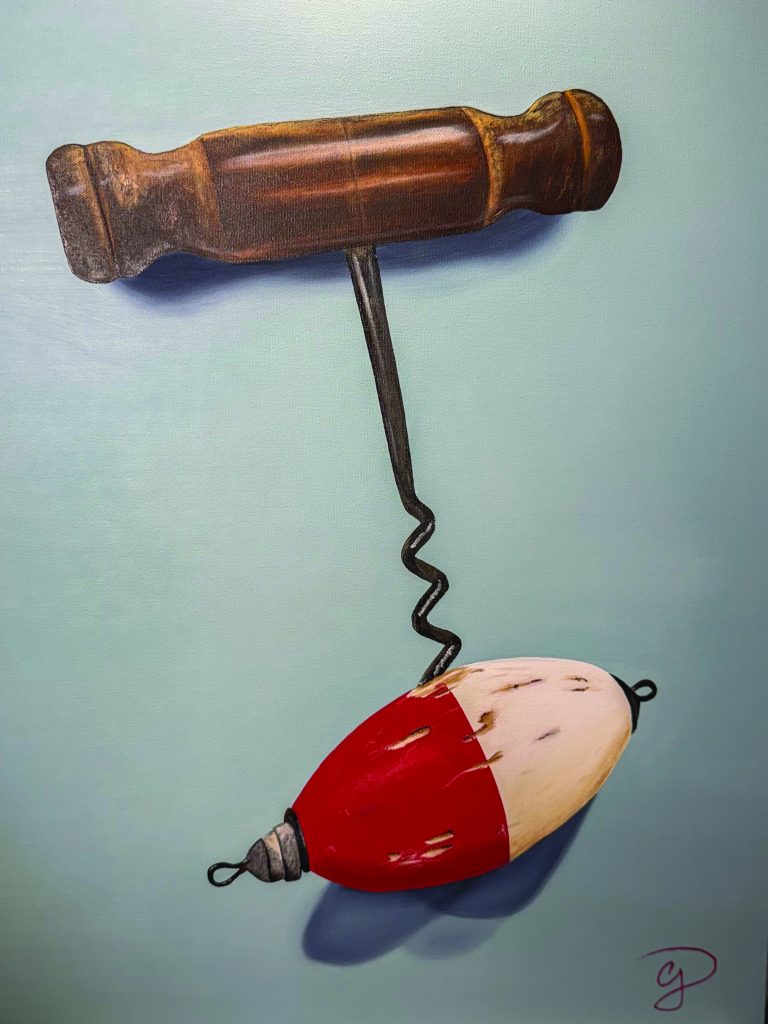
Davitt’s bobber paintings played a major role in honing his creative identity, but he never considered there would be public interest in his pieces. “I just paint the things I like because they have meaning to me, and if people enjoy them or find meaning in my work, that’s great,” he said. Thanks to a lack of wall space and a little encouragement from his wife, Davitt’s work is now available in a handful of New Jersey art galleries including Frederick Gallery in Spring Lake, Autumn Elise Gallery in Rumson, and Noon Designs in Bay Head.
“It is cool to have other people own my artwork and appreciate each piece the way I do,” Davitt said, “but it’s my hobby. I’m not doing it for more money.” All he wants is more time to paint.
» To explore more of CJ Davitt’s work, follow him on Instagram @craigjamesd