

Condensation dripped from the windshield of Natasha Farrell Manhardt’s vehicle as she and her husband awoke. It was just after 4 a.m., and upon emerging from the back seat, the brisk, mid-September air, thick with the scent of mackerel, filled her lungs. There was just enough time to grab a coffee and return to the Cape Cod Canal’s rugged, rocky edges for the topwater bite at first light—the reason for their two-hour pilgrimage from New Hampshire the night before. As the two tied leaders and organized gear, Manhardt had an idea brighter than the early autumn sunshine, “Why don’t we just move down here?”
Manhardt grew up on a farm in Missouri, a long way from striper country. She wasn’t much of an angler in her formative years, but she was, and still is, a skilled illustrator. “I took only one art class in high school,” she said, “but I’ve been drawing since kindergarten.”
Fishing became a part of her life once she met her husband, Michael, who hails from New Hampshire. The two connected at Fort Sam Houston in Houston, Texas, where they studied behavioral health before joining the U.S. Army. Eventually, Natasha followed Michael back to the Granite State, where she first dipped her toes into fishing rivers, lakes, and ponds for myriad freshwater fish. It wasn’t until the pair paid a visit to a friend’s house on Cape Cod that they became infatuated with striped bass fishing. “After that trip, we drove to the Canal every weekend for an entire season,” said Manhardt. “I’d pick up Michael from work at 11 p.m. and we’d make the long drive down, sleep in our car for a few hours, and fish the morning tide.” They were mesmerized by the coast and quickly grew tired of the weekly trek. By December 2016, the Manhardts were Cape Cod’s newest residents.

A few years after settling down on the Cape, Manhardt, looking for a creative outlet, picked up a paint brush for the first time since her high school art courses. “I figured if I can draw, I can paint,” she said. It was 2020, the COVID-19 pandemic had just begun, and the military had temporarily shut down operations. “I was sitting at home with a 3-month-old and a 2-year-old, slowly going stir-crazy, so I bought some acrylic paints and started painting fish, using photos Michael and I had taken for reference.” Like fishing, she found painting to be therapeutic; it provided her with a temporary release from the daily stressors of raising two young children amid a global pandemic. One of her very first pieces showed her husband holding a striper, followed by a sea bass portrait, which detailed the lovely turquoise blues and purples radiated by its deep black scales.
To Manhardt’s surprise, what began as a leisurely hobby reflecting her recreational pursuits eventually blossomed into an opportunity to share her work with the public. Off The Grid, an art gallery in Sandwich, Massachusetts, discovered one of her pieces titled Fish Monkey—a portrait of her husband Michael holding a healthy striped bass—and was interested in showcasing it. “Initially, I wasn’t planning to sell my work, so I was very excited to hear they liked it,” said Manhardt. “I made only four versions of Fish Monkey, but they wanted to bring in some new artists and styles as they restocked the gallery.” Her first painting was sold to a Falmouth resident and, from there, she became more engaged with community organizations and events. “I got into the Sandwich Arts Alliance and painted Adirondack chairs for their Chair Trail event and even painted whales for Chatham’s Art in the Park,” she said. Her unique style and perspective shines through in the way she portrays the elements.

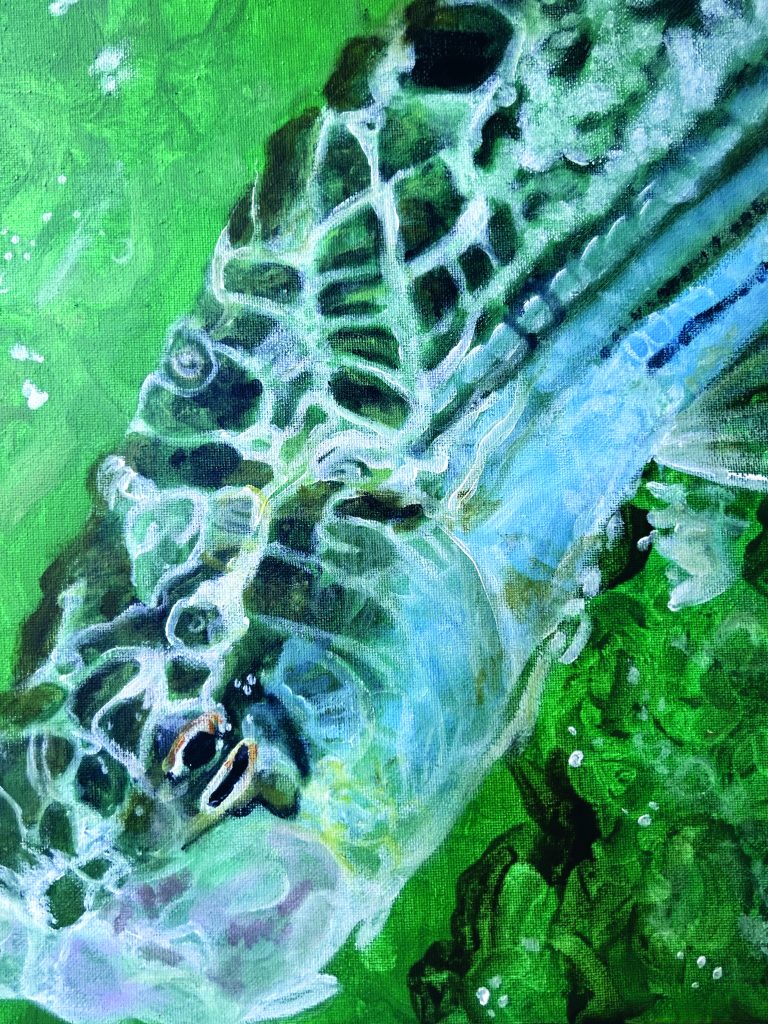
Manhardt aims to capture the kinetic energy of marine environments in her paintings. She references several photos to create the perfect coastal scene before adding fish such as striped bass and mackerel. “Because we spend so much time fishing, I always try to reflect the angler’s perspective so that observers can feel the wind and waves,” she said. Although it changes with each painting, her typical process begins with a focus on water, which consists of a base layer of blues and greens. “My paintings tend to look “drippy” after the first layer because I let the colors bleed and go where they want, which helps depict the natural motion of water. Once that layer dries, I revisit it and adjust from there by adding in the fish and landscape elements,” Manhardt continued. “Experimentation is a big part of my process. I like to use different types of acrylic paints for texture. For example, thicker, heavier paints work well for osprey nests, grasses, rocks, etc. By using acrylics, everything I paint can be touched, as opposed to oil paints which tend to bleed and smudge when touched.”

When asked what she most enjoys about the creative process, Manhardt says, “I am free to paint what I love, which is fishing and a life by the water.” Knowing that someone will appreciate and relate to her work because of a special catch or experience they had is what drives her, though she also cited the positive impact of her artwork on family life. “This all started because my husband and I bonded over fishing long before we had kids, and now fishing is a part of their lives, too. Our 5-year-old could reel in stripers all day; it feels so good to hear the kids beginning to understand tides and tackle.”
While the Manhardt family loves and appreciates their striped bass, Natasha continues to experiment with different perspectives and fish species. “Right now, I really enjoy painting bluefin tuna. There’s so much variation in pelagic colors, and I’m starting to play around with metallics, which adds a sense of realism,” she said. “Like stripers, tuna are great subjects for me because I enjoy action-packed, in-the-moment angler perspectives. I want to continue exploring new species and styles, like the reflection of sunlight on the water’s surface when a hooked tuna appears boatside.”

Along with her original paintings and the occasional commissioned piece, Manhardt hopes to begin selling prints of her existing work and would like to paint more whales, which are a popular request by collectors of coastal art. In the more immediate future, a family trip to the Cape Cod Canal is in order—only this time, they need not camp out in the car.