
With a pocket full of sewing thread, hooks, and a lump of dough from the local bakery, a young Vito DeVito set out for The Pond in Central Park. From his home on West 43rd Street in Hell’s Kitchen, the park’s 59th Street entrance was a short stroll—a route he became familiar with during his childhood. Like many kids who grew up in Manhattan, Central Park was DeVito’s playground. “I used to hand line dough baits beneath the No Fishing sign and catch all sorts of carp and catfish, so it’s safe to say I caught the bug early on,” he said. Fishing was, and still is a therapeutic activity for him, but it took a backseat to his passion for art and design, which was ingrained in him long before he ever picked up a hand line or rod and reel.
DeVito was raised in a strict household on Manhattan’s west side. His father, a former U.S. Army Drill Sargeant, worked as a longshoreman on the bustling New York City shipping docks. Between his military background and the labor-intensive logistical duties associated with working in the Port of New York and New Jersey, it’s no surprise that DeVito’s father ran a tight ship at home. His mother, on the other hand, worked with Anne Fogarty—a prominent women’s fashion designer in New York at the time—and significantly influenced DeVito’s imaginative and inventive nature. “My uncle Joseph was also a very important figure in my early childhood,” said DeVito. “He was a priest and a still-life artist, and I frequently watched him paint in the formal parlor of our brownstone building.” By age 6, DeVito was following in the footsteps of his mother and uncle, sketching, and drawing in his free time. With his father’s stern, regimented work ethic and his mother’s creative flair in the fashion industry, the foundation for DeVito’s path into fine art and design was already in place.
Over the years, DeVito’s father taught him and his brother Joseph about the waters surrounding New York City. “My dad used to take us to Sheepshead Bay and Broad Channel in Jamaica Bay to learn the tides and the best times to go fishing. We even took trips to the east end of Long Island to fish the Peconic River.”
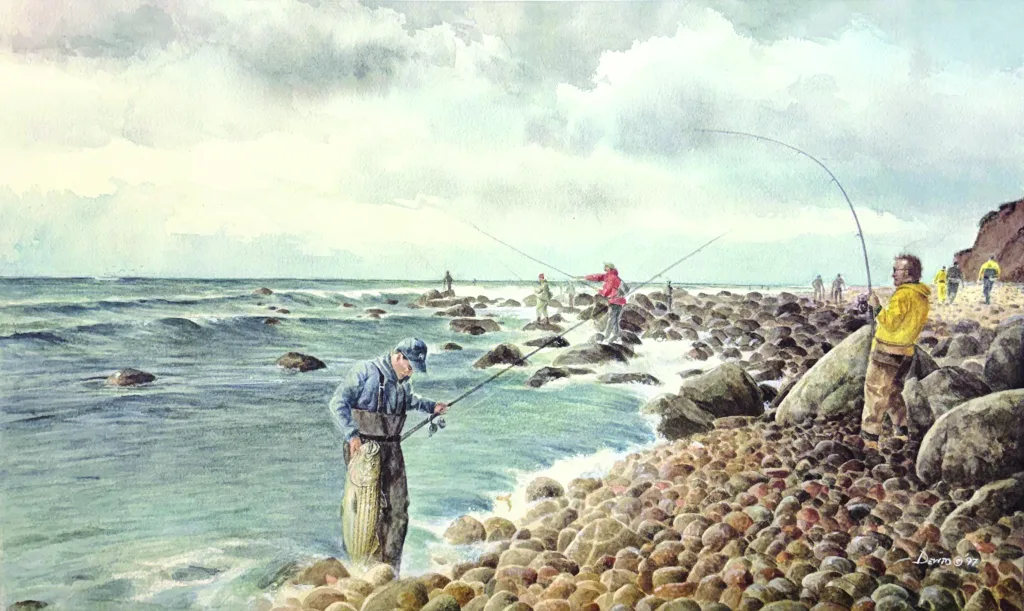
As a teen, his family moved from New York to Berkley Heights, New Jersey. It was there that DeVito first picked up a fly rod. “I learned to fish for trout in the Raritan and Musconetcong rivers and once I got the hang of it, I fished them religiously.” He spent his teenage summers lifeguarding down the shore on Long Beach Island and soon began surf fishing with his new friends.
In college, he focused more on his studies, and his fishing habit temporarily fell by the wayside. DeVito graduated from Seton Hall University in 1975 with a degree in art history and moved to Florence, Italy, and Lamal, Belgium, where he lived, worked, and painted until 1980.
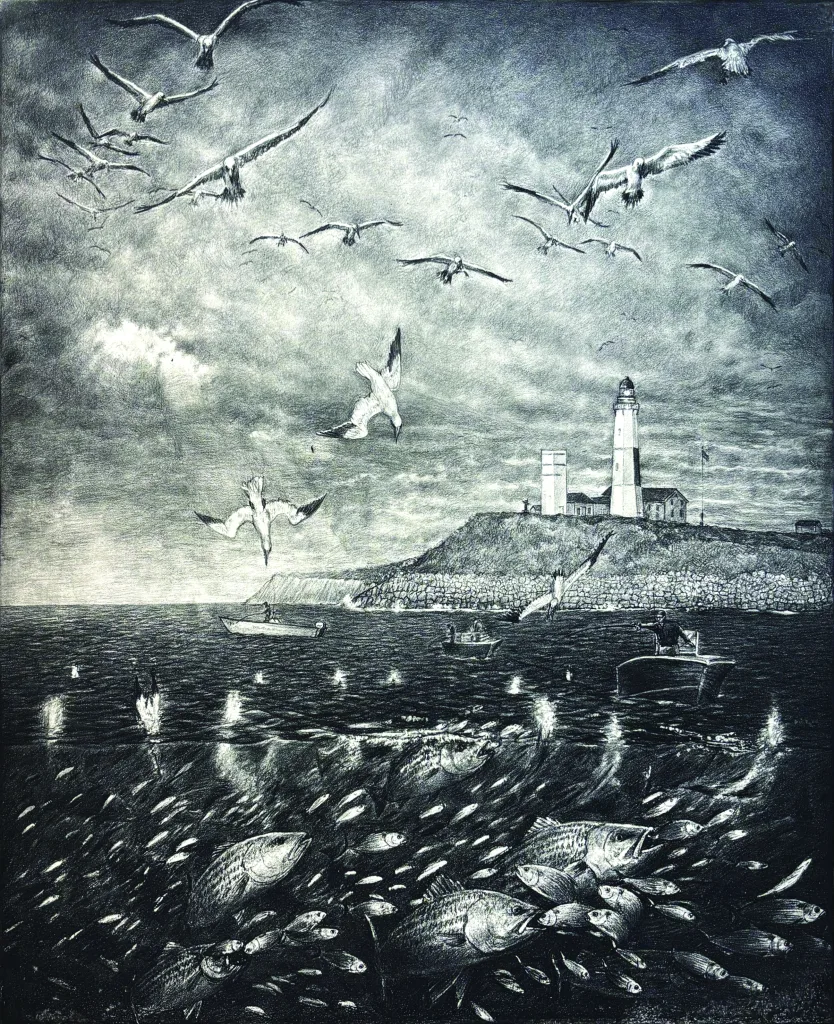
Upon returning to the states, DeVito married his wife, Laurie—a professional artist and potter—in 1981 and began managing galleries in New York, including J.N. Bartfield Galleries and Meisner Gallery. “Being involved in gallery management taught me how to enjoy and understand the business of art,” said DeVito. However, the fast-paced city life no longer aligned with his personal goals, so it was time for a change of pace. “We moved to eastern Long Island shortly after our honeymoon. I was supposed to open a gallery out here, and that plan fell through, but we stayed. I got a job at a restaurant; my wife began teaching art at a school in Sag Harbor, and I spent 7 or 8 years as a freelancer for different publications in New York City.” All the while, DeVito’s love for fishing and the sea was slowly rekindling.

His new stomping grounds of Montauk and the North Fork began to influence the subject matter of his work and how he preferred to share it with the world. He was done with traveling to and from the city. “The demanding lifestyle and cadence of freelance work no longer agreed with me, so I decided to go private full-time,” he said. Although it was a major undertaking, the switch to private work afforded him the freedom to pursue projects that reflected his interests and values.
“After a year solo, I had already built up a good clientele, and I didn’t need a gallery as a middleman anymore. I knew what it took to run my own. Now I have a beautiful home with my own gallery and studio right here in Sagaponack.”
Since going private, many of his paintings, etchings, and sculptures have focused on the interactions between humans and the natural world, namely through hunting and fishing. A conservationist at heart, DeVito became a major partner of The Redbone Gallery in Islamorada, Florida, which organized fishing tournaments that supported cystic fibrosis research while emphasizing catch-and-release practices with redfish and bonefish in the south, and striped bass in his home waters off Montauk. He has also partnered with organizations like Ducks Unlimited, Trout Unlimited, the IGFA, The Nature Conservancy, and the Atlantic Salmon Federation.
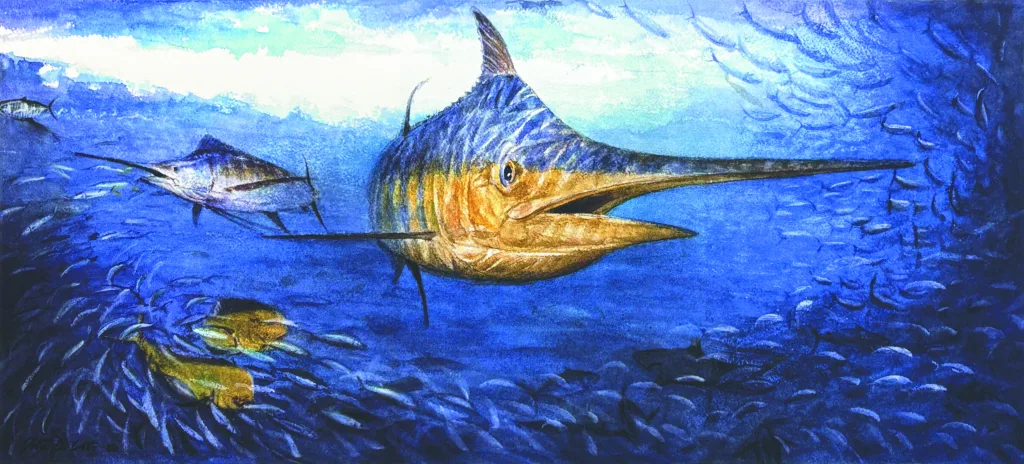
“As a private artist, I really enjoy supporting organizations that value conservation and outdoor stewardship,” he said. In partnering with groups like these, he has had opportunities to paint alongside renowned artists who share his interest in fishing, like Guy Harvey. But DeVito is a family man, and he feels even more fortunate to have had the freedom to collaborate with his younger brother, Joseph DeVito—a successful sculptor and artist in his own right.
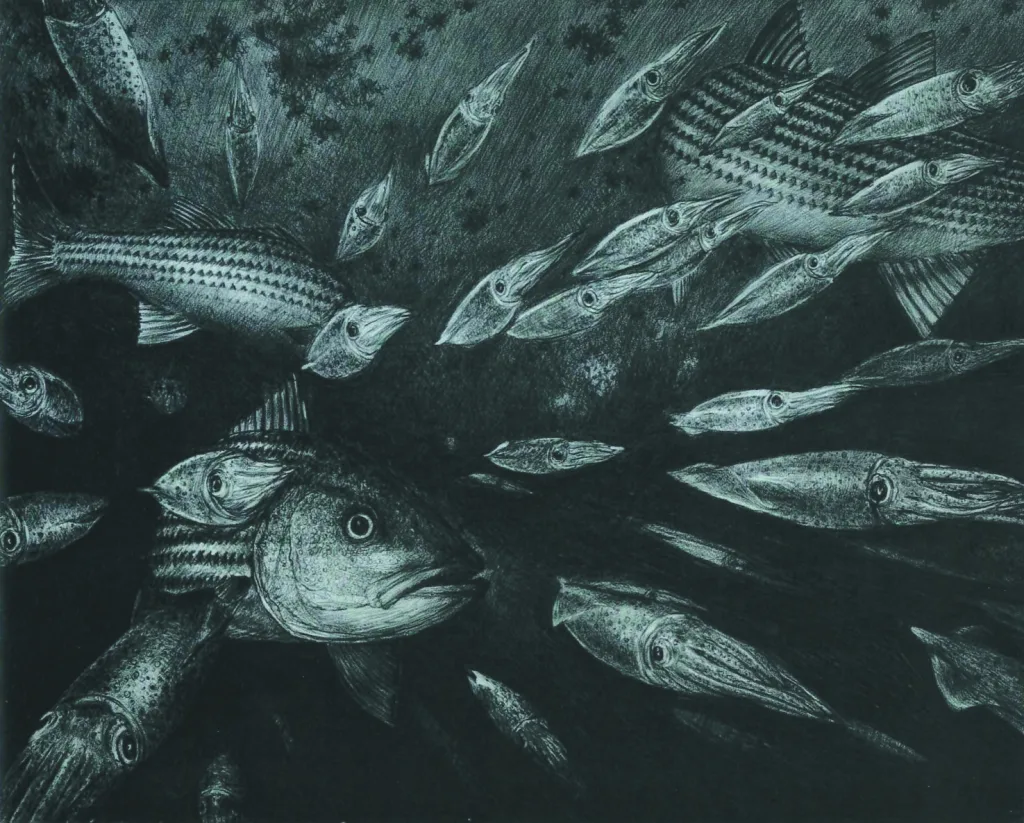
DeVito works in many mediums, including etching, pencilwork, engraving, and sculpture, but painting is his bread and butter. “Sculpture is fun and I’d like to do more of it, but it’s time consuming, a bit restrictive, and it ain’t cheap! In my free time, I paint mostly with oil. I like watercolor, too, because I can usually complete a piece in a week or less since it dries quickly,” he noted.

An oil painting may require more time and attention to detail, but DeVito finds that the strong primary colors and glaze give each piece a depth and richness that is unrivaled by watercolor. Since his painting style has gone from very tight and photorealistic to more abstract, oil helps better achieve a balance between composition, light, hard and soft edges, and evenly saturated colors.
“Being a professional artist is very competitive. There is so much talent out there, so when my work resonates with someone, it still humbles me, DeVito said. “I started being paid to paint fish about forty years ago, and I consider myself lucky to have found my lane at a young age. I like to learn—my goal has always been to keep progressing and trying new things so that I can leave my mark in this field with a body of work that I’m proud of.”
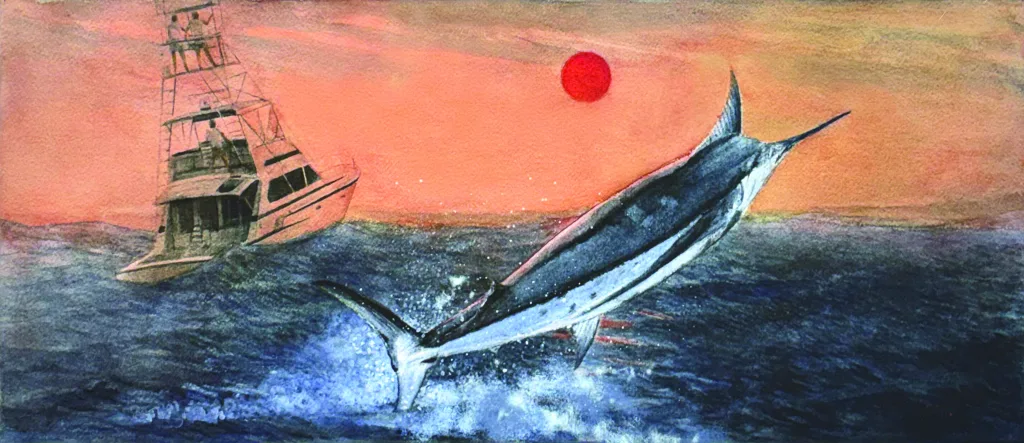
When asked if there is a particular catch that he’s most proud of, DeVito laughed. “No, I just enjoy the process, which is why I like painting and sculpting. The fluid motions of fly casting, the surrounding environment, the colors of the fish… it’s the entire scene, and being able to recreate it, that I most enjoy. Fishing is a sport that doesn’t get old, and I hope to be doing it when I’m 90.”
DeVito still has plenty of goals beyond the canvas. “I want to catch a big permit, a trophy pike in Maine, and a 30-pound striper on the fly.”
From June through October, DeVito and his wife live and work from Norway, Maine. “It’s a privilege to paint in different areas, and it forces me to work with different color palettes. Along the coast in New York, the light is very bright and intense, while in the woods, there are much darker, earthier tones. Those kinds of adjustments in lighting, color, and contrast keep me on my toes.”
READ MORE