
The air is hot and the water temperature in Buzzards Bay is peaking, which could spell slim pickings this month, particularly for anglers targeting stripers. Hopefully, with the expected influx of small baitfish to our waters, we’ll be blessed with another good run of bonito to kick things back into gear.
The last couple of seasons have been exceptional, with bonito showing as early as late July, though I traditionally see them in good numbers around the islands and the west end of the bay by the second week of August. From there they make their way toward the center of the bay, but there are no guarantees. The presence of bait is the greatest determining factor, and so far this season there’s been a ton of small baitfish throughout our waters, meaning the stage is set.
Spinning Tackle
While I mainly target bonito with the fly rod, I occasionally use spinning tackle as well, especially early in the season when they’re spotty and shots are limited. The spinning rod provides the advantages of range and speed of delivery, so I pick one up when I need to, without hesitation. For hardtails, I use a 7’6” 10–20 lb. Star Rods Seagis paired with a Shimano Stradic 5000, loaded with 30-pound braid, onto which I tie a 6-foot leader of 20-pound mono. It’s a setup I’ve relied on for well over a decade — one that handles small lures just as well as it handles the backbone-bending runs of the most determined inshore fish. From soft plastics to tins and topwaters, this combo does it all.
When it comes to lures, my number one choice is the bone-colored Rebel Jumpin’ Minnow rigged with a single inline hook at the tail. This budget-friendly but proven lure casts like a bullet, creates a lot of commotion on the surface, and does a great job of getting the bones’ attention even when blind casting. Speaking of blind casting, it can save the day when feeds are scarce, sporadic, or over too quickly to reach with a cast. Don’t wait for fish to pop up; they’re already out there, and a lure ripped across the surface makes an easy target. Another go-to of mine is a white Rapala X-Rap, once again rigged with a single inline hook at the tail. When eelgrass or surface weeds would make a topwater impractical, this is my first call. A rapid retrieve with frequent slashes is practically guaranteed to earn a hit. Like the Jumpin’ Minnow, the X-Rap is deadly when cast blind.
I also like to have a few epoxy jigs or small tins on hand, all with single inline hooks instead of trebles. Trebles may have a slightly better hookup ratio, but the tradeoffs are significant: they catch weeds far more readily and complicate hook removal in ways that can tear a fish’s mouth or gills and cause serious bleeding. If you’re keeping a few for the grill, that’s one thing, but it’s a poor outcome if release is the goal. Single inline hooks won’t eliminate these problems entirely, but you’ll run into them far less often.

On the Fly
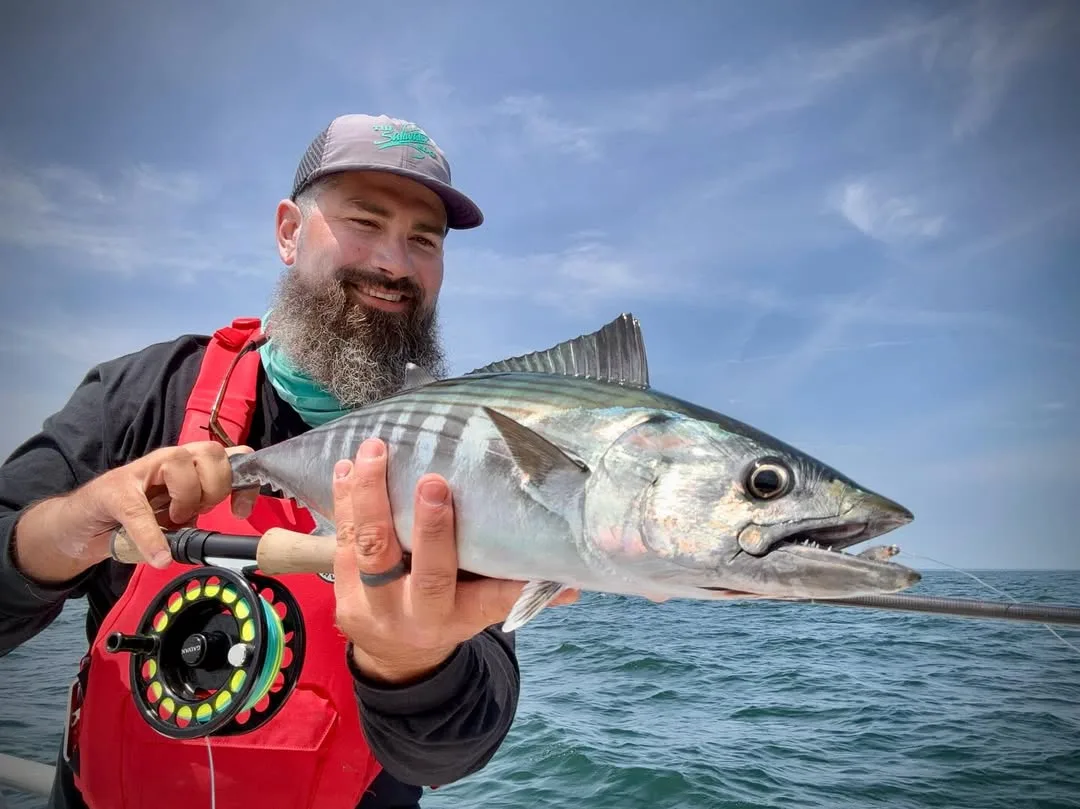
The fly rod is my absolute preferred method for targeting bonito. Yes, there’s an added element of difficulty with the limited range and slower delivery, but that’s precisely what makes success so gratifying. And despite those disadvantages, the fly rod prevails when fish are keyed in on tiny baits and demand a lifelike presentation. Flies can match the size and appearance of small baitfish almost perfectly, and certain patterns also replicate the natural sink rate of a stunned baitfish in a way no lure can. Sometimes a slow, almost neutral sink is exactly what draws hits from finicky fish. Over the years, I’ve grown to rely heavily on a slower retrieve studded with long pauses, which keeps the fly in the strike zone longer and simulates the behavior of a stunned or confused baitfish. Don’t get me wrong; there are times when a rapid retrieve is necessary, but not nearly as often as I once believed.
When bones are happy and cooperative, I almost always reach for a small popping fly. The noise and commotion they produce make them excellent for calling fish to the surface on blind casts. There’s no beating the sight of a bone blowing up on the fly.
The Two-Hand Retrieve
Whether I’m burning the fly back to the boat or simply dead-drifting it, I use a hand-over-hand stripping technique. Many associate this style with speed alone, and for burning it’s nearly mandatory, but fast or slow, the greatest advantage is that the line is always in one of my hands, which means I’m ready to deliver a strip set at any moment. It also lets me rapidly take up line and maintain steady pressure if a fish eats the fly and turns toward me.
In my opinion, there are too many disadvantages to the single-hand strip, especially when targeting bonito and false albacore. For one, there’s always a point in my strip where I have to let go of the line to reach forward and grab it again, and if a fish hits at that exact moment, I can’t deliver a solid hookset, which usually means a missed fish. Second, if a fish hits at the very end of my strip, I’ve got no range of motion left; I have to let go, reach forward, and hope to drive the hook home before the fish spits it. Third, if a fish grabs the fly and charges toward me at full speed, I’m scrambling to strip line fast enough to eliminate slack and regain pressure. The two-hand retrieve solves all of these problems. Give it some practice if it doesn’t come naturally. Once you get the hang of tucking the rod under your arm after the cast, you’ll notice the advantages almost immediately.
Other Species
Aside from the bonito action, other fish will be feeding on the same small baitfish — namely bluefish and striped bass, though the bass will more likely be found along the islands and the Westport/Rhode Island end of the bay. Most stripers will run 24 to 30 inches, but some much larger fish can be encountered. When locked onto small bait, they can be just as finicky as any bonito or albacore, so be ready to match the hatch if needed.
The best bottom fishing will continue in Vineyard Sound and south toward Noman’s, and if your search takes you that far, you may even turn up some jumbo bluefish — though these gators can prove frustrating for anglers focused on pulling up intact sea bass and scup. Toward the final week of August, we may even see false albacore push into the bay. If not, they’ll almost certainly be on our doorstep by then.
Rumors are big albies coming up the coast! Lots of state records being broken as they head north. Tight lines.