
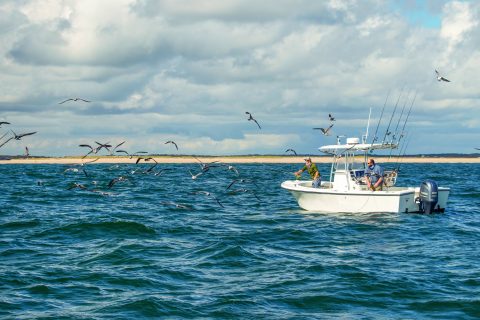
It was like a scene out of Hitchcock’s Birds as we rounded the corner and approached the inlet. “Hold on!” I screamed over the delightful hum of the 4-stroke outboard as I pinned the throttle and headed for the immense clouds of wheeling and diving birds. Two hats flew off and went careening into the rooster tail behind the boat, but there was no turning around to get them. There was a true fall blitz of epic proportions forming against a threatening gunmetal-gray sky in front of us and there was a sense of utmost urgency.
As we got closer we could see individual white splashes, and even before I could get to the mayhem just off of the jetty, all around the boat, shiny bait jettisoned out of the water under heavy boils in desperate but futile attempts to flee hungry predators. Before I could cut the engine, my two anglers were zipping topwater plugs into the boiling fish. “I’m on!” screamed one as a big striper shook its head and splashed on the surface. Behind me, I could hear the wonderful zing of line peeling against the second angler’s drag. The fall blitz had officially begun.
For many Northeast and Mid-Atlantic anglers, the fall is a time of the year when sleep all-of-the-sudden doesn’t seem that important. We cash in those sick days, chores just don’t get done, and we make up pathetically transparent excuses to get out of prior commitments and responsibilities. This is the time of the year when it all comes together in the form of huge bait concentrations and hungry migrating predators cumulating in massive feeding frenzies or what we call the blitz.
Undoubtedly the main ingredient to any good fall blitz is bait concentration. From New York to Jersey there are five dominant bait species that fuel these fall blitzes. The following are brief descriptions of the baits of choice for feeding bass, bluefish and false albacore this fall.
Juvenile Atlantic Menhaden (“Peanut Bunker”)

Atlantic menhaden are one of the most abundant baitfish species in estuarine and coastal waters. The juveniles that have been growing in the back-bay areas become super-abundant by late August. You can usually see big schools in the marinas or local creeks in your area right around that first week. Without a doubt, these silver-dollar-sized baits create the bulk of the fall blitz.

Adult bunker actually spawn in the ocean and their young develop and grow in the less saline waters of estuaries and marshes during their first year before migrating to the ocean in the fall. When juvenile menhaden move out of those inland areas beginning sometime in September, the big schools become easy prey for excessively hungry migrating stripers, bluefish, and false albacore.
A menhaden’s only survival method is to school in such numbers that only the weaker fish on the outside get picked off and so the schools are often tightly packed and quite large. You can expect to see these schools stick around until November.
Menhaden are a wide-profile, silvery fish, and when they flash in the sun, they elicit an immediate predatory response. Thus, metal lures and flashy lipless crankbaits work well when they are around. They can range from 1 to 5 inches long, and tend to grow quickly, therefore, the later in the fall run the larger the peanuts tend to be. Kastmasters or Crocodile spoons are a good choice. Heavily tied bucktails are also a good imitation as their wide-profile matches that of a peanut bunker. Swim shads and paddletails in the 4- and 5-inch sizes a dead ringer for these baitfish. Make sure you have plenty of these in your box when the fish are feeding heavily on peanut bunker. And, don’t forget poppers in menhaden-matching colors.
As far as flies go, Crease Flies are a pretty darn close imitation, but I prefer to use Boilermaker or Conehead Poppers as they make more noise and seem to attract more strikes. Wide-profiled Deceivers and Half-n-Halves work well when the fish are feeding deep, but really anything tied with a wide profile usually does the trick.
Bay Anchovies

This bait comes in a close second to the peanut bunker when it comes to igniting fall blitzes. They are typically 3 to 4 inches long and are nearly transparent. They sport a silvery band along the sides of the body and have a copper tint when in a group. Thus, when you come across a big school they will appear as a big copper mass on the surface of the water.
Bay anchovies live along the coast in estuaries, bays and near sandy beaches. They can handle a wide range of saltiness but are most often found in water that is slightly less salty than seawater. It’s interesting that they are not found in any real numbers off the outer islands like Martha’s Vineyard, Nantucket or Block Island. This could be because there is no real freshwater source like there are on the coastal areas.
Like peanut bunker, bay anchovies swim in schools. While they spend most of the summer in less saline estuaries, they spend the winter in deep water. When they migrate out of the bays, they come in great numbers and the predators are there to eat them.
There are two things that set bay anchovies apart from peanut bunker. The first is its ability to draw false albacore. Once we see the big pods of bay-anchovies, we know that the albies aren’t far behind. The second and perhaps the most extraordinary distinguishing characteristic of bay anchovy concentrations is their ability to create some of the most jaw-dropping blitzes you can imagine. When bass find large schools of these baits, particularly in Montauk, the surface mayhem over a large area is impressive. Expect to see bay anchovies well into November.
These baits are so small they are difficult to imitate unless you are fly fishing, in which case small epoxy baitfish patterns work well. Spin fishermen do well with epoxy-style jigs and Albie snax. For some reason or another, the small pink Slug-Gos work well during bay anchovy blitzes as well. And don’t forget poppers. They seem to draw strikes during a blitz on any bait.
Sand Eels

These fish are abundant in the late-summer and early fall, swimming in large schools in shallow water close to the shoreline. The color of sand eels depends on where you are because it varies in shade over different bottoms. The many I have handled have been olive, brownish, or bluish green above, with silvery lower sides and a duller white belly. Some have a longitudinal stripe of steel-blue iridescence along each side, but others lack this. Mature sand eels run from about 4 inches to about 6 inches in length, with a few I’ve seen on Cape Cod going as large as 8 inches.
Sand eels usually congregate in dense schools, numbering in the thousands. They swim as an eel does, by sidewise undulations that run along the body from front to rear, which makes them easy to recognize in the water. The most interesting habit of the sand eel is the custom it has of digging itself several inches deep in the sand, opening the way with its sharp-pointed snout.
Unweighted 5-inch Slug-Gos are a good bet though, and there are hundreds of sand-eel imitation fly patterns.
Atlantic Silversides

These fish get their name from the distinctive silver band on their side, accompanied by the translucent green coloring on top. They are not big, only growing to about 5 inches long. They are very common in nearshore waters, usually on sand or gravel shores and in salt marshes at high tide. They are considered the most abundant fish in most back-bay areas throughout the year, but seem to disappear by October as they move into the ocean.
Unlike the other baitfish mentioned, silversides won’t form dense schools visible from a distance. Instead, these fish form loose shoals. Therefore, blitzes on these baits won’t be quite as intense as those on bay anchovies, but will consist more of isolated surface breaks over a wide area.
Silversides also, almost always swim near the surface, making them a target for birds even when no gamefish are feeding on them. In the fall, this creates a “smoke but no fire” situation where anglers are drawn to a flock of diving birds picking spearing, only to find no predatory fish in the vicinity.
To mimic these baits, anglers can use the same sorts of imitations as they use to imitate bay anchovies and sand eels. Slim profile soft plastics or flies. Bob Popovics Surf Candies are a dead ringer for silversides, and work exceptionally well when fish are keyed in on these baits.
Finger Mullet
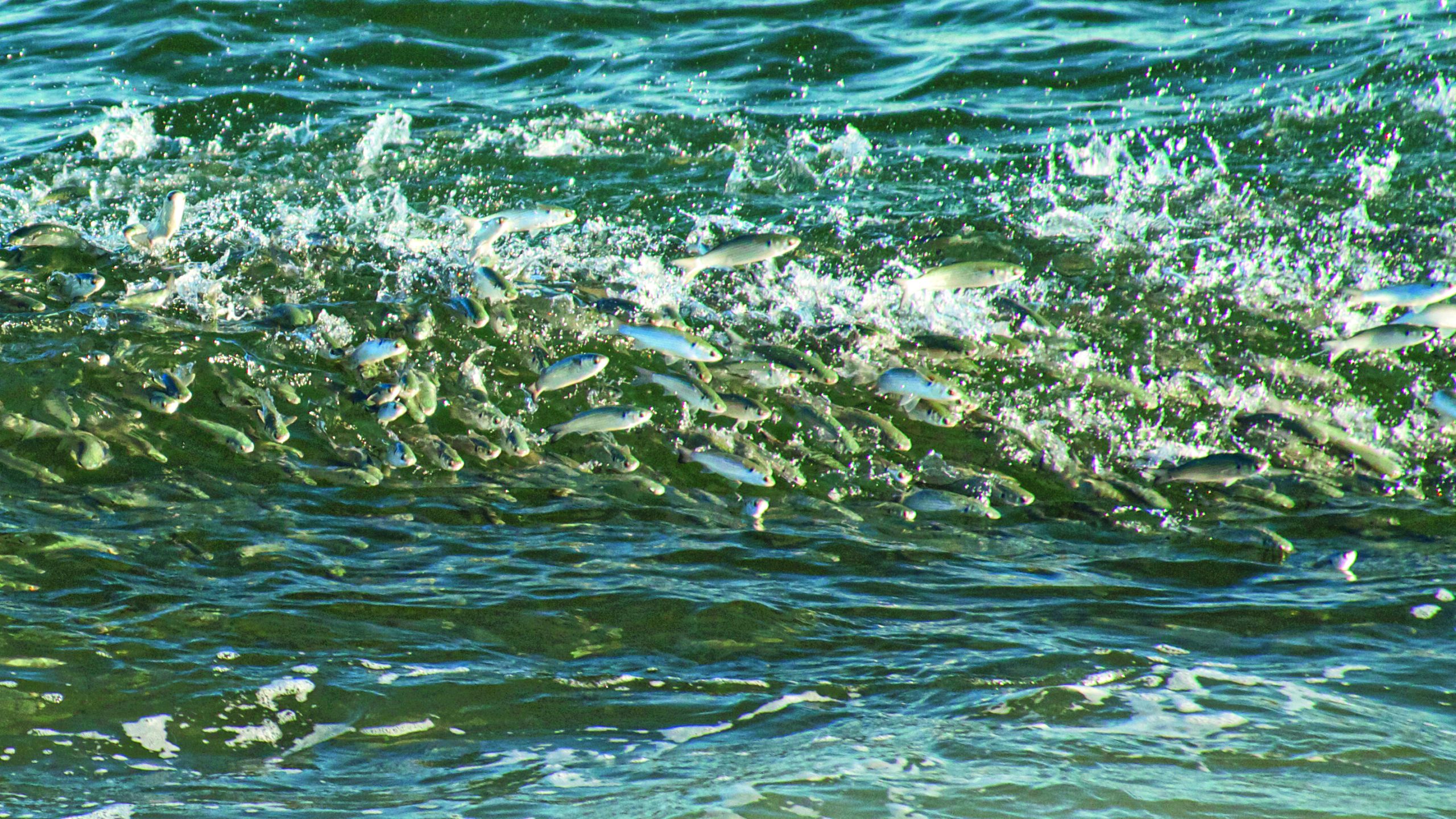
Migrating white mullet show up in mid- to late August and stick around for a month to a month-and-a-half before moving back to warmer waters. This long and slender baitfish is bluish-gray on its upper body, fading to silver on the sides and white underneath. Locally called “finger mullet,” this bait usually ranges in size from 5 to 8 inches. They feed on algae, detritus (dead organic matter) and other marine micro-organisms. They ingest food by picking up sand from the bottom and sifting edible material through gill rakers and tiny teeth. Sandbars offer dislodged food in the form of tiny crustaceans, bringing in mullet in large numbers to feed.
The flesh of this species has one of the highest sources of omega three fatty acids making it a sought after food source for hungry stripers, blues, and larger false albacore. When you find the mullet schools, you’re sure to find hungry predators in close proximity. When the surf is particularly big, those mullet that have gathered to feed amidst the suspended sand are also very susceptible to getting tossed around by the roiling water. Disoriented mullet quite often get separated from the school and can be seen bouncing out of the water with a big striper or bluefish in pursuit. On a clear sunny day, one can observe this spectacular occurrence with some clarity. Seeing roving schools of large bluefish and stripers inside a swell and then a subsequent blitz after the waves breaks can be a regular occurrence along the beach and on sand-bars. The presence of mullet, because of their oil content and size, usually seems to bring in the largest of predators to feed.
When mullet are around, it’s time to break out the swimming plugs. During low-light conditions I really like school-bus or chicken-scratch bombers. Black works well also. Once the sun comes up, blue and white plugs work somewhat better. Out of all of these plugs however, nothing seems to draw violent strikes like a pencil popper. The blue and silver versions of these things are the best plug I have in the box when mullet are around.