


Catching bluefish can be fun but knowing how to get an offering past the blues could nab you your largest striper of the season.
The night’s supply of fresh bunker was dwindling quickly as 8- to 10-pound bluefish attacked our baits almost as quickly as they hit the water. While the good-sized blues would have normally been a welcome catch, they were rapidly devouring the bait we’d brought to catch the large stripers that had been roaming the Long Island surf.
I was on Long Island, delivering the November Issue of On The Water to the local tackle shops, when I bumped into Alberto Knie, who at that time was working at the Camp-Site Sport Shop in Huntington. I asked him how the fishing had been, and he showed me a picture of a 40-plus-pounder taken just a few nights prior. He invited me along, as he was hitting the beach that night with two of his friends, hoping to chunk up another cow.
My last-minute addition meant the bunker would be divided by four anglers instead of three, a fact I only realized when I looked into the cooler after releasing a bluefish and saw three chunks left. Leaving the bait to the other guys, I racked the stout conventional setup, and picked up my 11-foot spinning rod rigged with a Super Strike Darter.

I got hit on my first cast, a solid thump I assumed was another bluefish. I set the hook, and the fish bolted over the sandbar with the heavy headshakes and slow, determined run of a big striper. A few minutes later, when I dragged the fish onto the sand and into the beam of Alberto’s headlamp, we saw that it was indeed a 35-pound striper.
The chunks were quickly forgotten, and everyone began throwing darters. One of Alberto’s friends connected next, bringing in a 20-pound striper, then Alberto caught one of a similar size. We’d found a way to get past the bluefish and to the bass, and enjoyed steady action on stripers until the rising sun chased them off.

At no time of the year is the adage, “the bass are under the blues” more true than in October when these two species move into the surf to fatten up on migrating baitfish. While catching bluefish can be fun, knowing how to get an offering past the blues could nab you the largest striper of the season.

A Cut Above
When chunking bunker, fishermen use the heads to avoid bluefish and specifically target larger bass. The theory is that the bony heads are less appealing to the predatory bluefish than the scavenger stripers. To take it a step farther, use a full third of the bunker, the head with a couple inches of trailing meat, to give a bluefish too much of a mouthful and entice only the largest bass.
Fish At Night
While not always a solution, returning to the scene of a bluefish blitz after dark can often be the key to scoring good-size stripers. The bass move in to pick up the scraps, feeding on the wounded baitfish that the bluefish left behind.

While blues regularly stay in an area after dark, using lures instead of chunk bait or live eels, will limit the number of bluefish strikes. Lures with subtle action, such as needlefish, will attract fewer bluefish than paddle-tail shads or swimming plugs.
Slow Down
Faster, herky-jerky retrieves are more likely to attract bluefish than stripers. Slow down your retrieve and fish your lures near the bottom, where the stripers are most likely to be.
If You Can’t Beat ‘Em…
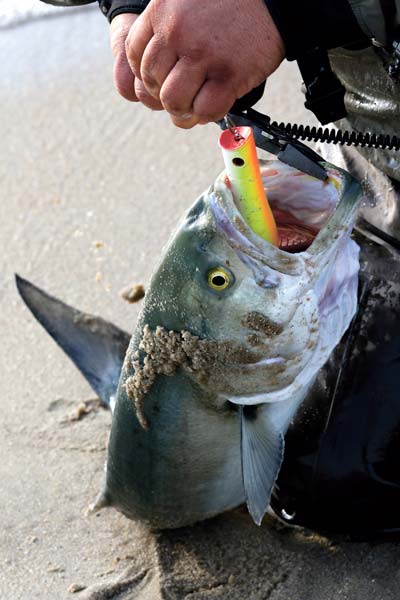
And when all else fails, enjoy the bluefish. These hard-fighting, aggressive predators are wonderful gamefish, and without them, surf-fishing would be a lot less exciting. Scale down your tackle, switch to some single hooks, and catch big fall-run bluefish until your arms are too tired to make another cast.
Great article. Never thought about bait being too big for Bluefish.
What I’ve heard is that at night, use dark lures. For instance, I purchased a deep purple darter and a black Danny for night fishing for bass. But the bass pic above is of a Daiwa SP minnow plug, which is quite colorful. I have a few of those as it my favorite bluefish lure. The holographic finish really flashes when the sunlight hits it and blues go for flashy things. But at night there is no sunlight to make it flash. Also the needlefish plug picture has an orange-red needlefish. Also a colorful plug imitating squid. Does this shoot a hole in the theory of “dark night/dark lures”?
Hahahahaha if you only new the truth.
Dark lures are the best lol
Baitfish don’t turn black or purple at night…. they remain primarily white or silver in color… take that how you will. The theory behind the dark lures on dark nights mindset is that a black lure will silhouette against a dark sky better than a light colored lure. Action and profile is more important than color anyway.
Some nights you want really dark lures some you want lighter colors and then some nights maybe a little flash is not a bad idea. Try different colors/patterns and sizes, sometimes larger at night is not the best… as an example this October the fish have been really picky at night and won’t respond to larger baits. So there is always room for experimenting. Try new things, Try old things a new way, ect, ect, ect. 🙂
It’s true that dark lures silhouette better against the dark sky at nightbut unless it’s pitch dark they aren’t needed.. many sharpies use bone and white at night also yellow is right in the middle of they’re color chart.. the bass’s lateral lines are so highly tuned that they can find a slow moving needlefish and they’re hearing is so good that they can hear the rattles in a SP minnow.. I love the tip about using larger lures at night.. already knew that the slower the retrieve the better..acually too slow is possible as I’ve heard it said that the lure should match the speed of the current.. not completely sure about that though because the only one I’ve ever heard say that was Alberto..
Yes while this was a interesting article, I was wondering what months you can fish for rock fish in Virginia? I know the limit is 2 person unless that has changed? Your answer would be greatly appreciated?
dec, jan, feb
Where do you go?
What’s a good place to cast in Long Island
Great article and great tips. I tend to prefer blue over stripers just for the work out but the dark colors and slow retrieves work every time for me. Switch out your sp minnow hooks to single circle hooks and that will alter the cadence. Makes night fishing less of a pain as well. I throw one ounce jigs around structure in the bay get the job done every time. Lately I’ve been getting bass staged behind columns and on gradual drop offs etc retrieving with the current. Tight lines everyone.
Love fishing love the magazine