

Cruise through any familiar harbor and you’ll recognize the same well-known boats resting on their moorings or lined up along the docks. Many of those names have become staples of Northeast marinas, passed down through generations of boaters. For many of us, those brand loyalties begin long before we ever buy a boat of our own — they start with family trips, conversations on the dock, and the boats we grow up admiring.
In my family, that experience has always been our annual trip to the New England Boat Show in Boston. My mom worked the show when I was growing up, and our visits were less about searching for a new boat than about seeing the latest gear, equipment, and upgrades from the brands we already knew.
When we attended the show in 2024 while searching for a new boat for our Cape Cod adventures, one familiar name stood out. We spent much of our time exploring the Blackfin models on display, a brand my father had admired since he was a kid.
“I remember talking about Blackfins with my father as a kid and admiring their reputation for being well built and dependable,” said Michael O’Brien, my dad. “It was the kind of boat you dreamed of owning someday.”
Years later, when Blackfin returned to the market, he followed the relaunch closely. “I remember reading a cover story when Blackfin came back,” he said. “I actually saved the magazine, because I thought maybe someday I’d own one.”
The brand name is what drew us in, but it was the redesigned boats’ features, versatility, and modern innovations that ultimately convinced us. After seeing the boats in person, we bought a 2021 Blackfin 222CC and named her Fins Up.

Our purchase was part of a broader trend across the boating industry: a brand many boaters remembered from decades ago was gaining recognition among a new generation. For longtime boaters like my dad, Blackfin was a name they hadn’t seen on the water in years. Now, after decades of relative absence, Blackfin is making a noticeable return to East Coast harbors.
Blackfin was founded in 1973 in Fort Lauderdale, Florida, a hotbed of offshore fishing and deep-sea angling culture. The company quickly built a reputation for producing some of the toughest offshore boats in America, and it soon expanded up the East Coast. Throughout the 1980s and ’90s, Blackfin developed an almost cult following among serious offshore fishermen. Blackfins were known for their deep-V hulls, which sliced through rough seas, and for rugged, overbuilt construction that prioritized offshore performance over luxury cruising.
Many Blackfins built in the ’70s and ’80s are still on the water today, a testament to the brand’s reputation for durability and craftsmanship. That reputation spread far beyond Florida. In New England, boaters like my dad came to know Blackfin as a brand built for people who valued quality over flash.
In the early 2000s, Blackfin struggled through industry downturns and ownership changes, and by the middle of the decade, the brand had largely faded from prominence while newer offshore fishing brands gained market share. In 2008, the owners of Monterey Boats purchased the Blackfin name. According to Monterey and Blackfin Boats Brand Manager René Moore, the company waited until 2017 to relaunch Blackfin because the owners wanted to make sure they “did it in a way that honored the legacy of the original brand and built a quality boat that people would still come to love.”
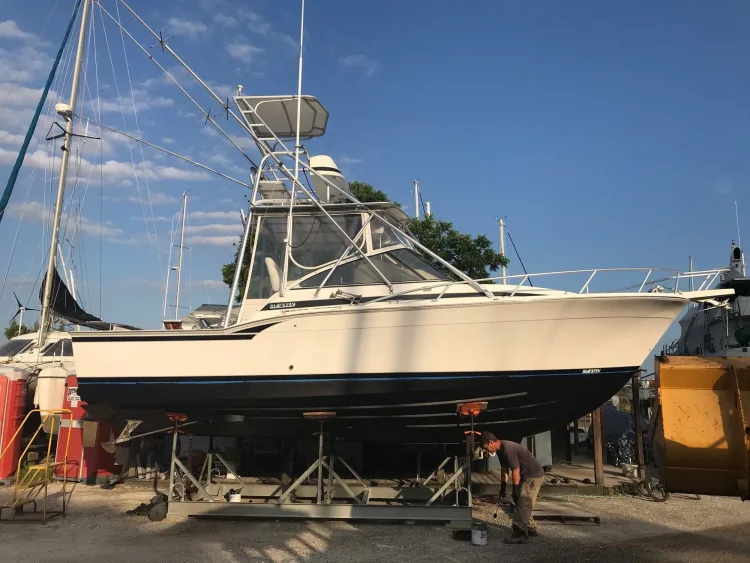
Instead of reviving the classic Blackfin style many New England boaters grew up with, Monterey redesigned the lineup from scratch while trying to preserve the brand’s reputation for toughness. The new Blackfins are modern center consoles built with carbon fiber reinforcement, modern electronics, larger outboard power, and family-friendly features alongside serious fishing capability. The boats look different from the classic Blackfins, but they still lean hard on the brand’s original reputation for strength.
That balance between honoring the past and embracing modern boating is exactly what appealed to my family. “The thing I liked about the new Blackfins is that they didn’t just bring back the name,” my dad said. “They kept the things that made the originals special. They’re still built with a purpose, but now they’re versatile enough for the many different ways families enjoy spending time on the water.”
At Bass River Marina, where we ultimately bought Fins Up, Sales Manager Troy Howard has watched firsthand how Blackfin’s reputation helped the brand return to a competitive market. “It’s very hard, especially on Cape Cod, to take on a brand-new name,” Howard said. “The marketing that goes into developing a new brand is five times more than developing a brand that already has a name out there.”
Blackfin’s history, he explained, gave both dealers and customers confidence in the relaunch. In New England, the name was already associated with high-quality offshore boats built to handle rough water, giving the new models a head start in a crowded market. Today’s Blackfins are different boats built under new ownership, Howard said, but the company successfully carried over the brand’s reputation for durability and premium construction, and the comeback has attracted longtime Blackfin admirers and new boaters alike.
Blackfin’s return happened during the center-console boom. In recent years, center consoles have become all-purpose family boats, day cruisers, and offshore entertainers, no longer viewed only as fishing platforms. Moore explained the appeal simply: “They buy the boat because they can fish it, and because it’s big enough to take their friends out fishing. It’s got amazing amenities. It’s got comfort, so if they’re going out a long way, they’ve got nice deep cushioned seats. Their wives are comfortable, their kids are comfortable, and they can feel safe taking their kids or grandkids on it, because it’s got very high gunwales. They don’t have to worry about somebody catching a fish and falling over.”
That versatility is exactly what drew my family to the boat. In a typical Cape Cod summer, our Blackfin might spend one day fishing, another cruising local harbors, and another making a quick trip over to Martha’s Vineyard.
Unlike many larger boat manufacturers, Blackfin’s owners stay closely involved in the design process. “The team is very diligent,” Moore said. “Not only do they listen to customers’ feedback, but when they come up with a design in a prototype, they’ll actually take it home and use it with their families. They’ll figure out: is that cup holder awkward? Is it hard for my dad to get on and off this boat? What adjustments could we make?” The engineering department tries to think of everything, she said. “That’s what sets us apart. We’re not just building a boat. We’re building something you’re going to keep.”

Today’s Blackfins occupy a spot somewhere between hardcore fishing boat and luxury center console. The quality that defined the originals has carried through the rebrand, and modern buyers are drawn to the boats’ versatility as much as the fact that they still look good on the dock. Blackfin remains a recognizable name to those who grew up with the originals, but the redesigned lineup appeals to a much broader audience than the brand once did. Today’s boats range in size from 22 to 40 feet, built for everyone from first-time offshore boaters to experienced anglers hunting a flagship vessel.
Rather than relying on nostalgia alone, Blackfin has found a way to connect two generations of boaters, and for my family, that connection between past and present is exactly what made the brand stand out. Owning a Blackfin meant becoming part of a tradition that started years before we ever stepped aboard one.
On many summer evenings, Fins Up sits on her mooring after another day on the water, having done exactly what we hoped she would: fishing in the morning, cruising in the afternoon, and carrying our family wherever we wanted to go. For my dad, finally owning a Blackfin fulfilled a dream that started decades ago, hanging around boats with his own father. For me, it’s the continuation of that tradition. A brand that once connected my dad to his childhood is now becoming part of my own family’s memories on the water.