

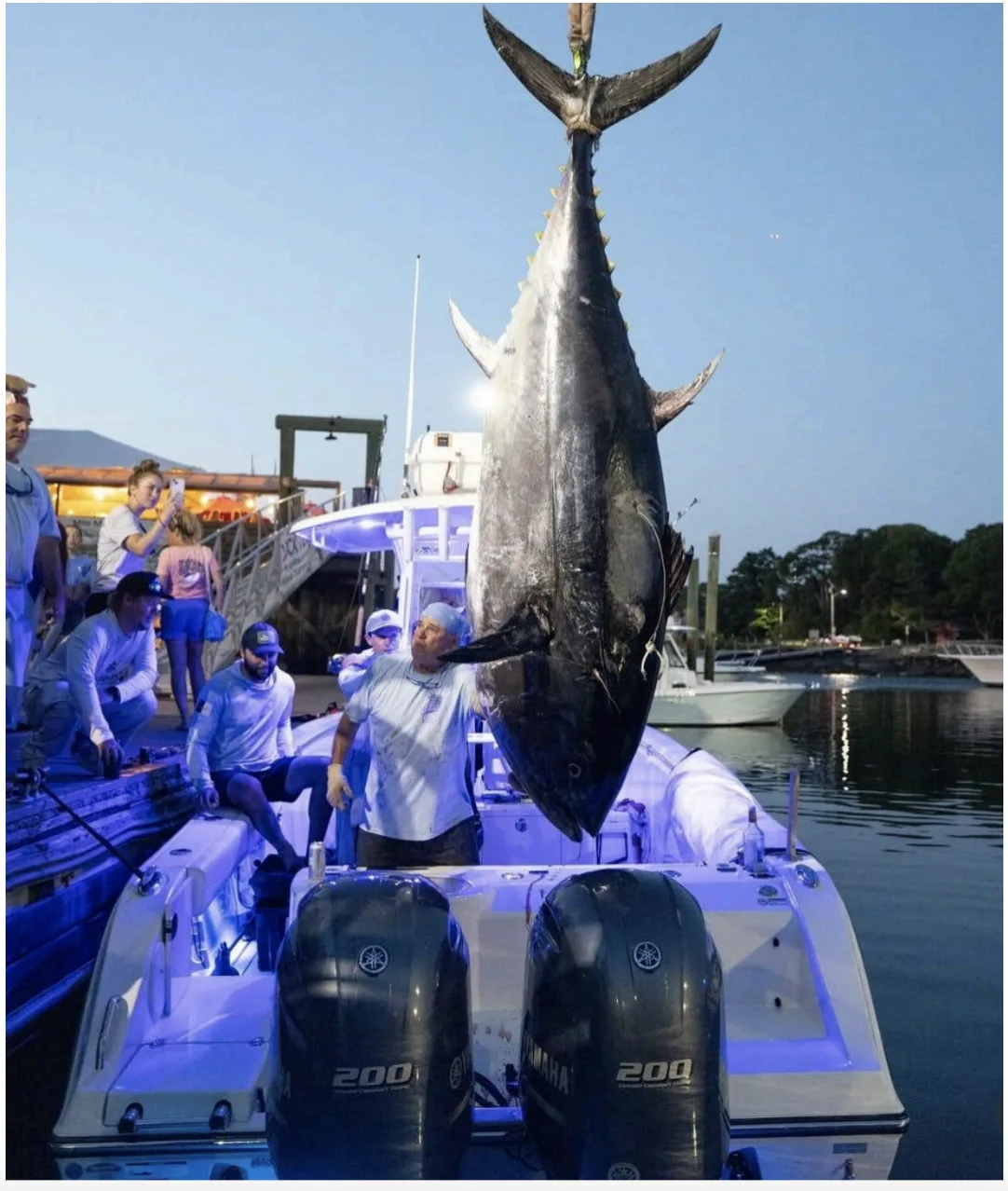
By the time the curtain closed on the 2025 Bluefin Blowout, only 19 giants had made it to the scales out of 117 boats. The Mass Bay bite had been unstable, fickle, borderline spiteful for weeks leading up to the event. But, somehow, the Charlestown crew aboard Jimmy Rig Charters—Eric Vargas, Tony Frascotti, and Chris Warner—threaded the needle, dragging a 728-pound bluefin all the way to the podium and $162,000 in winnings. What follows is not just their tale, but a testimony to how a small boat with a tight-knit crew can out-fish a fleet of sporties, Downeasts, and blue-water pros. It’s also a reminder that in giant bluefin fishing, especially when the odds are stacked against you, chemistry is just as important as coordinates.
95-MILE RUN, AND A CREW TO GO THE DISTANCE
Heading into the mid-July tournament week, lest we forget, the giant bite was unseasonably cold. Basically on ice. On a 20-something-foot center console out of Charlestown, running to intel half-baked in a far-flung place is usually a strategy frowned upon. You’re supposed to commit to a comfort area, or you stay home. But the Jimmy Rig crew had two things working in their favor: a network of truly fishy degenerates; a melting pot of commercial lobstermen, charter mates, and crafty weekend warriors. Also in their corner, an unshakable belief that if they could just get to the right zip code, they’d figure out the rest. The spot they settled on was 95 miles from their home port nestled within earshot of the Zakim Bridge. In a battle wagon, that’s strategy. In a small sled, it’s something closer to religion. There was no room for Plan B, and Plan C was to make sure Plan A worked. They watched the weather window loosen into something workable and stacked the well with the local bait they swore by.
“Never believe anyone who says bait is easy to get.” Rolling off the dock at 10 p.m. to meet tournament standards, they were met with a bright moon and glassy passage beyond Stone Ledge into Cape Cod Bay. And then Peaked Hill happened: a wall of fog thick enough to chew.
WET BUNKING, AND A BLOW TO MORALE
This is right around when a small center console stops being romantic and enters “type two” fun territory. Speaking of which, their bunking situation? Three $40 Target sleeping bags on a bare deck. Shockingly, those are not waterproof. Once the white-knuckled ride was over and lines were out, Captain Eric would take up residence in the lone dry spot under the T-top. Tradition is a well-maintained hierarchy, after all.
They set up their drift in the dark, the way small-boat crews have to: simple and deliberate. A floater was sent into the ether, and another bait was suspended at 12 fathoms. Two pogies soaking. A long night ahead, but they were getting down to business.
At 4 a.m., the down rod doubled over without warning. Captain Eric began to wind against resistance, still cocooned in his sleeping bag, only to discover he was tight to a six-foot porbeagle. Not an uncommon bait tax to pay in the darkness out east.
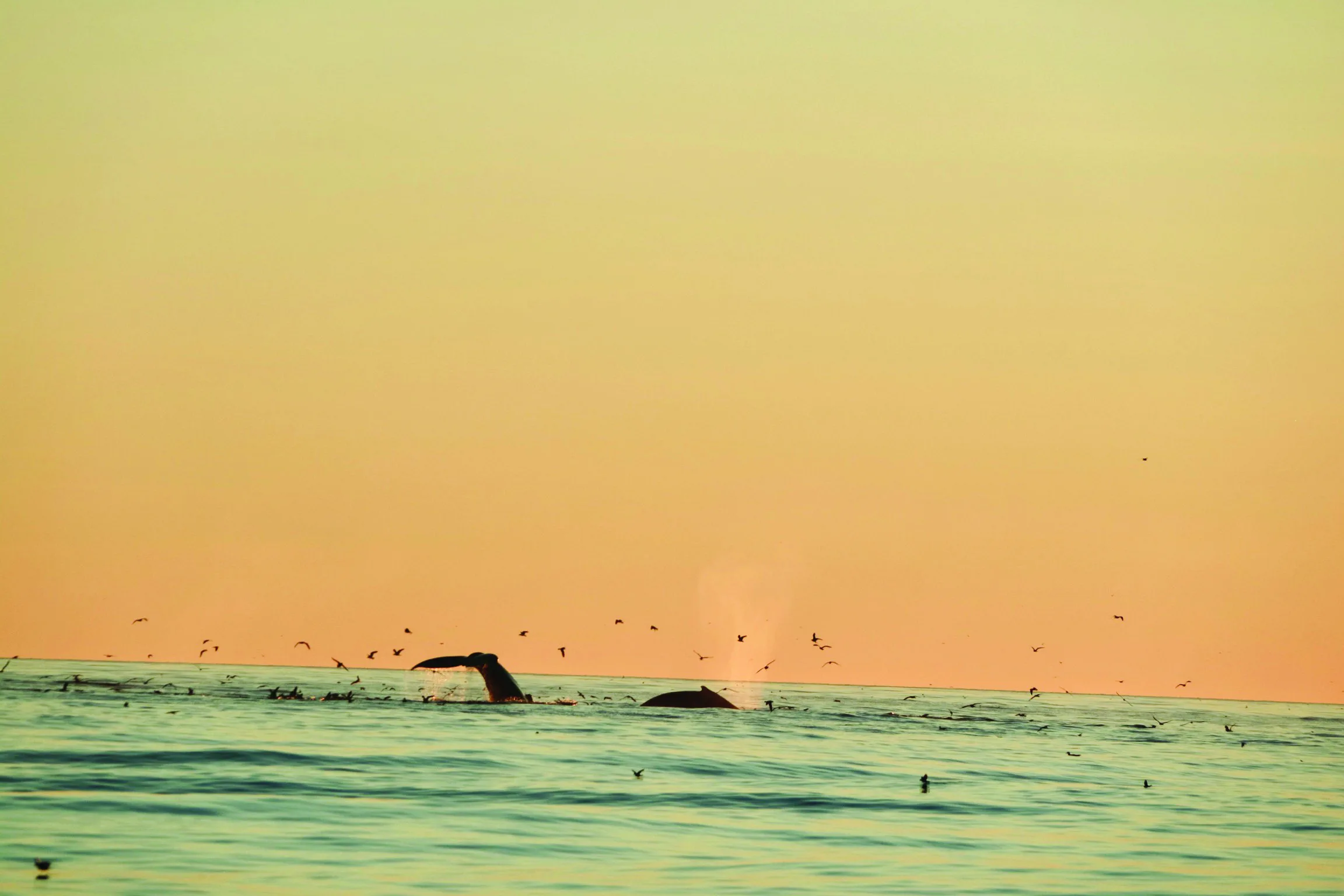
Slowly but surely, the world woke up around them in a symphony: humpbacks barking, chittering shearwater rafts sliding by, a minke surfacing and circling them like a curious retriever. Maybe it would be a show day.
Then came the first test of their mettle.
Just after 5:30 a.m., they marked a solid fish “screwed into the mud.” Eric jokingly said, “You gotta feed him,” dumped the down bait, cranked up twice, and the rod bowed in agreement. For two hours, the bluefin played its hand: black-backing, sounding, figure-eighting like a true “Crazy Ivan.” Finally, it chafed through the 150-pound leader, the rod tip snapping skyward, and the battle ended as unceremoniously as it began. The kind of loss that cracks something inside your ribs, sucking wind from your gut.
The shame bottle of Captain Morgan made its debut. Three pulls. Silence, but an absence of blame. Just about the only thing a crew can do when the wound is that fresh…get another hook in the damn water.
EGG WRAPS AND HORSE MACKS
With morale in a trough but discipline intact, the crew reset. Chris jigged up a string of horse macks. These were the thick-bodied, showy baits that were needed to stand out in a carpet of micro-fauna on bottom. They put one on a stick, one on the kite, and reset their pogies; one far and floating, another subsurface on a 12-ounce weight.
Breakfast wraps came next. Mission critical. Eggs and sausage on a Coleman grill swaying back and forth in the chop, a meal fit for salt-saturated maniacs running on fumes. Warm and savory, a wave of morale washed over the three as they waited in the blanketed light of dawn.
The next bite didn’t come until late morning, after a move back up their drift. Mike Murphy on Widowmaker had radioed that he’d just marked a good one. They slid a couple of miles west to give him space, a karmic gesture. As they passed another Charlestown vessel, All In, by the looks of it, they were already tight.
Then Eric let the down bait out: sixteen pulls of topshot out of his fingers before something ripped it away.
He locked up. The rod slowly loaded. The reel crackled to life.
On like Donkey Kong.
AND A GIANT THAT REFUSED TO DIE
The two-hour battle had almost every hallmark of another tournament heartbreak waiting to happen. The crew slowly worked the 130W up to 45 pounds of drag, and when they saw the tuna flash broadside for the first time, not a word passed the crew’s lips. Sometimes language gets in the way of the sublime.
The bluefin’s pinwheels were so wide that the decision was made to shut off and raise the engines. Every clockwise turn eclipsed both the starboard trim tab and bow anchor. A true Nantucket sleigh ride. In the heat of battle, All In gave the Jimmy Rig a scare, ghosting out of the fog with the tunes blaring, on a near collision course. To their credit, after a curt apology, the path to an endgame was finally clear
With their quartering fish within range, Eric launched a vicious shot, putting a harpoon neatly through both gill plates. But, even with a dart and main-line tether, the fish refused to quit, dumping 80 yards of basket- and main-line. Inch by inch, loop by hand loop, they fought the fish back into range on the reel and dart line, terrified of either one parting or pulling free.
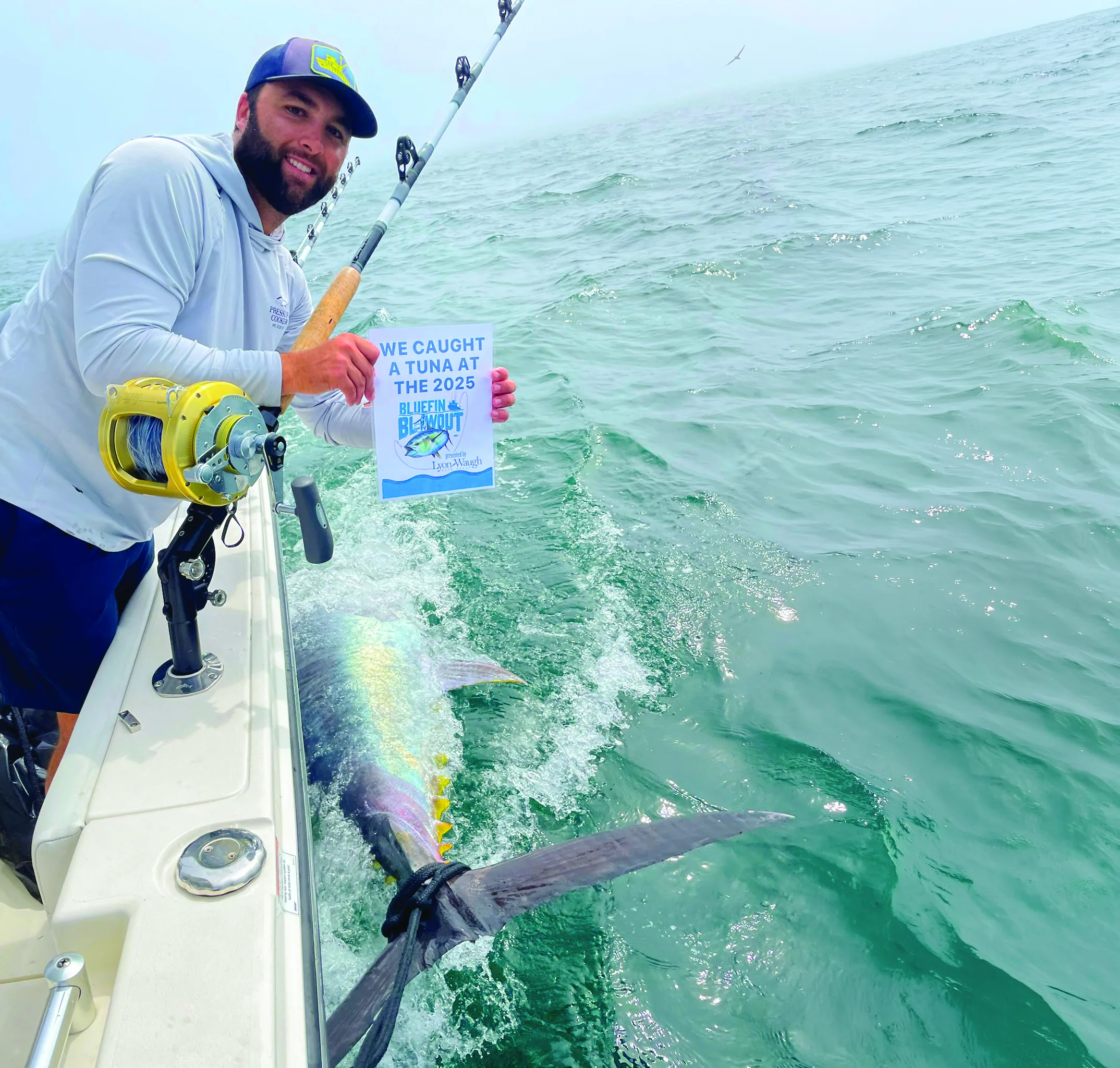
At a perilous moment close to the end of the tug-of-war, a rogue swell caused Tony to knock the reel briefly into free spool, creating a bird’s nest that would’ve sent lesser crews feral. Yet, calm prevailed. After a second dart to the spinal column, however, the fish finally gave in, sliding boat-side. Gaffed, exhausted, it was defeated through pure attrition.
LESSONS FROM THE RIG
When speaking with the crew after the champagne had gone flat and the big check was cut, the narrative threads of their victory began to unfurl, with the soundtrack of success a bit off the beaten path. They made a point to note that every trip offshore on the Jimmy Rig starts with “You’ll Never Beat the Irish” and ends—if the tail rope is secured—with “Tainted Love.” That’s consistency, in preparation and celebration.
In the end, the Jimmy Rig boys didn’t win because of a sneaky waypoint or a miracle bait or because the tuna gods finally threw them a bone. They overcame the odds because they lived a code—one built on superstition and the kind of quiet discipline that only comes from years of getting punched in the teeth from Jeffrey’s Ledge to Veatch Canyon. The shame bottle was, of course, symbolic of their stubbornness, a liquid sealant on their belief that the next bite would materialize.
Primarily, they committed to the long run.
Small boats don’t get to hedge. They don’t get a choice of multiple temperature breaks and a fallback plan somewhere inside cell range. When Eric pointed that bow, they were married to whatever waited on the other side. That commitment bought them something an uninterrupted flow of intel never will: continuous time in the right zip code.
Second, they brought their own bait.
“Easy bait” is the quietest lie in deck boots. Anyone who’s ever shook a sabiki stick for hours on end while the rest of the fleet roars off toward the grounds knows it. The crew rolled out with pogies, then doubled down by jigging macks at first light. That fat, shimmering pony turned out to be the difference-maker.
Third, they fished together, not like a yard sale of egos.
No yelling, no gorilla panic, no mid-endgame quarterback swap. Just three guys who knew exactly when to wind, when to clear, when to shut up, and when to get loud. That 150-pound leader that parted at grey light? Lesson learned. They bumped to 180 and never looked back. Unemotional clarity wins tournaments.
And finally, they assumed the next bite was the bite.
Most crews break after losing a tournament-class fish before sunrise. The Jimmy Rig’s didn’t. They swallowed the heartache, reset the drift, jigged fresh baits, and stayed in the life. The next bite was the winning bite, but only because they acted like it.
In the end, the Jimmy Rig didn’t beat 116 boats because they outgunned them. They beat them because they out-believed them and out-fished them in the simplest, truest sense of the word. A small boat, a long run, a giant fish, and a crew that embraced the proper way to rot.

(Originally Published as “How to Properly Rot” in the June 2026 Issue of On The Water Magazine)