
Originally Published in the July 2007 Issue of On The Water Magazine.
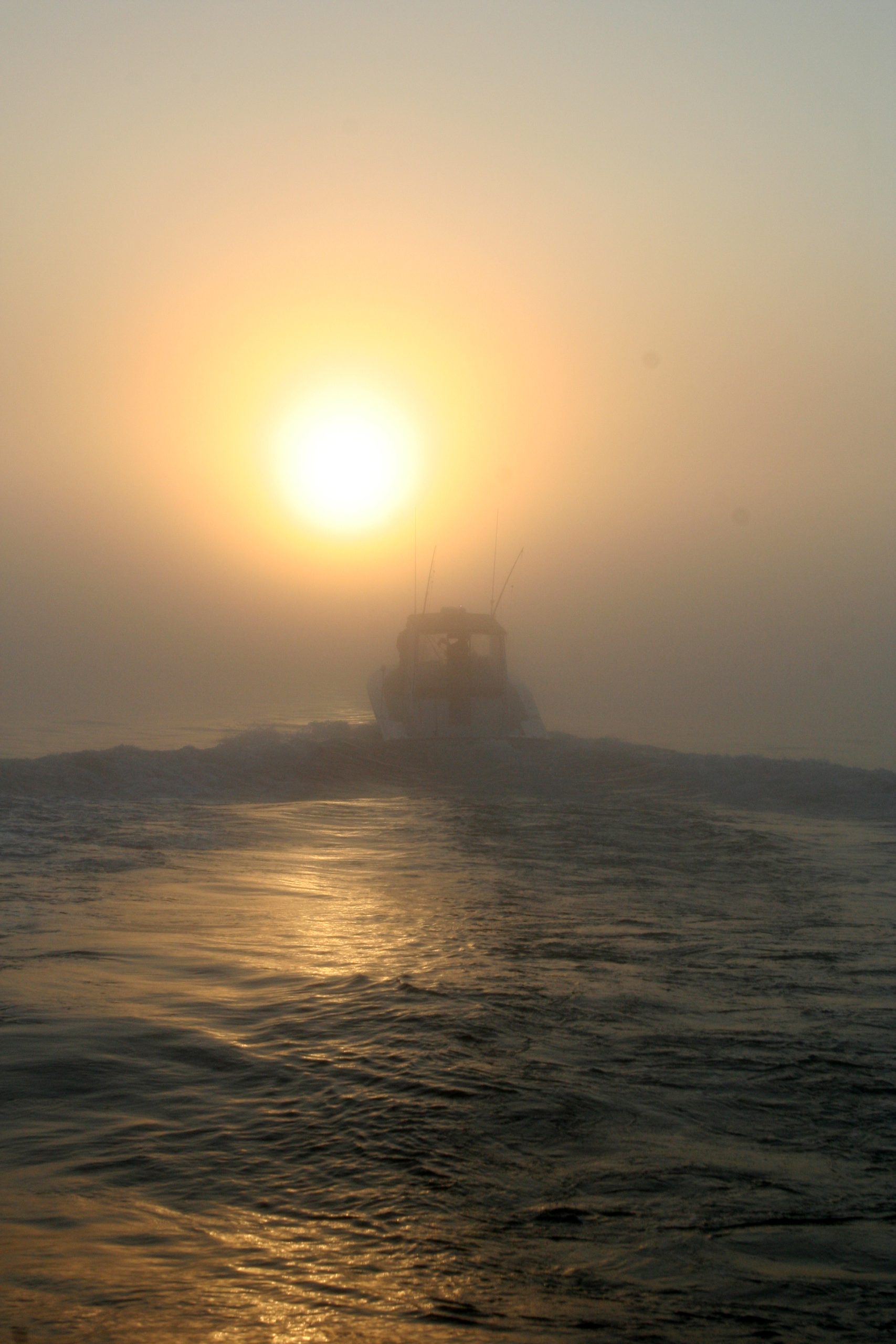
There is nothing more mysterious than the open ocean after dark. After the sun sets, the sea’s secrets are compounded by the night sky and our wandering imaginations. An already unfamiliar place becomes a shifting phantom of uncertainty and surprises, a fact that even the saltiest sea-goers do not take for granted.
Despite this unsettling notion, spending a night offshore along the New England coast is common practice for many diehard fishermen. Big fish often like an early breakfast, so it pays to be there ahead of time to help serve the buffet. When the giant bluefin tuna show in the Great South Channel far east of Nantucket, the offshore grounds become a parking lot for tuna boats after the sun goes down. When the night bite at the canyons heats up, this obscure, distant patch of deep blue sea can be dotted with spreader lights in no time.
Whether you’re actively fishing and deploying baits, or simply spending the night offshore to conserve fuel and gain an early start the next day, safety should be your first priority. There are ghosts out on the canyons of all shapes and sizes. This particular story is about a close encounter with such a ghost that took place one autumn night seven years ago in the Great South Channel.
It was a typical October trip on the Castafari, a long day spent on the water soaking baits with a scattered fleet of boats… waiting. The giant bluefin were there – we knew that for a fact. As the sun dissolved into the cold sea, tuna started rocketing out of the ocean all around us in pursuit of mackerel. We had been fishing since four a.m., and now, fourteen hours later, the fish decided to show. That’s tuna fishing! The tired fleet of over a hundred boats awoke from its dormant drifting with a succession of hook-ups that swept through like the wind. Puffs of smoke popped up all over the place as engines fired, crews shouted and boats catapulted into action, battling huge tuna. As our rods sat motionless in their holders, my mate Andre began questioning where our baits were positioned in the water column. Before I could snap back, one of my 130 outfits swung violently and started screaming.
Off we went into battle with our own big fish, yelling and screaming as if it were life and death, and loving every minute of it. The sun was gone, and all it left behind was a black sky, an even blacker ocean, and a bent rod. The massive fleet of boats surrounding us had faded away to flickering glitter in the cold mist. The fish, like most car-sized tuna, distanced itself from the boat and then settled down into the depths. Andre was on the rod and the rest of the crew, basically a bunch of greenhorns that had probably never seen a fish over 20 pounds, retired to the bridge deck with their jaws hanging open. I stayed at the helm, pawing at the range buttons on my radar and hoping to make some of the blips disappear. Instead they simply grew larger. Nobody likes a crowd when tuna fishing, especially in darkness while fighting a fish in what now appeared to be a heavy fog rolling in. I counted over twenty boats within a half-mile range on my radar screen, and most were moving.
As I scanned a few range settings, I soon realized we had an even bigger problem… a real blip on the radar screen. A freighter was bearing down on the massive fleet from just a couple miles away, and according to my plotter, the Castafari was smack in the middle of the shipping lane. A few captains chimed in on the VHF radio and reported that the big freighter was pointed on a course that lead directly into the west side of the fleet. It was bad enough that we were surrounded by a maze of circling boats helmed by nervous captains and shouting crews. It was even worse that a very large steel-hulled ship would soon be factored into the equation. Before I knew it, there were three other boats within yelling distance of the Castafari. My radar became a slow-motion game of Asteroids. I did everything I could to avoid the other boats, but the stubborn fish at the end of our line made it difficult. At one point, another boat came so close that I mistook its spreader lights for mine. Some “kind” words were exchanged with the other boat’s captain. I focused on the bent rod, the radar, and yelling at my mates. I’m pretty good at the last one. We continued to gain line on the fish and avoid contact with other boats. Eventually the only spreader lights I could see were my own. Things were going well until I glanced back at the radar and the screen reminded me of a much bigger problem. The freighter was less than a half-mile away and bearing down on us faster than I had anticipated. It was becoming a real concern. No matter what I did, the blip inched toward the center, and it was obvious that this ship had no intention of altering course. I could now barely perceive the ship’s massive silhouette creeping through the dark, sandwiched between two tiny red and green lights. It was heading right toward us.
The yelling stopped and the cockpit grew quiet. There was a haunting sound, one I had heard before and never liked. We all heard it, and could even feel it – the burly rumble of the huge ship’s engines turning deep within its hull. Judging from my radar, I estimated the freighter’s speed to be about 15 knots. I was amazed by this fact alone. I started hearing more chatter on the VHF radio about close calls and lost fish. Then I heard what sounded like angry Russian dialogue on channel 16. Andre continued his grudge match with the fish while we inched forward. I focused on the radar screen. The huge asteroid plowed into the “safe zone” confines of the quarter-mile range ring and pulsed its way toward the center – every captain’s worst nightmare. I took a closer look off the transom. The shadow was huge, and I began to see white water where its ghostly frame tore into the ocean. The speed of this ship was unnerving, and I came to a frightening realization. We had to move or simply disappear. The bent rod and fish were no longer the priority.
The ship started to flash a blazing, blinding white light. I knew right away it was Morse code. That’s when the horror set in. We were about to be run over by a freighter and crushed into the dark ocean. As the ship continued to bear down on us, I quickly informed everyone to hold on to something. I told Andre to glove the reel’s spool, open the drag, and dump line while maintaining pressure to avoid backlash. I throttled up, and we were on the run in a flash. The Castafari scurried across the dark ocean, and line melted from the reel’s spool. I looked up to see that the ship was still pointed directly at us. It didn’t flinch.
The Castafari raced at 15 knots. At least 400 yards of line had now been dumped from the spool, and the ship was still only a few hundred feet away! I turned hard to starboard to change the angle between the ship and us. A few long seconds passed before I realized we were finally out of its path. I pulled back the throttles and glanced toward the cockpit to see the rod still somewhat bent. The reel was nearly void of line, with maybe 50 yards remaining around the spool. We all looked up as the huge growling mass of iron passed across our stern with its glaring white eye still flashing at other boats in its path. The ship then sounded a merciless horn, a sound that resembled Godzilla’s roar just before a Tokyo invasion! It trampled over the piece of ocean where our fish appeared to be. The rod tip began to straighten. That fish is gone, I thought. Andre remained hunched over the reel, cranking desperately to absorb the slack. Then, another shrieking blast from the freighter. Boats dashed in different directions. The greenhorns on my bridge deck were quiet and still, mesmerized by the profanity now spouting from the VHF radio.
The ominous drone of the big ship’s engines thundered away. Its shadowy contour continued to stream by. Suddenly, the disturbed sea thrown aside by the bow of the freighter crept out of the dark and struck us. While the Castafari pitched, I looked up at the ship’s aft deck, which was like looking up at a Boston skyscraper. I saw what appeared to be crewmembers smoking cigarettes along the rail. I wondered if they had any inkling as to why we were out on the ocean during a cold, damp night in late October. I stopped wondering when Andre came tight on the fish. Miraculously, it had also escaped the ship’s wrath. The rod bounced into a full arc. Death cheated, we got back to our original priority. I glanced one last time at the passing ghost. It sounded another blast, and plowed forward through the cold mist and the north side of the fleet. I could no longer see the white water. Its rumbling growl was soon drowned out by the screaming reel in my boat. The ghost was someone else’s problem now.
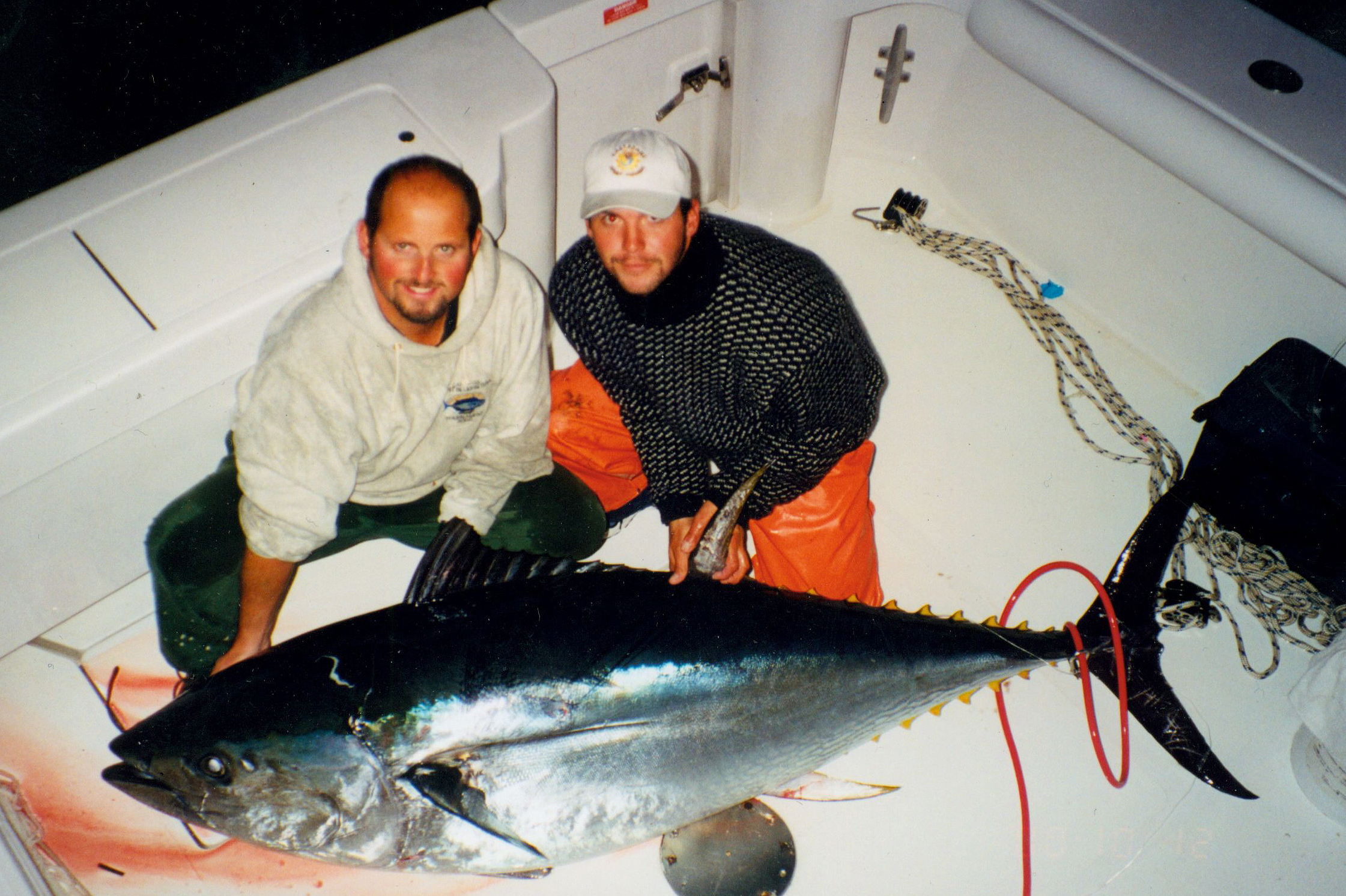
We caught the 400-pound bluefin tuna about twenty minutes later. It wasn’t a real corker like we had hoped, but it ended its days on the deck of the Castafari, and that was more than enough, given the circumstances. The fact that we caught that fish at all was nothing short of a miracle. Though I enjoy telling this story, it was one of the scariest experiences I have ever endured. There were a few seconds of true horror, something that I hope never to encounter again. It was a learning experience, one that taught me not to take things for granted out there, and that the offshore world at night is a place where you should expect the unexpected. Keep the radar and the coffee on.