

Flirt with the floor and catch big bronzebacks this season
It was a late-summer day, and my wife and I had just pulled up to a 25-foot mid-lake hump. I grabbed two combos from the rod locker, one rigged with a drop-shot sporting a 5-inch finesse worm, and the other with a football jig and 4-inch spider grub.
“Take your pick,” I said to my wife.
“You can have the drop-shot,” Sue said, reaching for the stick rigged with the green pumpkin plastic. “I’ve got a feeling about this one.”
She made a long cast with the bait. After it hit bottom, she slowly dragged it along the floor, scurrying and then stalling the jig.

While Sue was doing this, I was shaking the drop-shot rig along the hump’s ledge. Different vibrations revealed a mix of sand and rock. My focus was interrupted by the motion of my better half setting the hook. Soon enough, a chunky smallmouth broke the surface, reaching for the sky before splashing back down. She played it into the net, and we took a quick photo before releasing it.
We continued to experience a good bite drop-shotting and jigging the hump, catching a dozen or so fish before it was time to move on. For the rest of the morning, we used bottom-contact presentations in deep water and hooked several smallmouth bass between 2 and 4 pounds.
Down-Feeding, Bottom Dwellers
Smallmouth are often bottom-oriented because this is where a lot of their food lives. Crayfish are a popular menu item that live on the floor. Sculpins and various insect nymphs are also common foodstuffs. The invasive round goby, found in the Great Lakes and other waterbodies, is another significant type of bottom-dwelling prey.

When smallies are down-feeding, getting a bait on bottom is essential to catching them. This holds true from shallow to deep water. The following are bottom-contact tactics and some reliable locations to fish these rigs, beginning with shallow haunts.
Skinny-Water Behavior
Smallmouth are often bottom-oriented in shallow water. On many natural lakes and rivers, it’s common for them to inhabit skinny-water shoreline areas and flats in search of food.
Hot, sunny days are one scenario. The heat stimulates fish to move shallow. I’ve spent a lot of time sight-fishing smallmouth in clear water. Sometimes, big bass will guard a prime piece of structure, like a log or boulder, while sunbathing in the shallows. These fish are catchable with a well-placed cast from afar to avoid spooking them.
In other cases, bass are more mobile. I’ve watched smallmouth packs stalk and eat small crayfish from grass and sunken timber in less than 6 feet of water. They mosey along, cock sideways when they spot a target, then move in and slurp up the snack.
I’ve also watched smallmouth cruise back and forth along the edge on top of a shallow flat, and I’ve seen the same thing along a bottom transition, such as where sand changes to rock. These edges are hotspots, especially when found close to deeper water.
Shallow Tactics
Shallow-water smallmouth presentations are not a one-size-fits-all approach. Tactics are influenced by bass activity level, behavior and habitat. Here are a few good options.

When bass are territorial and holding on a specific spot, precision casts with finesse baits is a reliable approach. It also applies when sight-fishing cruising bass in clear water and on calm days. A drop-shot rigged with a 3- to 5-inch leech or finesse worm is a go-to presentation in my boat. A jig and grub or tube in the 3- to 4-inch range is also deadly. I fish these baits on 7-pound-test fluorocarbon.
Cast the bait beyond the target, and then dead-stick it. Smallmouth are in tune with their environment and will often explore the bait. If there isn’t a bite, I’ll work the bait along bottom toward the prime area, frequently pausing it. Juicing up baits with scent is always a good idea to help coax bites.
Windy weather creates different conditions. Sandbars, points and rocky shorelines are prime spots when washed with waves. Expect smallmouth to be active. Big, moving baits get the nod in these conditions. Hopping a jig or grinding a crankbait along bottom are two deadly tactics in the windy shallows.

Another scenario is when smallmouth are scattered on shallow sand flats. Here, I’ve found retrieving a jerkbait and hitting bottom is awesome for covering water and triggering reaction strikes.
Begin by reeling a moderate- to deep-running lure until it hits bottom. To increase running depth, I use thin-diameter, 15- to 20-pound braid as the mainline and a 15-pound, 24-inch fluorocarbon leader. Use a brisk, twitching retrieve. The jerkbait should move erratically and frequently bang bottom to kick up mud and silt. Done right, the lure mimics a baitfish fleeing for its life and riles up big bass. Add a brief pause now and then, but be sure to hold on—big bass often smash the jerkbait when you put on the brakes.
Finding the Best Mid-Depth Zones
Bottom-contact tactics are effective in mid-depth areas, provided smallmouth are relating to the bottom. On many days, focusing on 8 to 18 feet of water has served me well.
Here’s the catch: mid-depth areas can contain a lot of unproductive water. This is when side-scanning sonar is invaluable for pinpointing hotspots. (Truthfully, it can be effective at sniffing out prime smallmouth areas at any depth.) Use this sonar-scanning technology to locate bottom transitions, such as sand to rock. Secondary points (bars) are other good finds. A sand flat with sparse grass is also promising, especially when it contains isolated rock piles, boulder strips or sunken timber.

Pay attention to the depth of fish around these structures, confirming they’re bottom-oriented. This is important because if bass are suspended, a bottom-contact bait isn’t the best choice (see up-feeders sidebar). Mark waypoints on productive-looking areas and return with the following tactics.
Dragging, Grinding and Snapping Mid-Depths
Assuming the bottom’s fairly snag free, a drag-pause retrieve with a jig is a good first choice. The occasional hop off the floor isn’t a bad idea now and then to attract bass from a distance. A 4-inch tube jig or a football jig rigged with a creature or hula grub are excellent bottom-contact baits. Smoke, green pumpkin, root beer, and other natural colors work well.

All things being equal, I prefer a football combo when fishing an area with a mixed bottom. The exposed head transmits vibrations, and when these change from mud or sand to hard rock, it’s the cue that the bait’s in a productive zone. Pausing the jig at this point often triggers strikes from following smallmouth.
Another presentation is snapping a jig to replicate a panicking baitfish. For this approach, I’ll use a 1/4-ounce to 3/8-ounce jighead rigged with a 4- to 5-inch fluke or paddletail minnow. Equally good is a small bucktail jig, though several anglers I know use tubes for this approach.
Snapping a jig is pretty straightforward. Let it get to bottom, then use a short pop of the rod tip to cause the jig to jump off the floor. Next, leave the rod in the up position while the jig swings down—or, immediately lower the rod tip, reeling for a moment, then let the jig fall. The bass will tell you what they like best. Once the bait hits bottom, pause for a moment to give smallmouth an easy target. Then, repeat the snap-glide/swim sequence.
At times, smallmouth are more susceptible to snap-jigging over dragging tactics. Another reality is that snapping results in less bottom contact, which can reduce hang-ups in snaggy terrain. I fish jigs on a 7-foot spinning rod spooled with 8-pound-test fluorocarbon or 15-pound-test braid with 8-pound-test fluorocarbon leader.
Banging crankbaits and jerkbaits along bottom as noted above also works in mid-depth areas, though a friend of mine has an ace up his sleeve. He slowly grinds a big willow-leaf spinnerbait on bottom. The first time he told me about it, he got my attention because I often employ this tactic for bottom-hugging pike and muskie. I asked for more details on his method.
“Cast the spinnerbait out, let it get to bottom, and then slowly reel it on bottom so it stumbles along, hitting sand and rocks,” he said. “I know, you were expecting a little more, but it’s that straightforward. It doesn’t always work, but when other tactics aren’t catching fish, this spinnerbait trick has put me in the money in a couple tournaments.”
Give this method a try if you haven’t already. It’s darn effective at fooling big, pressured bass.
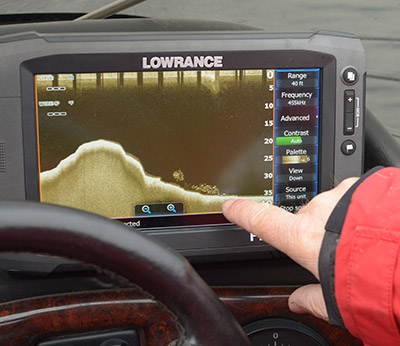
When shad, smelt, and other pelagic baitfish are abundant, populations of smallmouth will suspend around this food source. These bass will display on sonar as large arcs around baitfish. When this occurs, it’s time for horizontally tracking hardbaits, like spinnerbaits and jerkbaits, or slow-falling finesse offerings, such as wacky-rigged stickbaits.Rough Floors:
Bottom contact can quickly dull hook points. Be diligent and sharpen points frequently with a hook file. Rough rocks and mussels can also wreak havoc on fishing line. Use fluorocarbon for its abrasion resistance, and the fact that it is nearly invisible underwater. Still, check regularly for nicks and cuts.
Deep Zones
Structure starting at 20 feet is considered deep in my boat. Humps, reefs, bars, and saddles are prime smallmouth territory, though steep drop-offs and river-channel edges are also good. Flats are smallie hangouts, too, at times. Expect bass to relate to some sort of edge, as noted earlier. Again, the value of side-scanning sonar cannot be overstated for locating prime water, spot-on-the-spot gems, and determining whether smallmouth are suspended or relating to bottom.
Vertical And Horizontal Options
Jigging spoons are often sidelined by anglers until fall, but these lures are adept at catching deep summer smallmouth. It’s a vertical-jigging approach, but to cover water, I keep the boat moving using river current or the trolling motor. The result is a jigging spoon jumping off bottom and fluttering down while simultaneously moving horizontally.
The nuts and bolts of this approach is a snap-fall-pause sequence. Sometimes, I’ll use a double-snap to raise the bait. One key factor is following the spoon down with the rod tip while maintaining semi-slack line to feel a strike.
Letting the spoon regularly hit bottom is also critical. On rock, this creates a ticking sound that calls in fish; on sand, the impact and follow-up jig stroke creates a silt cloud that attracts bass. Shaking the spoon slightly after the pause is often the tipping point for bass and regularly evokes a hit. A 7-foot, medium-power, fast-action casting rod and 12-pound-test fluorocarbon is recommended for this style of jigging.
Another reliable deep-water tactic is dragging a Carolina rig. While casting certainly works, many anglers I know are slow-drifting or “strolling” these rigs to keep them in the strike zone longer. Deep flats, interconnected structures, and large secondary points are all prime locations to drag a Carolina rig for smallmouth.
My friend and competitive angler, David Chong, regularly strolls a Carolina rig on many lakes. He likes it because it’s unpopular, which means smallmouth don’t see it regularly, making it a good choice on heavily-fished lakes. Chong uses a Texas-rigged 4- to 5-inch plastic, and the size of offset hook used is determined by bait size. Good picks include a tube, stickbait, crayfish, creature, or goby imitation. A typical rig consists of a 1/4- to 3/4-ounce bullet sinker, a bead, and an 18- to 24-inch, 14-pound Sunline Structure FC fluorocarbon leader. His mainline is 30-pound braid.
Something Chong is adamant about is using an Ultra Tungsten weight, which produces a higher-pitched sound than lead when it hits bottom. This is a sound many bass have yet to get used to, so he believes it gives him an edge over other anglers dragging lead or brass weights.
In addition to spoons and Carolina rigging, a drop-shot rig, along with the jig tactics described above, are reliable methods for dissecting deep areas. Increase weight to maintain bottom contact.
When smallmouth are eating their dinners off the floor, it’s tough to beat bottom-contact tactics. Try these methods this season and you’ll pull plenty of bronzebacks up from the ground floor.
Great info. Ty. I’ve only been on the river 3 times for tourneys. Do you do any guide servicing on there? Would be interested in learning more about it.
Thank you. Randy