

Is Dave Lamoureux crazy? It’s tough to come up with another way to describe someone who willingly paddles into notoriously dangerous seas in a 12-foot plastic kayak with the goal of tethering himself to a 400-pound bluefin tuna that will make every attempt to drag him out to sea. So, I spoke to Lamoureux this winter and as he described his relentless pursuit, a few other words came to mind: extreme, pioneering, gutsy… then he told me about the great white sharks.
Big-game kayak fishing has grown from a lunatic fringe to a legitimate segment of the kayak-fishing community. Around the globe, paddlers regularly target big tarpon, amberjacks, halibut, sailfish and yellowfin tuna from their plastic crafts. But, for a number of reasons, catching a North Atlantic bluefin tuna from a kayak remains a frontier of big-game kayak fishing.
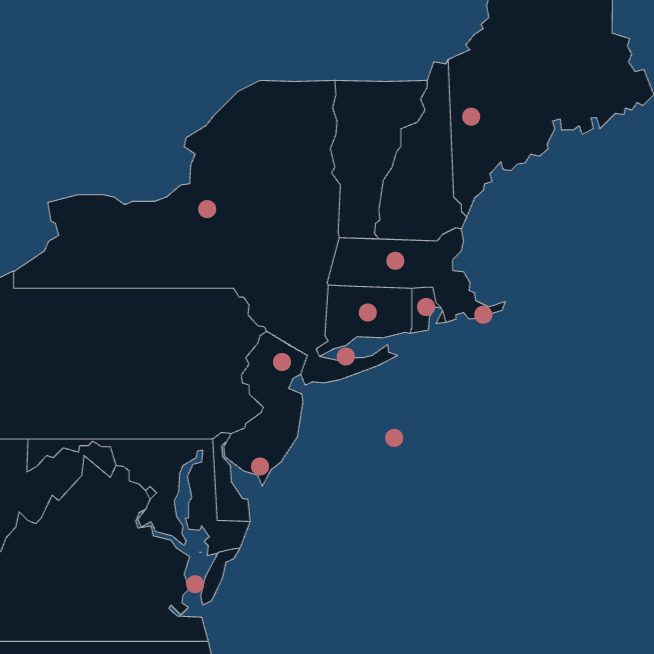
There are a few places in New England where bluefin tuna occasionally cruise within a mile or two of the shoreline, close enough to spark wintertime BS sessions among kayak anglers about the feasibility of tanging with one—off Cape Ann on the North Shore of Massachusetts, in the deep water of Cape Cod Bay not far off Plymouth, and occasionally at the entrance to Narragansett Bay off Point Judith, Rhode Island. Of course, another area that consistently holds bluefin tuna within sight of shoreline is the stretch from Race Point at the tip of the Cape down along its backside to Chatham. But those waters have obvious deterrents to kayak fishing—there’s the swift tidal current, the swell rolling in from offshore, the pervasive fog banks, the traffic from commercial and recreational boats of all sizes, the massive whales and huge numbers of 400-pound gray seals. And then there are the sharks. Not just pesky blue sharks, but 14-foot-plus great whites, returning every summer to prowl the Outer Cape beaches to make meals of those 400-pound seals.

So, let’s say that you’re a kayak fisherman tempted to meet the challenge of catching a bluefin tuna from your kayak, ideally a school-size fish in the 40- to 60-pound range that has ventured close to shore in an area relatively safe for kayaking. The first barrier to catching a bluefin tuna from a kayak is a regulatory one: to even target bluefin tuna, you must have a federal Highly Migratory Species permit from the National Marine Fisheries Service for your vessel. To get a permit, your vessel must have a state registration, which is usually issued by the state department of motor vehicles. Most states don’t have a process for registering a non-powered kayak, and the DMV (or RMV, as it’s known in Massachusetts) isn’t known for its flexibility or customer service. Forget about “mothershipping” your kayak aboard a permitted powerboat and launching it once you’ve reached the tuna grounds. The regulations state that a bluefin tuna fisherman must go out under his own power, fish under his own power, and return under his own power.
While it makes for good tackle shop talk, it’s a lot of effort just so you can paddle around for hours and hope to cross paths with a notoriously fickle bluefin tuna, which unpredictably appear and disappear from one day to the next. It’s frustrating enough for fishermen in center consoles with twin 250s, never mind a poor soul with a plastic paddle. Of course, there is that one area off the backside of the Cape, where most recreational and commercial tuna fishermen go, where tuna of all sizes can be found with some regularity, but… no. That’s crazy talk.

Originally from the Boston area, Dave Lamoureux had been working as a portfolio manager and derivatives trader on both the trading floors of the Chicago Mercantile Exchange and Chicago Board of Trade when he started spending time at his parents’ summer house on Cape Cod. That’s where, in 2009 at the age of 41, he began talking to local fishermen and tackle-counter regulars about his crazy idea to try to catch a bluefin tuna from a kayak. “They all thought I was nuts,” says Lamoureux. “That’s what they told me.”
He wasn’t the typical kayak fisherman who wanted to push his sport to the next level—he was a thrill seeker and big-game fisherman who enjoyed chartering offshore boats while on vacation, strapping into a fighting chair aboard a 30-foot sportfisherman, battling billfish and tuna. He looked at a kayak and saw the fighting chair without the big boat. “If there was a way to get hooked up with a tuna from a kayak,” explains Lamoureux, “I could have a purer big-game experience of angler versus fish.”
Lamoureux borrowed a 12-foot Heritage Featherlight sit-inside kayak—not even a fishing kayak—from the garage of his parents’ home. Realizing that taking a kayak out into the turbulent waters off Race Point would be dangerous, and familiar with the concept of risk from his time working as a trader, he decided to proceed slowly. He took a number of trips to check out the area, get a feel for the current and the tides, and stayed close to shore, fishing for stripers and blues. On some days, he’d see the tuna fleet gathered a couple of miles offshore on Peaked Hill Bar; when conditions were favorable, he paddled closer.

One day, he approached the tuna fleet after a day of trolling for bluefish, a Yo-Zuri Crystal Minnow dragging behind his kayak. A tuna smashed the lure, the drag on his bass and bluefish outfit screamed, and line flew off the spool for a few seconds before the connection parted. From that point on, Lamoureux was targeting tuna.
To consistently target bluefin tuna from his kayak, however, required overcoming a series of challenges and hurdles. “Every time I figured out one step in the process, there was another obstacle,” says Lamoureux. “I quickly found that I couldn’t possibly pull the spreader bars most of the tuna fishermen use—they acted like a sea anchor behind the kayak. I tried smaller bars and daisy chains, but they were still too tough to troll.” Back at the Goose Hummock shop in Orleans, he found a solution at the bait counter: ballyhoo.
There was still some trial and error. Before he could get up to trolling speed, shearwaters would dive from the sky and tear into the expensive baits, so he had to experiment with different weighted rigging solutions. The next issue was achieving the speed necessary to get the ballyhoo to attract tuna strikes. Paddling with the current was the only way to get a consistent troll speed over 3 knots.
Then, Lamoureux started hooking tuna, and another set of challenges began. “The first tuna I hooked solidly almost spooled me,” says Lamoureux. “It was a new experience, and I was scared to tighten the drag. I was thinking – Is this fish going to pull me to France?” He was nearly to the end of the 80-pound-test line on his Shimano Stella spinning reel when the hook pulled. Another lesson on drag setting was delivered by a tuna that claimed a complete spinning outfit when it struck so hard that it tore the rod holder off the deck of the kayak.

Another issue, one that Lamoureux has no control over, is that bluefin tuna can weigh up to (and over) 1,000 pounds. Lamoureux realizes now that one of the first few fish he hooked was probably in the “giant” category, at least 250 pounds. “When that fish hit, it pulled my stern underwater,” says Lamoureux. “I got the rod in my hands, spun around to face the fish, and saw that I was losing line incredibly fast. I tried to use my hand on the reel spool to add extra drag, and it was like an accelerator—as I applied the brake to the reel, the kayak accelerated, and the bow actually threw up a wall of spray at eye level. As I clamped down on the drag, the kayak actually started to plane out!”
Lamoureux says that he never got a single crank on that fish, but he learned some good lessons in how to fight a tuna from a kayak.
“First, I had to figure out how to ride it,” says Lamoureux, referring to the early portion of the fight when the bluefin tows him on a Nantucket sleigh ride—a term used by Nantucket whalers to describe what occurs immediately following the harpooning of a whale. “Then I had to learn how to actually fight it, using the rod and reel to bring it up to the kayak.”
The final lesson to learn was how to deal with a live bluefin tuna boatside—a dangerous proposition when your boat is a 12-foot sit-inside kayak that rides just six inches above the water. Eventually, he designed a custom system for subduing a bluefin tuna to tow it back to shore. He has plans to begin selling the customized gear he uses, including a titanium swim hook/harpoon and titanium rods and reels, under the name Fortitude Fishing (fortitudefishing.com).
The first tuna Lamoureux brought to shore was a 60-pounder, then an 80-pounder, and then a short time later, he managed a 157-pounder that earned him the world record for the largest tuna of any species ever caught unassisted from a kayak. That catch landed him in national news and led to a mixed response from the fishing community; some praised his pioneering spirit and marveled at his catch, while others called him crazy—a disaster waiting to happen—and worried that he could inspire others to emulate his dangerous pursuit.
Lamoureux says that he feels safe and describes what he does as measured risk. He obsessively monitors the weather and sea conditions, and brings in the kayak a full suite of safety gear including a GPS, VHF radio, cell phone, compass, fog horn, emergency knives, a lifejacket, flares, whistle, mirror and a set of dive fins—in case he has to swim to shore. “I don’t ever want to rely on anyone to rescue me,” says Lamoureux. “That would be irresponsible.”
So, what about the sharks?
 Aware that he’d be paddling through waters known to be frequented by great white sharks, Lamoureux decided to assess the risk. He researched shark attacks, and learned that if he encountered a great white shark, he should act like a boat, not like a seal: paddle slowly, calmly and mechanically in a straight line away from shore (seals will flee toward shallow water when chased by a shark). He spoke with well-known shark scientist, Dr. Greg Skomal. (Skomal’s opinion on Lamoureux’s pursuit: “I wouldn’t do it.”) He decided that if he landed a tuna he wouldn’t lash it to the kayak, but would drag it on a line held in his hand and draped over his shoulder. If a shark was attracted to the bleeding fish, he could release the line and escape.
While he hasn’t had a shark claim one of his fish yet, he once returned to the beach at Race Point in Provincetown and was greeted by a couple of park rangers who said they had watched a large shark, that they believed was a great white, zigzagging behind him and slowly closing the gap as he made his way in.
The first time Lamoureux encountered a great white, he was paddling off Truro and saw something jump clear out of the water. Assuming it was a big tuna, he started paddling toward it. The next time it jumped, he realized it was a seal, then he noticed the huge pressure wave behind it and the tip of a dorsal fin. From a safe distance, he watched the shark give chase and then made his way to shore.
Must-See Video: Dave Lamoureux Paddles Through Leaping Giant Bluefin Tuna

The next encounter was far more harrowing. In the very early morning, just at first light, Lamoureux pushed off the beach on a flat-calm day and was only ¾ of a mile offshore he spotted some commotion off his bow. Thinking it was a seal, he stopped paddling and was coasting toward it when he realize–at about 30 yards away–that he was looking at the head of a great white shark, which had surfaced with a seal clenched in its jaws. About five feet to the left, the shark’s dorsal fin began rising out of the water; about another seven feet to the left of the dorsal appeared the shark’s tail.
“The fins kept rising together, and suddenly the full body broke the surface of the water,” recounts Lamoureux. “Just as I realized exactly what I was looking at, the shark thrashed violently, and the sheer force—the volume of water it moved—was awe-inspiring.
“Being that close to a great white shark, there is no ‘National Geographic’ moment. There is nothing cool about it. It is the oddest fear ever … it’s primeval fear, it’s this weird fear you’ve never had before, from the pit of your stomach, of getting eaten by something, and you have zero control. Before that encounter, I thought, ‘If I get approached by a shark, I’m going to hit him with a paddle,’ but that day I understood I was never going to fend one of those things off.”
Video: Dave Lamoureux Hooks Giant Bluefin Tuna In Kayak

Lamoureux says that it was the one time he turned and went back to shore without fishing. “I got back to within knee-deep water and jumped out of the kayak and practically ran to shore. I didn’t go back out for two weeks after that. It was an incredible experience, but I don’t ever want to repeat it.”
Now, when the shark reports are at their peak in mid-summer, he takes some time off from kayak fishing.
Does Lamoureux ever wonder if he is crazy to keep chasing bluefin tuna from a kayak? Does he ever wonder if maybe it’s time to give it up?
“Oh, all the time,” laughed Lamoureux. But, it’s the grueling routine more than the dangers of the sea that have him considering calling it quits. Each outing requires about seven hours of preparation and cleanup and then three hours of paddling for less than two hours actually spent fishing.
“I’m forty-five, and I have to drag all my equipment over the dunes at the beginning and end of every day. The average day is fifteen miles of paddling, and that’s if I don’t catch a tuna. It’s an incredible amount of work. Then there are those hot days with no wind, no fish, and I ask myself, ‘Is it worth it?’ But every summer, I’m itching to get out there. And then a tuna hits, and the reel screams, and the whole kayak pulls back, and the back end submerges. At that moment, I laugh, recalling all those times I considered quitting and think, ‘No way, this is the best thing in the world.’”