

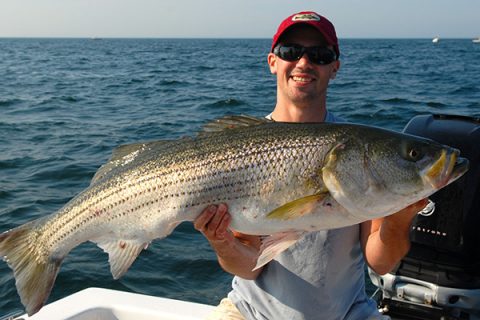
Pictured: Most of the striped bass schooled up in the area will be in the 26- to 36-inch range, but there are certainly some trophy-sized fish mixed in as well.
The striper bite off the Outer Cape heats up in the summertime.
In most of New England, hot weather can slow down the bass fishing in July and August, particularly during daytime hours. At the same time, rising water temperatures push a large percentage of big, “keeper-size” bass to the north and farther offshore to deeper, cooler waters. Several years ago, bass used to take up summer residence in inshore areas such as Buzzards Bay and Vineyard Sound, and striped bass fishermen, including commercial fishermen, could consistently catch them in the months of July and August. That fishing is much less reliable now, perhaps due to warmer inshore waters, a shift in baitfish patterns, or a change in the striper population – or perhaps a combination of these and other factors.
When inshore options for catching keeper-sized striped bass in Massachusetts waters dwindle in the height of the summer, there remains one area off Cape Cod that has become a very popular bass fishing destination. The Outer Cape has been a popular summer fishery for local fishermen for many years, and now anglers from across New England are trailering to the area for its reliable striper fishing.
The water on the backside of the Cape attracts many stripers in the height of summer because of its cooler water temperatures and abundant bait, mostly in the form of massive schools of sand eels. The influence of the open Atlantic Ocean, which is responsible for the cool, bait-rich waters, can produce rough seas and a tricky swell at times, but most boaters will be able to find plenty of suitable weather days. There are several ramps in the area for trailered boats and a number of charter boats operate out of Orleans, Chatham and Harwich. Depending on your preferred fishing style, there are many ways to connect with summertime stripers on the Outer Cape, from light-tackle casting and fly-fishing for surface-feeding fish, to vertical jigging and trolling. Often, the anglers who do the best are the ones who are flexible in their techniques and can adjust to the behavior of the fish.
First Light
When fishing the Outer Cape on a boat, it is worth the early wakeup to arrive by first light. Start looking in areas close to the shore, watching for signs of bass pushing bait in shallow water. Keep an eye out for stripers splashing on the surface and watch for swirls, dimpling bait that look like raindrops, and any congregations of seabirds. Most often, the birds will lead you to the fish and provide an indication as to which direction the school is heading. Often these surface-feeding bass will be skittish, so try to quietly slip ahead of the school and let the fish come to you – or drift down toward them.
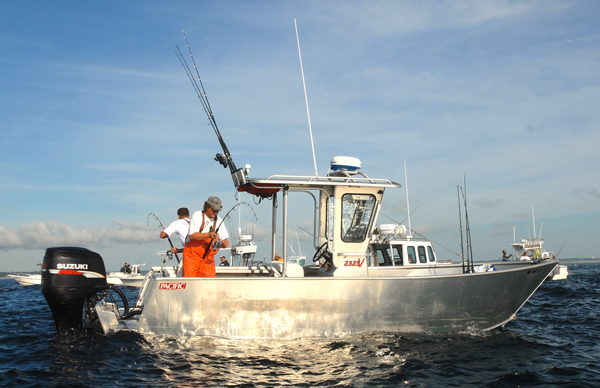

At first light, striped bass will often respond very aggressively to topwater presentations. Soft-plastic stickbaits can be very effective, but you should switch to hard-bodied plugs if bluefish are in the mix. Poppers, spook-style lures, and swimmers will all produce exciting strikes when the fish are feeding. Once the sun breaks the horizon, the fish will usually retreat into deeper water, making it necessary to change your technique.
Going Vertical
Vertical jigging can be one of the most fun and productive ways to catch striped bass and bluefish on the Outer Cape. While jigging for fish that have gone deep used to mean heavy gear and jigs that took a lot of the fun out of the fight, new lightweight jigging rods and braid-friendly reels make vertical jigging exciting and enjoyable. The ideal rod for this style of fishing is one rated for 30- to 50-pound braided line with a medium to fast action (and it should have some flex through the middle of the rod, not just the tip). Having the right rod and reel combo can make a huge difference when vertical jigging. On my conventional setups, I use a Release SG reel, and on my spinning setups, a Quantum Cabo 60. Both are spooled with 60-pound-test Gamma braided line.

-photo by Captain Mel True
Vertical jigging works best when the tide is moving – this concentrates the fish into schools and make them more aggressive. I start by looking for birds, which will indicate the presence of bait, and then I cover as much ground as possible while keeping my eyes on the electronics. Almost any area will hold fish on a given day, but some locations seem to be more consistent. Most of the fish taken by vertical jigging will be holding in 35 to 60 feet of water. A popular area where I recommend looking is just outside of the “new cut” off Chatham Beach. Most fishermen never venture more than a few miles from this area and are able to find all the fish they want. Nauset Beach is also a great area to check out. I’d suggest working the water between these two locations when fishing out of the Chatham area. Once the vertical bite heats up, you will be able to easily tell where the schools of feeding bass are located by the tightly packed boats.
Vertical Jigs

There are three vertical jig styles that have worked well for me when fishing the Outer Cape. The predominant baitfish is the sand eel, so using a lure that imitates its size, shape and color makes sense. When vertical jigging, I tend to work only the bottom quarter of the water column. This is where you will find the biggest bass; staying deep can also help you avoid hooking the bluefish that will prowl closer to the surface. To fish through the tide cycle, bring a selection of metal jigs ranging in weight from 1.5 to 5 ounces.
With any of the metal jigs, a green tube trailer is highly recommended. For some reason, striped bass in the Outer Cape area seem to respond well to the action of a tube trailer, and green is far and away the most popular color among anglers.
Vertical jigging is almost always best when the tidal current is moving fast. When it slows, it’s time to explore other options in order to keep catching.
Trolling Wire
When the tide starts to slow, you’ll often notice on your electronics that the fish are no longer ranging and feeding throughout the lower half of the water column. Instead, the fish will hang tight to the bottom and suddenly show little interest in metal jigs. When this happens, I know it is time to deploy the wire-line rods. On my boat, we “pull wire” in the same locations we vertical jig–it’s just a matter of adjusting our method to keep the fish hitting. My wire rods are by Slater Mills and are designed to take the specific abuse of fishing wire line. You’ll also need a heavy-duty conventional reel to hold the wire line.
Pulling wire on the Outer Cape is done very differently than in other places I have fished in New England. Off Chatham, we deploy enough wire line to tap the sandy bottom. The rod is then fished from the rod holder by grabbing the wire line with a gloved hand and manually jigging the lure. There is a steep learning curve to this method, but as soon as you get the hang of it you’ll find that it is an invaluable technique for putting finicky fish in the boat. And, the force of a big bass slamming a jig at the end of a wire line while you are holding the line in your hand is a thrill that every fisherman needs to experience at least once.
When trolling wire line off Chatham, go with lead-head jigs in 3- to 5-ounce sizes, keeping in mind that the color and type of jig can often play a big role in your success. Look for bucktail lures that are specifically designed for wire-line jigging to tackle these waters.
If your arms get tired pulling a lead-head, another option is to troll a tube-and-worm rig. This is a hands-free technique, allowing the angler to grab a quick bite to eat or just a chance to relax. Once the tube is tipped with a big, fat sea worm, it is as easy as dragging it along the bottom, slow and low. I also fish another locally-made tube by Jay Jigs which has a spinner at the front of the lure. The spinner causes a vibration that you can feel all the way to the rod. It attracts fish, but it also lets me know that the lure is running true and not fouled by weeds.
The most effective way to fish the summer striper bite off Chatham is to be prepared to fish with a variety of methods, and having the correct gear onboard is half the battle. The other half might be how well you work with the rest of the fleet. Good fishing can attract a large number of boats to an area, and when different captains are using different techniques, it becomes necessary to work together. For example, if you see a bunch of boats trolling wire, don’t attempt to set up and vertical jig in the middle of them. Be respectful of the other fishermen and if you’re new to the area, keep your eyes open and go with the flow. When the fish are biting, there’s usually plenty of room for everyone.