
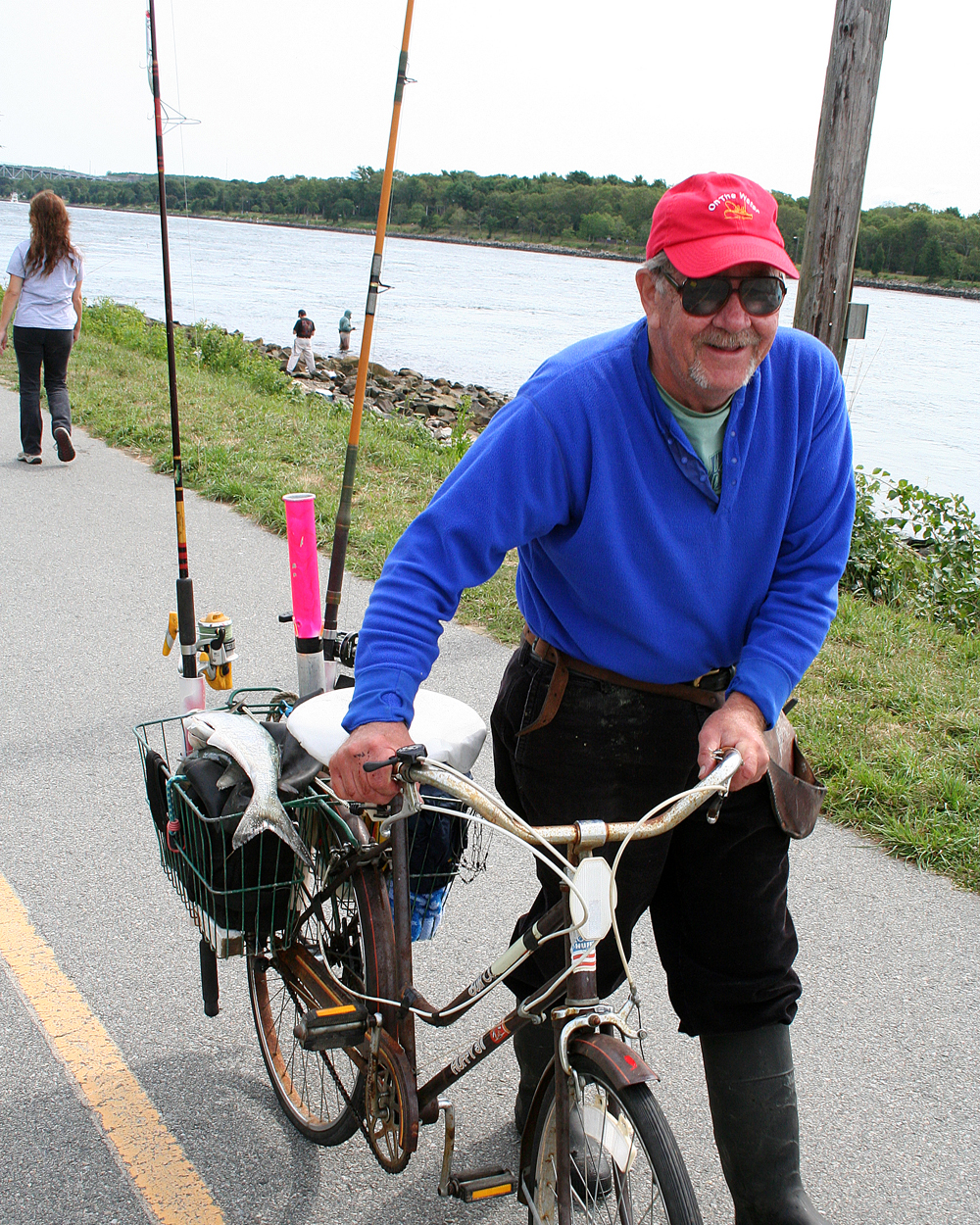
This week, the Massachusetts fishing community lost a legend. Carl Johansen, “Angler #1” believed that fishing saved his life, and spent a lifetime sharing his passion and knowledge with other anglers. He was especially well known around the Cape Cod Canal, which he began fishing in the 1940s. In the following story, originally published in the October 2006 Issue of On The Water Magazine, Carl recalls one of his most memorable blitzes. – Jimmy Fee
In my 60 years of fishing the Cape Cod Canal, I have never taken my experiences for granted. Sometimes the fish gods offer up remarkable events for my pleasure, which makes me love and respect the Big Ditch even more. These old eyes have seen the glory days when the majority of the bass caught by experienced Canal anglers were in the 20- to 30-pound range. It was always a sight to behold – the spring run of herring, squid, whiting and mackerel being chased out of the water by hordes of large bass. This will always remain locked away in my memory.
Changes along the way were not always for the better. We saw the decline of the bass population and then the rebound. Over the years we have witnessed a radically diminished bait resource, due to both manmade and natural causes. Big baits in abundance result in larger bass making up a greater percentage of the population. Today, small bait makes up the majority of the diet for bass of all sizes, and we have to wonder if the larger forage items will ever recover and how this will affect future generations of fish and fishermen.
One thing that hasn’t changed is that anglers who seek striped bass and are willing to accept the challenge of fishing an area that doesn’t reveal its secrets easily still flock to the shores of the Canal. The faces have changed over the years, although there are still a few of the Old Guard left. My experiences have taught me that the Ditch will challenge you every time. Keeping your options open and learning all the ways a large fish can be caught from these waters will make you a better fisherman regardless of where you spend your time pursuing the mighty striper.
On October 12, 2005, a very memorable event took place. Those who were there took part in an experience that will go down in the annals of Cape Cod Canal fishing and be forever imprinted in the minds of those fishing, especially the younger fishermen among us. For others, and myself, the dawning of that event began some two days earlier as we stalked the elusive striped bass along the water’s edge near the West End of the Canal.
The bass had pushed sea herring into the East End and all the way down to the Maritime Academy. There were some quality bass in the school, but it lacked big numbers. When the current turned east the sea herring were chased back into the Ditch by bass coming in from Buzzards Bay. Those who fished the current change with topwater plugs took good numbers of these breaking fish and those using soft-plastic shads did well targeting fish that were deeper. Metal also played a role, as did jigs on the bottom. The activity was of short duration in an area, but those on bikes were able to stay with the breaking fish all the way to the Herring Run. Everyone landed many quality fish as the bass pushed the bait out into Cape Cod Bay. For two days this pattern would repeat itself as the current turned west. The bait would be driven into the Canal by feeding bass all the way down to the Maritime Academy where they would run into another school of bass that would chase them back into the Ditch when the current turned east.
On October 12, 2005, natural events came together to break this cycle. The previous evening the wind started to pick up from the east and grew in force until a wall of water was created in the East End when tide and wind collided. I believe this cauldron was too much for the sea herring to get through and back out into Cape Cod Bay.
On that fateful morning of the 12th, I was waiting along with others on the low-lying outcroppings on the mainland side near the Railroad Bridge, as we had been doing for the previous two days. If one paid attention to the water, you could see the bait starting to school as the bass were herding the herring for an attack. Then it happened! Wave after wave of marauding bass attacked the bait. The bass ranged in size from small keepers to cows well over 40 pounds. Everyone casting a plug or a jig had either a fish on or a strike as the water came alive with swirling and feeding bass. The feeding activity spread from one side of the Canal to the other.
As this was my first opportunity to test my back after falling off a ladder in June, I was apprehensive about whether I would be up to the challenge of multiple hookups with large fish. The previous two days of fishing did not affect my back, but this was a whole different happening. Even though I was able to put a cast on the breaking fish running in the middle I was unable to hook up, so I switched to a bucktail jig. Judging by fish I saw being caught around me, I surmised that the larger fish were picking up the scraps provided by the smaller bass, which were on top in a feeding frenzy. I cast once and before I could take the slack out I had a large fish running with the jig. I tightened and had a good, solid hook up. It would take several minutes of a really satisfying battle with a large fish in the 30-pound range before I was able to slide the fish onto the rocks. As I fought my fish there were stripers well over 40 pounds chasing bait at my feet and coming almost out of the water. All the rods around me were bent over with fish, some small, some large. I unhooked my fish, grabbed a little air and made another cast. Again, a fish was on before I could get the slack out. It was at least as big as the first one with a large, full body that showed it was living high off the hog. The larger fish were definitely beneath the ones on top. I was physically spent after battling and landing over 60 pounds of fish in two consecutive casts. It became very clear that I had to stop fishing as my back was in some pain from my ladder fall.
With the help of my good friend Paul Foley, I was able to make it back to the truck with my fish and gear. I was forced to leave, knowing that I still needed to fillet my catch to put away for the long winter months. Each time we had some for supper it would be a reminder of that day.
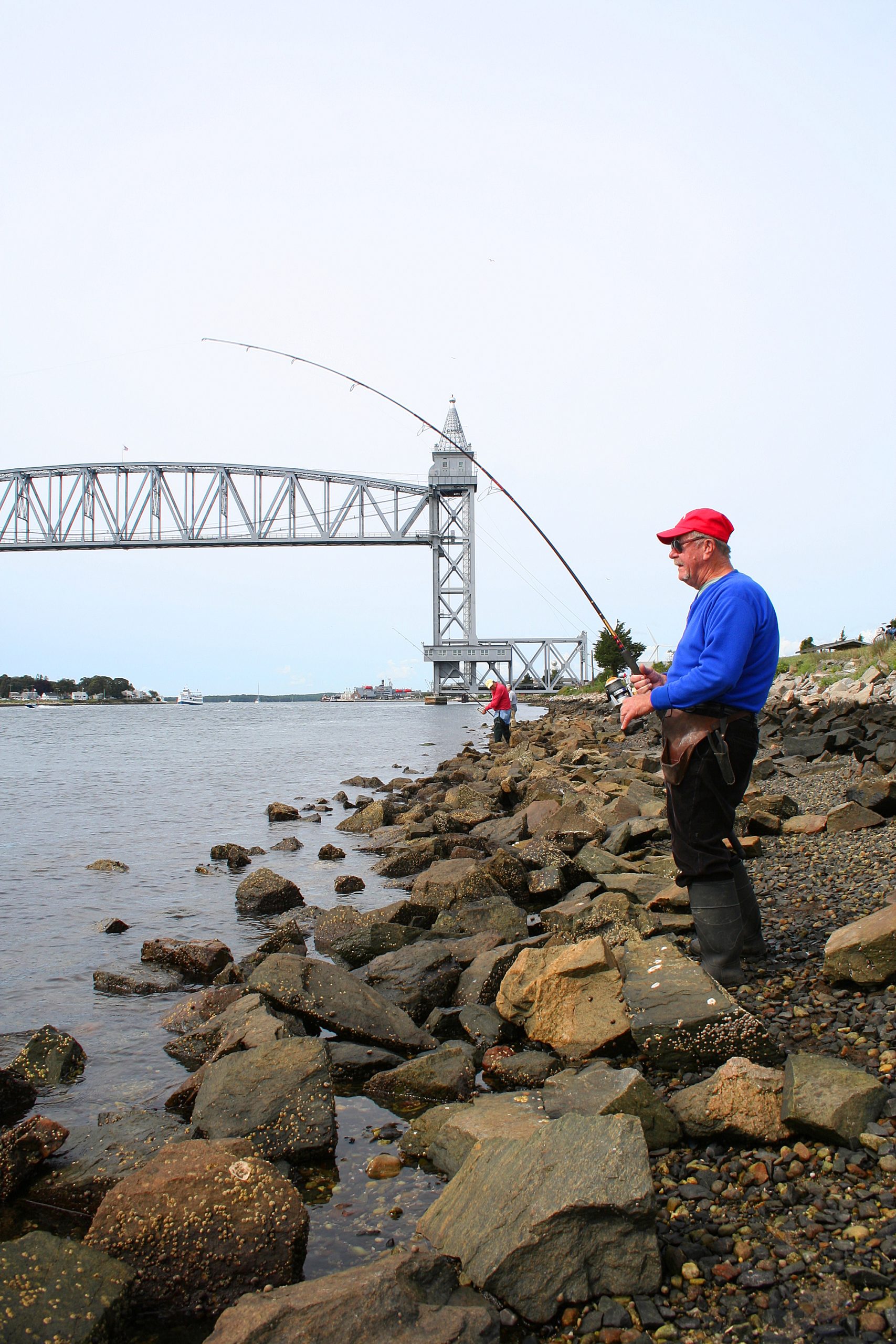
Many of my fellow fishermen followed the feeding bass to the East End where conditions and fish came together for an experience striper anglers dream about. The action was nonstop until early evening when the current dispersed both the herring and gorged bass. But before it ended the wind and current kept the sea herring from escaping into open water, easy prey for countless striped bass as they engaged in one of the longest and largest blitzes witnessed in over 30 years inside the Cape Cod Canal.
I spoke to many anglers in the days that followed and their accounts were amazing as to the numbers and size of fish caught. Several fishermen from Alaska had been staying at the Bourne Scenic Park. Using light freshwater gear, they caught and landed many keepers of more than 30 pounds at the Dolphins. One fisherman even placed a live herring on the plug he was using to nail a mid-30-pound bass.
Many I spoke with caught and released over 25 keepers of good size up to 35 pounds each. One of the top fish weighed in was caught by Bob Lubold from Sandwich and topped off at 38-plus pounds. It was caught on the Cape side at the East End. The fish took top honors in the Stan Gibbs Fishermen’s Classic, a local Canal tournament among hardcore Canal rats. Numerous bass in the mid-30-pound range were also weighed in at the local shops.
To old hands and novices alike, the joy of participating in such an event was overwhelming and will never be forgotten. By the time the action stopped both sides of the Big Ditch from the Sagamore Bridge to the East End jetties were lined with happy fishermen.
It has come to be known by those who took part as the Columbus Day Massacre of October 12, 2005 along the banks of the Cape Cod Canal. Will this happen again this year? Who knows? If weather conditions are similar and there is big bait around, it certainly could. If it does, be ready for an experience that will change your life as a fisherman.