The sunrise cast a cold, gray light over Cape May as Captain Rob Taylor sat heron-still, eyes focused, waiting to draw his prey into the open. Across the table, Anthony (Cheech) DeiCicchi, sensing the trap, folded his cards and retreated, like a wary blackfish returning to the safety of the wreck. A fierce wind rattled the windows of our Airbnb as Rob dragged the chips toward him. Somewhere offshore, the tog fed unbothered.
Booking a winter tog trip off southern New Jersey is a bit of a gamble itself. The best captains fill out their calendars up to a year in advance, leaving anglers praying for months that the weather on their chosen dates will allow them to fish. These invocations are driven by the knowledge that the biggest blackfish in the world are caught between southern New Jersey and Virginia during the winter. The milder temperatures, longer growing seasons, and lighter fishing pressure at the distant offshore structures help Mid-Atlantic tog attain record-breaking sizes.
Our own prayers seemed to have gone unheard. The two days of tog fishing booked with Captain Tom Daffin the previous June promised wind and snow. The odds of a full day on the water were slim; still, we drove to Cape May. I suppose there are worse ways to spend a winter day than drinking, playing cards, and telling fish stories.
Mike Kim and I, having already surrendered the last of our chips, retired to our rooms while Anthony and Rob debated whether to keep playing or split the pot. Hours later, we met Daffin for lunch at a dockside watering hole, where we picked through several servings of steamed local clams and mussels, mopping up the drippings with hunks of fresh-baked bread. Amid the stories, the shellfish, and a third round of drinks, we almost forgot that we were supposed to be fishing. During a lull in the conversation, Daffin said that despite the big snowstorm moving in overnight, the wind and seas should be calm enough to fish in the morning. This wouldn’t give us enough time to reach his deep-water spots, the ones where Daffin’s crews have caught double digits of double-digit tog, but we’d at least be able to sneak in some fishing.
Captain Tom Daffin has seen more 20-pound-plus tog than most other charter captains combined. He broke the ice on this snow day tog trip with the first keeper of the morning.
I felt a twinge of disappointment at the news. Tautog are slow-growing homebodies. When a big fish gets pulled off a structure, it may take years for another to take its place. That’s why, when the weather allows, Daffin prefers to take the Fishin’ Fever 20 or 30 miles offshore, beyond the range most anglers are willing to travel for blackfish. Out there, they see far fewer hooks; therefore, they have a better chance of growing to trophy size. However, for winter fishing, you must play the cards you’re dealt, and given the choice between folding and fishing inshore, the answer was easy. Plus, Mike knew firsthand that this plan didn’t rule out the possibility of seeing a whopper.
Mike had booked Daffin for the final day of New Jersey’s spring tog season on April 30, 2024. He’d hoped to get offshore to an area where Frank LaMorte had caught the former state-record tog while fishing with Daffin in April 2015. The weather prevented the long run, however, forcing a pivot to Cape May Reef.
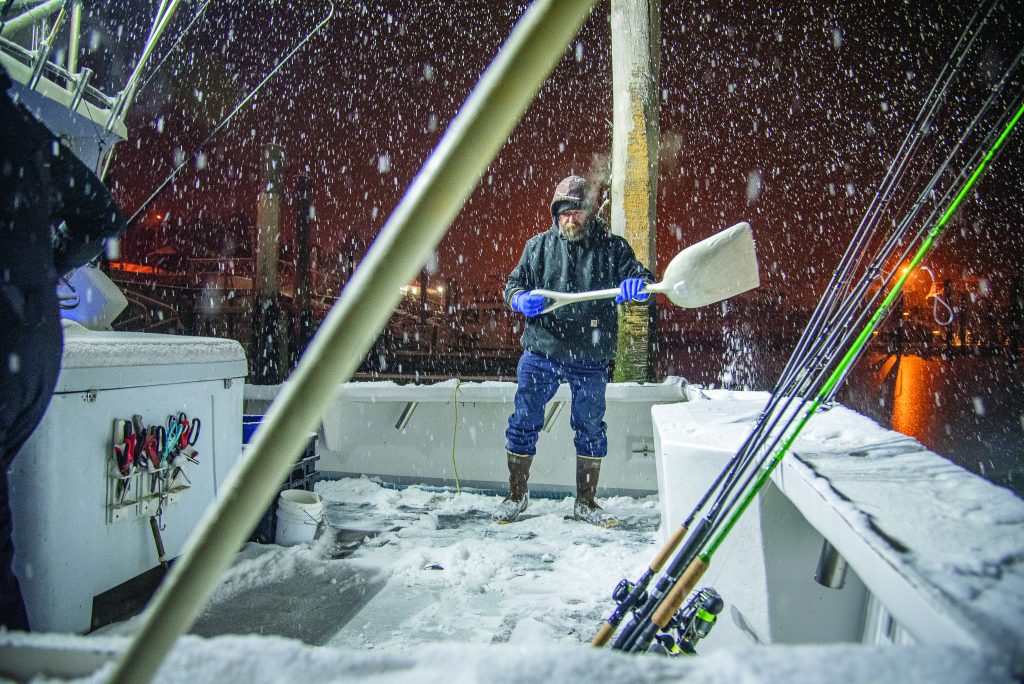
Captain Tom Daffin shovels off the deck before throwing off the lines.
Charter captains began sinking structure off Cape May in efforts to improve the local bottom fishing as far back as the 1930s. In the 1980s, the New Jersey Department of Environmental Protection took over the artificial reef building and continued to add structure to the area 9 miles off Cape May Inlet. Today, with hundreds of reef balls, shipwrecks, subway cars, and tanks spread over 5½ square miles, the Cape May Reef is the largest in New Jersey, with plenty of space and structure for tog to grow big and old.
Nevertheless, Mike adjusted his expectations and the goal of the trip in 2024 from a trophy tog hunt to a cooler-filling mission. The crew enjoyed a laid-back day of sifting through shorts for keepers until a serious tog crashed the party.
Mike fishes with relatively light tackle to effectively present jigs to the tog. His reel, a Shimano Stella 3000, was spooled with 15-pound-test braided line and fitted with a 30-pound-test leader. For context, Daffin’s crews often fished 65- to 80-pound test when targeting big tog, and they still regularly lost fish.Mike’s rod, a 7’2” heavy-action Jigging World Night Ranger, bent to the grip as that tog took line at will. Eventually, he steered it toward the boat, and Daffin slipped the net under the fish. At 21 pounds, it was the biggest tog that Tom had ever seen so close to shore.
Mike Kim’s tog tackle looks lightweight, but he’s used it to land blackfish of more than 20-pounds.
The story of Mike’s catch in 2024 loomed large in our Airbnb that night as we rigged our rods in front of Sunday Night Football. I had to redo my braid-to-leader connection three times, as my fingers fumbled the FG knot every time I imagined it being tested by a 20-pound tog.
There was no poker game that night.As we slept, four inches of snow fell over Cape May County. It continued to snow through our pitstop at Wawa and showed no signs of slowing down as we boarded the boat. The wind, mercifully, had abated, and while the heavy snowfall limited visibility, the seas remained calm. Upon breaking the inlet, the disappointment I’d felt the previous day was gone. I was eastbound on a snow-covered boat with two captains who had three state-record blackfish between them—inshore or offshore, I liked our odds.
New Englanders and New Yorkers don’t know what they’re missing when it comes to pre-trip convenience store stops. Rob Taylor, Anthony DeiCicchi, and Mike Kim fuel up on Wawa Sizzlis before heading out onto the snowy ocean.
In addition to the former 25-pound state-record tog caught aboard the Fishin’ Fever in 2015, Daffin guided Chris Sullivan to the current New Jersey record, a 25-pound, 13-ounce blackfish, on a late-December trip five years later. And, just a few months before our trip, Vinny Simms, Jr., raised the bar on the Rhode Island tog record: a 22-pound, 5-ouncer while fishing with Rob Taylor aboard his Reel E-Z. Add in Mike’s 20-pounder, and that’s a boatload of toggin’ talent. Cheech and I, both of whom had never caught a double-digit tog, would have to provide the comic relief.
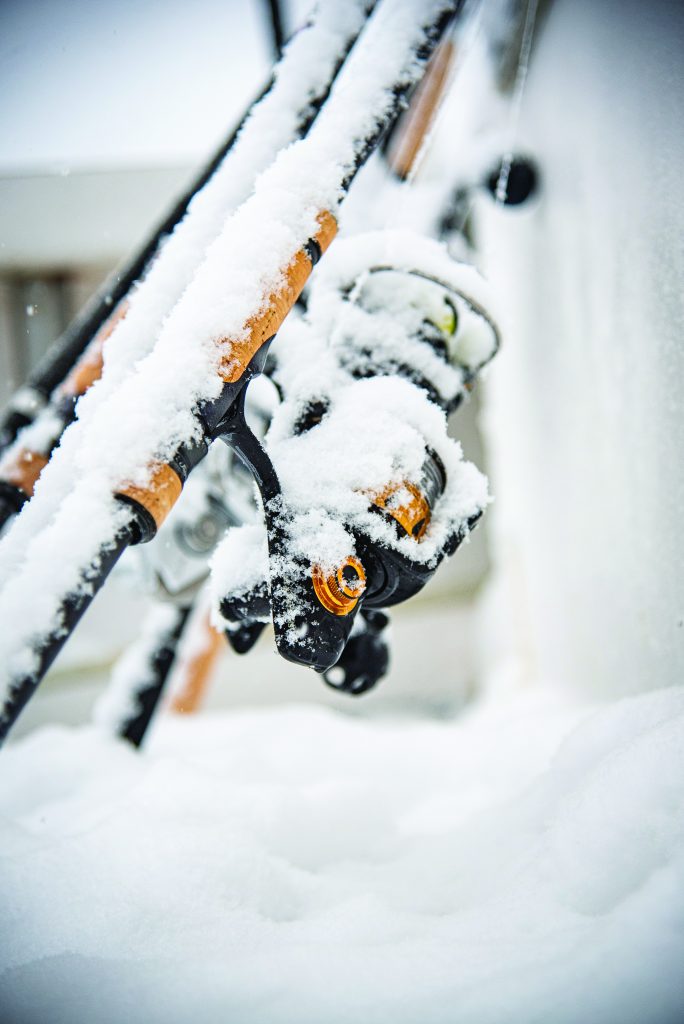
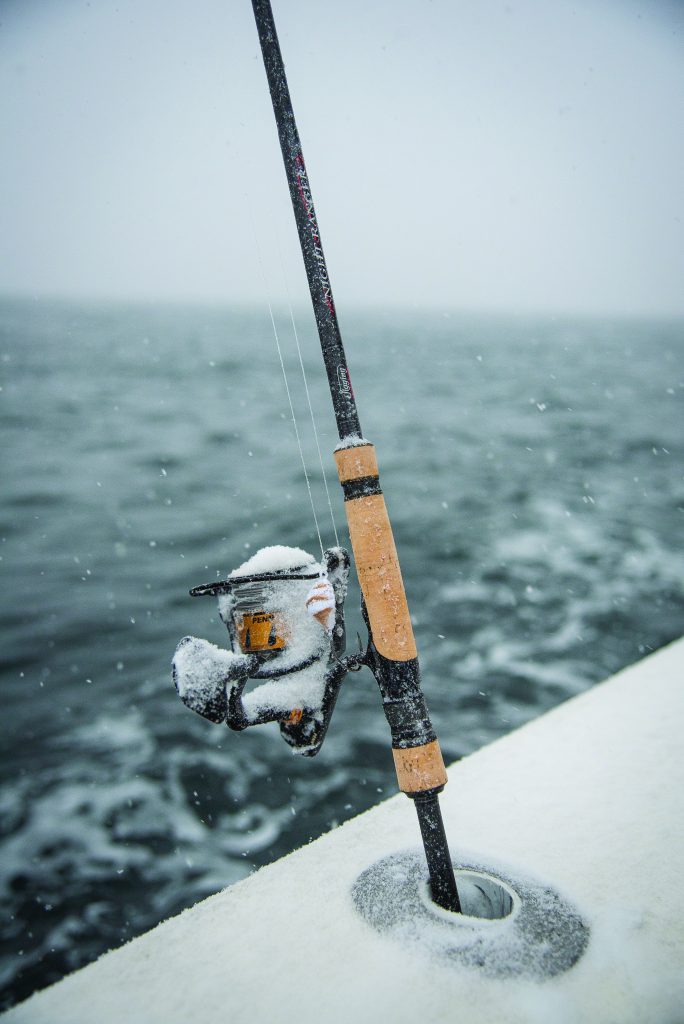
Snowfall buried the rods and reels on the ride to Cape May Reef.
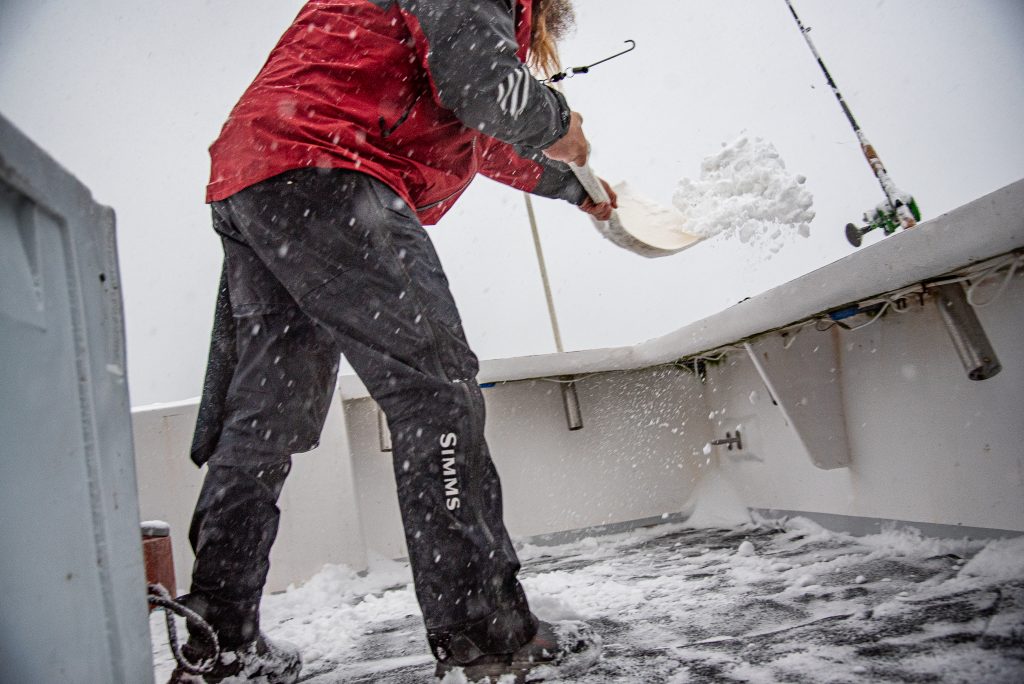
The heavy snow continued as the fishing began, forcing occasional breaks to shovel the deck. Unattended crabs vanished quickly under snowdrifts; at one point, I noticed a small snowman with crab-leg arms and a tog jig pipe had been crafted along the portside. Around then, Tom reminded us that this was a fishing trip, not a snow day, and swung the first keeper aboard. Mike, Rob, and I followed suit; soon, a steady pick of keeper tog was hitting the snow-covered deck.
The deck of the Fishin’ Fever had to be shoveled periodically throughout the morning. Here, Rob Taylor clears the snow between drops.
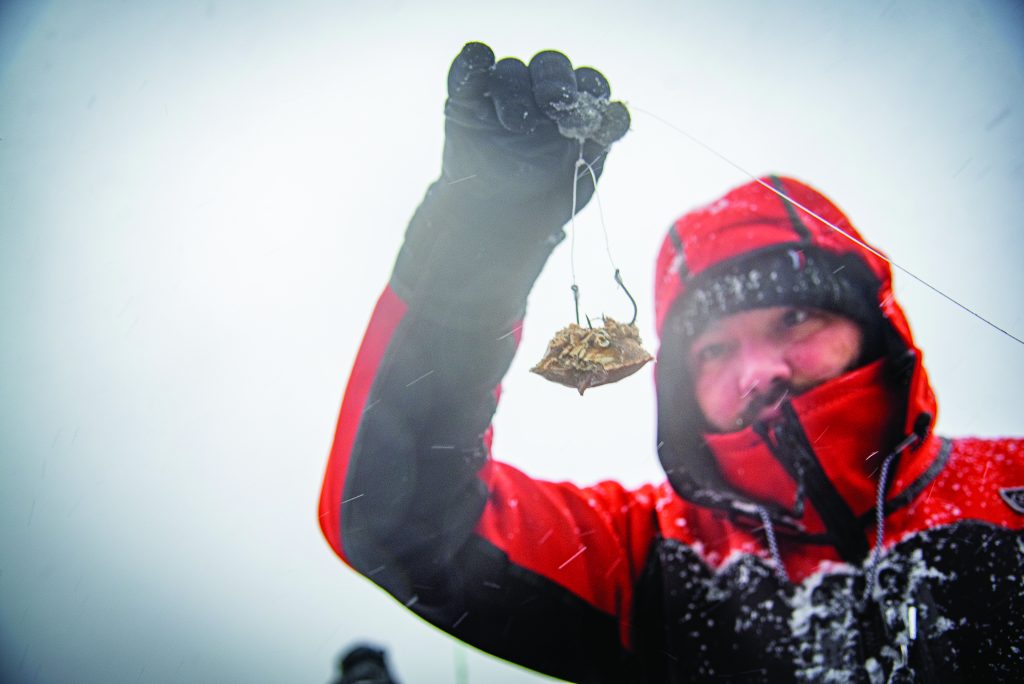
We were fishing with white-legger crabs, their larger size and brighter color making them the preferred bait of trophy tog hunters. Our rigs ranged from two-hook sliders and V-rigs to a single jig deployed on a spinning rod. With the current running steadily over the 80-foot depths, an 8-ounce, flat bank sinker held bottom for the rigs, while a 1½-ounce jig, fished with lighter braided line, stayed in the strike zone long enough to draw interest.
When using large, whole crabs for tog, a two hook rig, like this Snafu, offers the better odds of a successful hookset.
The Only Two Blackfish Rods You Need
The well-prepared togger steps aboard a vessel with two different setups: a spinning rod for fishing jigs and a conventional rod for fishing rigs.
Anthony and I have fished together for a wide variety of species over the last 15 years, long enough to know each other’s idiosyncrasies on the water. When he’s not catching but others around him are, he goes uncharacteristically quiet, trying to account for the discrepancy in the catch rates. I’d nearly forgotten he was on board as he huddled into the starboard corner, eyes locked on his rod tip. He made his presence known just after freshening up his bait with the largest crab in the tote. He had trimmed the claws, lightly cracked the shell, and sent it to the bottom.
When the rig touched down, he felt the light “scratching” of an interested tog. Less experienced anglers tend to swing at these bites with little hope of hooking the fish. Plus, a premature hookset has the additional drawback of sending a large, wary tog back into the structure. Anthony held firm until he lost contact with the rig completely. A sudden slack in the line indicated the tog had fully taken the bait and lifted the sinker off the bottom in the process. (This seldom happens with smaller tog.) Anthony set the hook, and the thundering tailbeats transmitted through the rod told him right away he’d hooked his biggest-ever blackfish.
A locked-down drag and steady pressure prevented the fish from returning to the structure, and a still silent Anthony worked the fish to the surface. My first glimpse of the fish was of a long band of cream-colored belly, characteristic of a large male tautog. As the fish spiraled into view, everyone got a full glimpse of its size.
The head was massive, the eyes bulging, the tail thick and powerful. We admired the fish as Tom weighed it at 14½ pounds. “I need to get it back in the water,” Anthony said, as he leaned over the snow-covered gunwale of the Downeast and delivered the big tog headfirst back into the cold Atlantic.
After failing to hook a fish for the first couple hours, Cheech selected the largest white-legger in the tote and turned it into a personal-best-crushing 14.5-pounder, proving that Cape May’s big tog potential isn’t limited to the offshore structures.
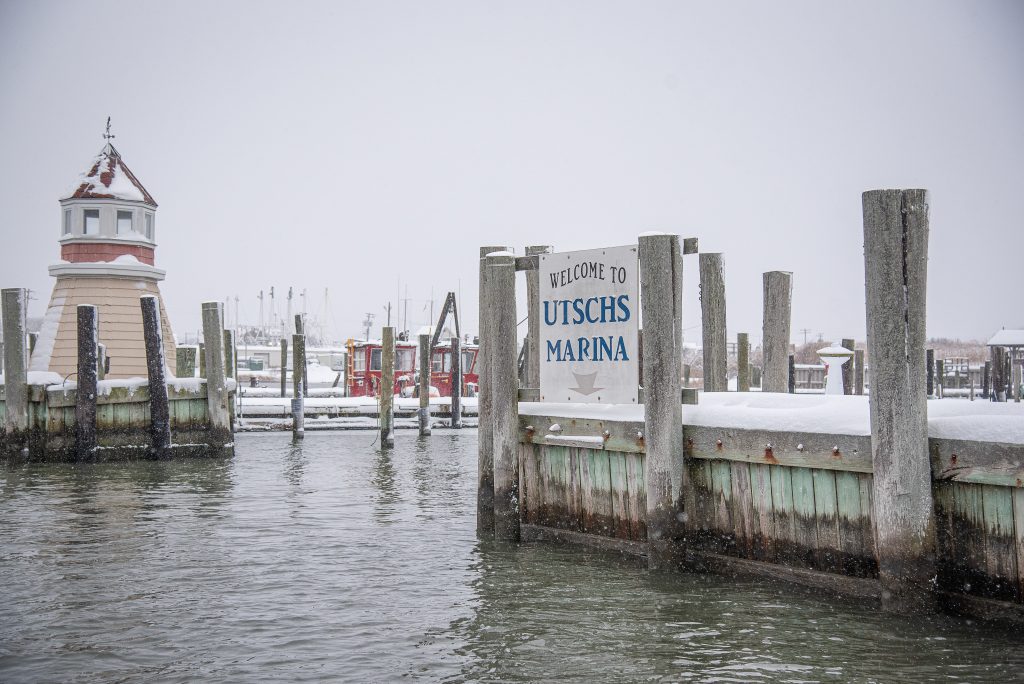
The wind picked back up in the late morning, forcing a retreat to the slushy waters of Utsch’s Marina. We posed with our keepers in the snowy parking lot as Daffin tucked in the Fishin’ Fever until the next weather window, which appeared to be at least a week away.
A quiet, snow-covered Cape May Marina greeted us on our return from the first trip of our 2025 saltwater fishing season.
A couple of hours into the drive back north, we stopped at the Jon Bon Jovi Service Area off the Garden State Parkway. At the Burger King inside, Anthony, now fully back to his loud and boisterous self, grabbed one of the paper crowns left out for children and declared himself the tog king of New Jersey. As I looked out over the freshly plowed parking lot, realizing that no one would be tog fishing over the next few days, I supposed, for the moment, he was.
Jimmy Fee is the Editor of On The Water and a lifelong surfcaster. He grew up fishing the bridges and beaches of Southern New Jersey before moving to Cape Cod in his early 20s. He's pursued striped bass from North Carolina to Massachusetts. He began with On The Water in 2008, and since then has covered a variety of Northeast fisheries from small pond panfish to bluewater billfish through writing, video, and podcasting.