
Refine your daytime surfcasting techniques to catch a “keeper” from shore this season.
When I was just starting out with surfcasting, a crusty old timer told me, “God made stripers nocturnal, and if you want to catch them, you will have to lose a lot of sleep!” He certainly knew what he was talking about, and since learning that nighttime is the “right time” for finding surf stripers, I have fished the third shift for most of my 30-odd years of surf fishing. I would be the first one to tell you that the absolute best time to catch big striped bass from shore is after dark.

However, nighttime fishing isn’t for everyone. Most surf fishermen still prefer fishing during the day, and fitting in even a couple of hours after sunset or before sunrise isn’t in the cards for everyone. Take, for example, the guy who works evenings and can only fish when the sun is shining, or the striper nut who works a lot of overtime and has to grab sleep when he can so he‘s not a wreck when the boss comes calling. Some folks just flat out don’t like fishing in the dark. For all of those fishermen, there are plenty of striped bass to be had from shore during daylight hours. A very close fishing friend of mine, Dave Pickering, catches hundreds of striped bass each season, and most of them come during daylight hours, and, more amazingly, he uses nothing but artificial lures. No bait!
I have known Dave for many years, and he has always been a fishing role model and mentor to me. I learn from him every time I speak to him, and he has taught me a book-full of lessons about catching stripers during the day. Dave just retired from being an elementary school teacher for 35 years. During his teaching years, Dave tailored his striper fishing around his very important and demanding profession. Instead of staying up half the night chasing stripers, Dave would leave school daily at 3:15 p.m. and go fishing. Dave’s many striper spots ranged from upper Narragansett Bay to the south shore of Rhode Island. However, Dave, like me, has a special place in his heart for the fishy coastline of Narragansett, Rhode Island, and he fishes there the majority of the season.

On his way to the beach (or during last period at school) Dave would devise a strategy for fishing that afternoon. His plan of attack usually consisted of hitting three or four spots before calling it quits. Dave would generally fish from about 4:00 p.m. until an hour or so after dark. He’d be back home and in bed at a decent hour, getting a good night’s sleep so he would be ready to deal with a classroom of wide-awake children the next day. Dave has caught literally thousands of stripers on this schedule, and that is the reason I mention it. Anyone can catch stripers consistently during the day if they have a plan, know what to use, pay attention to conditions and have a little luck.
The first thing a surf fisherman looking for striped bass during daylight hours should do is divide the season into thirds; spring, summer and fall.

In the early spring, say around the first or second week of April, schoolie bass show up along the south coast of Rhode Island. Like clockwork, these small, fresh-run fish make their appearance at a couple of well known oceanfront areas located in South Kingstown as they migrate north. Fishing for them is strictly a daytime proposition. They will not hit after dark at this time of year, and I’ve heard many reasons for this phenomenon, but cold water temperatures makes the most sense.

The best fishing in early April happens from the afternoon until just before sunset. All that is needed is a light saltwater setup consisting of a 7-foot rod with matching reel and 12-pound-test line, and a handful of regular 3-inch pearl or glow soft-plastic Cocahoe Minnows on a ½- to 1-ounce bare jighead, or a ½-ounce white bucktail with a rubber twister tail. I like the Triple Ripple twister tails made by Bass Pro.
By the end of April, stripers are everywhere in the Rhode Island and Massachusetts area and still on the daytime feed. Cocahoes and small bucktails are still the way to go, but another productive artificial lure to use on bass this time of year is the shrimp teaser. This is a small shrimp fly developed by Dave Pickering. It is a simple tie and it is presented to the fish via a dropper or teaser rig.

HOOK: 1/0 or 2/0 short shank. Stainless steel or tinned
TAIL: several olive bucktail hairs and two or three strands of pearl or green Crystal Flash or the like
BODY: two or three strands of peacock hurl or one strand of light/medium olive chenille
WING: olive buck tail
HEAD: black or olive 3/0 thread
Tie the tail in, then wind the peacock hurl or chenille body. Tie on the olive bucktail wing at the head, leaving a little bucktail covering the hook eye. Trim front (head) bucktail so that it looks like an upside-down mustache. Apply cement to head wraps. Cut thread. Then put a few wraps of the thread around the body material and bucktail wing near the bend of the hook (rear). This secures the wing and makes the fly more streamlined. Finally, apply cement to rear wrap. The Shrimp Teaser is a very simple but very, very effective fly.
Such rigs are easily made by tying a 24-inch piece of 30-pound-test leader material to a snap and the other end to a quality black barrel swivel. On the bottom ring of the barrel swivel, right next to the leader knot, tie a short 6- to 8-inch piece of clear 40-pound-test leader material. Then tie the tag end to the fly. The shrimp teaser rig is very productive when you clip a Cocahoe Minnow or leadhead bucktail to it. Double headers are common. Many times big scores can be racked up using these teaser rigs. A tally of 25 to 100 stripers in a single day is not uncommon during the early spring.
The last early season striper method every angler should use is the egg-and-jig rig. This consists of a wooden egg or float, a short piece of 30- to 50-pound test leader material and a small bucktail or Cocahoe Minnow on a ¼- to ½-ounce plain jighead. The leader along with the light jig is attached to one end of the wooden egg or float, while the main line is tied to the other end of the casting egg. I’ve even seen guys use a popping plug without the hooks. This rig allows the fisherman to cast a light jig a good distance and cover more territory. The wooden float also keeps the jig off the bottom, which prevents hang-ups in shallow areas. This rig was originally developed in the 1950s by Rhode Island surf fishermen. It was called a “pollock rig” because it was used to catch the small pollock which invaded inshore waters in the early spring years ago. I guess the migrating stripers liked the rig too, and now it’s used primarily for bass because the inshore pollock run no longer exists. Every surf fisherman who intends on fishing during the day should have one or two of these rigs on them at all times. They are unbelievably effective and will out-fish everything else at times. Moreover, the egg-and-jig rig is not only productive during the spring, but throughout the entire season. My first and last stripers of the year are usually caught on this rig.

You can make a casting egg out of craft store supplies, or you can purchase one from a local tackle store or online shop. Some plug makers produce the egg float. Or, you can take a short, stubby popper that casts well, remove the hooks and tie a leader to the rear hook hanger.
When Mother’s Day rolls around, bigger stripers start infiltrating the area. I continue using the bucktails and Cocahoes (with teasers), and the casting egg and jig, but I also put a few surface plugs and some soft-plastic baits like Hogys and Slug-Gos in my bag. Continue to hit all of your spots by day using the leadheads and teasers, and don’t be afraid to throw ½- to 1 ½-ounce poppers, Danny-style metal lips and 7 ½-inch Slug-Gos in pearl or pink (bubblegum). This is prime time to land your very first “keeper” of the season. This is also the time of the year that I change outfits too. I put the lighter stuff in the basement and rig up a 9- or 10-foot medium-action outfit. This will handle the larger lures and bigger bass better. As May turns into June, you have an excellent chance at catching a real nice bass of 15 or 20 pounds during the day. I like to use Super Strike Little Neck poppers in white, yellow, parrot and amber, Danny-style metal lip swimmers from Beachmaster, RM Smith and Gary Hull in 1- and 2-ounce models, walk-the-dog plugs like the Rebel Jumpin’ Minnow and the RM Smith Jigsmith, as well as 2-ounce pencil poppers from Cotton Cordell, Gibbs and Beachmaster. Lastly, two of the best surface-swimming metal-lip plugs that always work well during the day are the Beachmaster Jointed Eely and a Danny-style eel skin plug by Lordship or Beachmaster. Both plugs are bass magnets when the sun is shining. I don’t think I would go fishing the surf after the middle of May without one of these plugs in my bag. Get a couple of Eelies in white or yellow and just watch how well they produce. Eel skin plugs are a little difficult to set up because you have to find a supply of skins or skin the eels yourself. Many local tackle stores carry eel skins these days, and I prefer to buy them.

During this time of year, time of day and weather conditions are a bit more important than they were earlier in the season. If you can, try to get out closer to dusk or dawn. You will almost always do better during these low-light periods. I prefer dusk. I like to arrive at my spot one or two hours before sunset. Stripers get very active around this time of day and this is your best chance to hook a bigger bass. Remember, in late May and early June there are a lot of different baitfish around. Besides small silversides and sand eels, large adult menhaden and river herring are flooding in and out of bay and estuary systems. Squid are everywhere, and are also likely targets for springtime, inshore stripers. Fluke, bergalls, small tautog and sea robins round out the menu for springtime stripers. Make it your business to be at river mouths or bay entrances and adjacent areas during this time period. It may be your last shot at a daytime monster for a while. If you don’t do it by mid June, you may have to wait until the fall.
The summer months are a great time for striper fishing, but consistently catching bass at this time of year can be difficult, especially during the day. After mid June, migrating fish have taken up residence for the summer, and many become nocturnal, especially the bigger bass. Chances of catching a good-sized bass from the surf during daylight hours dwindle from July through the first week of September. Schoolies abound though, and their numbers make up for the lack of larger keepers and really big fish. The shore-bound fisherman must take note of this and alter daytime strategies.
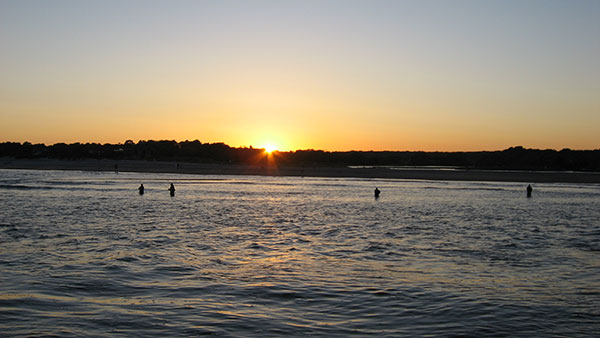
Remember, during the day, beaches are crowded even on so-so weather days, and traffic can be a headache. Getting to the beach before 8:00 a.m. or after 6:00 p.m. may be your only chance to fish without swimmers, jetskiers, boaters and surfers interfering with your efforts.
In the summer, don’t expect to get to the shore at 1:00 p.m. in the afternoon on a bright sunny day and catch a bunch of schoolies. The great afternoon fishing of April and May only happens in the summer when there is a storm. If you have to fish on a bright sunny day during prime sunbathers time (and I don’t advise it) try to find deeper or moving water like in an inlet or breachway. Also, look for white water. Try smaller lures like the Cocahoe Minnows and ½-ounce bucktails. The smaller the better. The average summer surf striper is about 6 pounds, so a ½-ounce white bucktail jig looks more appetizing to a bass that size than a 4-ounce pencil popper – especially in the middle of the afternoon. The egg and jig might be the best thing to use on bright summer days because of its ability to carry small offerings to deeper water.

Occasionally, low pressure systems move through in the summer and stir up the water and activate the bass. Surf fishermen should take advantage of these storms and fish them as much as possible. Please use common sense and extreme caution. Storms make seas rough, sometimes too rough to fish. Check out the shoreline first and try to find a safe place to cast. Believe me, there is always a place to fish in even the wildest of storms. There will be plenty of white water in most spots, and these areas are a striper’s favorite place to ambush disoriented baitfish. Cast heavier 1- to 2 ½-ounce white bucktail jigs with red and white pork rind, pencil poppers, Yo-Zuri Surface Cruisers, metal-lip swimmers and bottle plugs into this white water for excellent results. Bottle plugs are designed for rough, heavy water and will bite into the biggest swell. They should be a staple plug in any storm surf bag. I like the Little Neck Swimmer produced by Super Strike lures.

Summertime surfcasters should also be aware of the bait that is present during the summer months. Summer stripers usually key in on sand eels and spearing; both are small, and it’s wise for the fisherman to try to “match the hatch.” Dropper or teaser rigs that worked in the early spring will produce again in the summer, Instead of shrimp flies, however, use a fly that closely resembles the thin-bodied spearing or sand eel. I use black or white saddle hackle flies or 4-inch Red Gill sand eels in all black, pearl white and yellow. Both are dead ringers for the small baitfish. I rig them similar to the shrimp teaser rig however I only use one teaser per rig and I use heavier leader material of 50-pound-test. I also make the main leader longer, about 40 inches. The leader to the dropper fly or Red Gill is about 8 inches. I fish them in conjunction with bucktails, Cocahoe Minnows, 5-inch Red Fins, Greenpoint Sharp Eyes, surface swimming metal-lip plugs and needlefish plugs.
The autumn offers good to excellent fishing for the daytime surfcaster. Stripers are on the move migrating south for the winter. They have to eat a lot for their long swim, so they do come inshore to feed both day and night. Old timers used to say, “throw out the rule book in the fall.” By that statement they meant that bass can show up at any time and in any conditions during the fall run.

In the early fall, I still recommend fishing close to dusk or dawn and during all northeast storms. In October and into November, bass fishing usually gets better hitting a peak around the last week of October. Daytime striper fishing really hits its stride in November particularly along Rhode Island’s coastline. The bucktail jig gets a lot of action this month as does the Cocahoe Minnow. When I fish during the day, I really like to see the fish hit surface plugs, so I always use the small to mid-sized Danny, the jointed eely and the eel-skin Danny plug. Migrating bass just can’t resist them. Another great fall daytime plug is the 5-inch minnow-style plug in the straight or jointed version. Back in the 70s, there used to be a local ‘Gansett guy named John Snow who surf fished with nothing but a beefed-up, 5-inch blue-and-silver Rebel during the fall run. He would swap out the hooks and split rings with heavy duty ones, and boy did he catch bass on that plug. He used this lure exclusively along the rocky east facing shoreline along Narragansett’s infamous Ocean Road. He caught hundreds of fish on this plug, all during the daytime. He almost never fished after dark. One year his best fish was 35 pounds. The Finnish minnow lures continue to catch stripers today, and I always have one from either Rebel, Redfin, Gary2 or Greenpoint in my fall surf bag. This past season, I substituted the Sebile Magic swimmer 145 fast-sink model for the 5-inch plug with excellent results. Actually, I started using this Magic Swimmer in mid spring and found it difficult to take it off the end of my line. It is a great striper plug and catches bass by day or night.
By mid November most of the big bass have moved on and the smaller schoolies remain for a couple of weeks. The egg and the jig as well as the small buck tail jig and Cocahoe Minnow take the rest of the migrating fish all day long. The fall is my favorite time to surf fish. The cool crisp air makes long walks along the beach comfortable. The stripers are moving and eating and just about any artificial that looks like a meal will work. It is also the time of the year you can walk into a blitz of fish at 1:00 in the afternoon. Other than the early spring, the fall is the best time to catch daytime stripers in the surf. Plus, it’s a good time to catch a real nice fish. Perhaps even your best of the season.
Where can I find live reports for stripers?
I’m from Louisiana, and love to fish. I’m here for work and can’t wait to get out there and get a few fish , where do I go and what kind of tackle should I use , we fish off the bottom back home ?
Thanks
I have the most success using paddle tail shads in the rivers this time of year. I usually use 5″-6″ Storm wildeye shads. Good luck.
Hello,
Thank you for this article. I live in Northern California, I see a lot of articles from the east coast and most are from there, but very few written for the west coast. I appreciate your information though..