
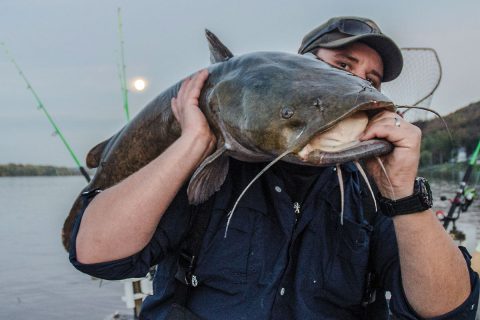
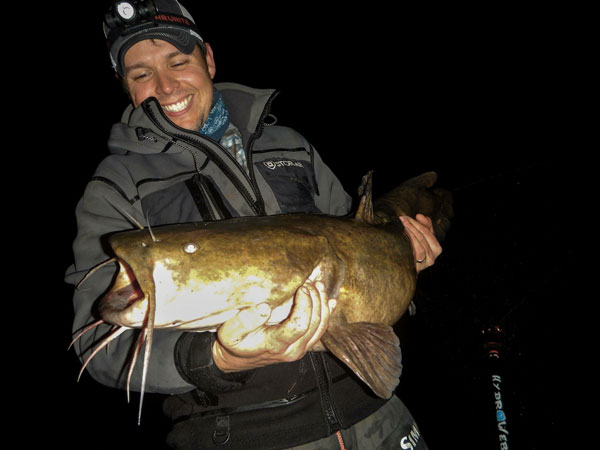
Pictured above: With winter not long off, this flathead catfish couldn’t wait for full dark to start feeding. After briefly interrupting its late-fall feast, Joe Cermele returned the fish to the slow-moving currents of the Susquehanna, where, in a few years, it may challenge the Pennsylvania state record.
I’ve fished the Susquehanna River from source to salt water, for carp and smallmouth in Cooperstown, New York, to stripers and shad in Havre De Grace, Maryland. I know that most of the river’s 444 miles run through central Pennsylvania; however, when I look at Joe Gunter’s aluminum boat peppered with “Catfish Life” stickers and bristling with neon-green rods, I wonder if the Susquehanna has meandered into the deeper south where catfish—not stripers—are king.
I drove through the night, leaving just after treat-or-treating with my daughter, to meet Joe Cermele just north of Philadelphia before heading west to Pennsylvania Dutch Country. There, we met Gunter with the goal of filming an episode of Cermele’s “Field and Stream” web show, Hook Shots.
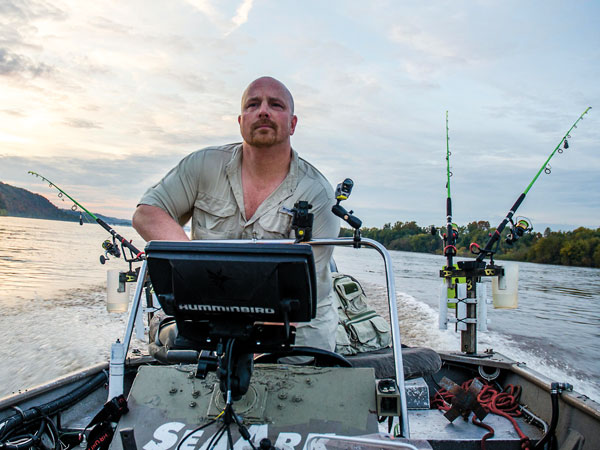
Gunter is one of a handful of guides who has embraced—and monetized—the “invasion” of flathead catfish into central and eastern Pennsylvania waters. These cats first reared their ugly, whiskered heads in the Susquehanna in 2002, and were quickly deemed invasive by the Pennsylvania Fishing and Boating Commission. Fishermen were required to kill any flatheads they caught, but the catfish reproduced too quickly for the catch-and-kill regulation to have any impact. In the process, however, many fishermen discovered how fun it was to catch these cats—something fishermen in the south have known forever.
In their native range of the lower Great Lakes and Mississippi River basin, flatheads can reach weights of 100 pounds or more. Due to a shorter growing season, Susquehanna flatheads max out at about half the size, but that’s still enough to make it the most formidable fish upriver of the Conowingo Dam.
I notice that the foliage is just shy of peak as Gunter launches the boat and waves Cermele and me aboard. According to Gunter, late October into early November is the prime time for these fish. With fall rains raising water levels and dropping water temperatures, flatheads group together and seek out holes and channels where they’ll spend the winter.

It’s a short ride to the first spot, but before we can wet a line, Gunter asks us to sit in the front of the boat while he delivers a well-rehearsed sermon on proper catfishing protocol aboard his vessel. He’s even more meticulous than the most militant offshore captain I’ve fished with. Cermele and I are assigned seats and rods and, under no circumstances, am I to touch the rods on Cermele’s side or is he to touch the rods on my side. Each corner of the boat has two rods and each rod is assigned a number and a letter ranging from 1A to 4B. When there is a strike, whoever sees it first is expected to shout the number and letter of that rod.
After the 20-minute debriefing, it takes only 5 minutes to get a bite once the rods go in. I see it first and, buckling under the pressure, shout, “There’s one on the right back, left rod.” We manage to figure out that I mean “3A,” and minutes later, the first flathead of the night, a “small” 10-pounder, is lifted aboard.
As darkness sets in, Gunter flicks on the bands of black lights around his boat, setting aglow the Ugly Stik rods that he’s spray-painted neon green. We’re primarily using live bait, a mix of bluegills and rock bass. Unlike the scavenging channel catfish, flatheads are predators, and less likely to eat the cut bait and chicken livers that channel cats favor.
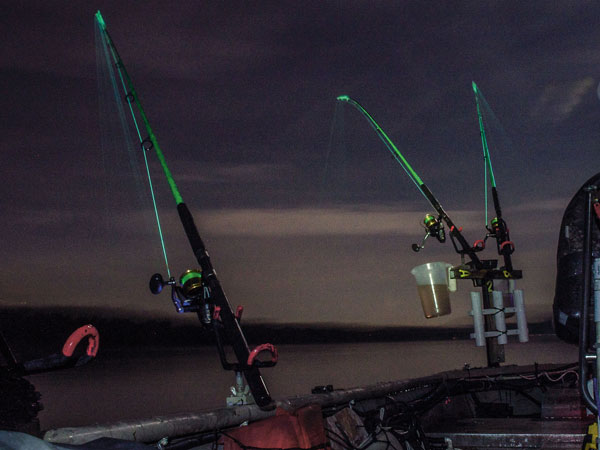
as adding glowsticks to the tips, Gunter is able
to quickly see when a catfish is biting, even
on pitch-black nights.
Despite the early success, we fail to catch another catfish, even after repositioning the boat several times. Just before midnight, we pull the boat and head to another ramp where Gunter is confident we can “fill the boat with 30-pounders.” After several hours of slow fishing at the first spot, I’m skeptical, but it takes just 15 minutes to prove him right.
It’s the freshwater equivalent of getting wolf-packed by tuna in the canyons—barely controlled chaos when the hooked fish outnumber the anglers on board. Cermele lands the first and third catfish hooked, I land the second, and Gunter lands the fourth, all of them between 28 and 38 pounds.
Flatheads fight well for a freshwater fish. They take a run right after feeling the hook, then swim at the boat, fighting to stay deep, usually making a last-ditch lunge under the boat before rolling over.

The small ones we catch are mottled yellow-brown, while the larger ones are goose-poop green. They have enormous mouths, beady eyes, and bands of coarse-grit sandpaper inside their lips that turns my hands to hamburger while lifting them for photos. They are ugly, ugly fish, which makes their size all the more intimidating.
Though catfish don’t get much attention from Northeast fishermen, in middle America—where going saltwater fishing requires a flight to the coast—channel, blue, and flathead catfish are the most popular species. There, they live in most bodies of water, grow to large sizes, and don’t require a ton of expensive tackle to catch. Of course, there are catfish zealots, like Gunter, who pack as many rods on their boats as professional bass fishermen and are as exacting about their fishing systems as offshore captains.
Despite fishing eight rods out of the relatively small boat, we never tangle, even when multiple fish are hooked. Gunter handles all the casting and bait checking, declining even when we offer to help.

We catch the catfish in spurts every half hour, and Gunter never loses his initial intensity, chastising—okay, yelling at—us for not fighting the fish to his liking. The reason is because he knows that the next state-record catfish is swimming in this stretch of the Susquehanna, and he wants it to be caught on his boat.
The Pennsylvania state record, as of this writing, weighed 48 pounds, 6 ounces. Gunter’s boat record is a 47-pounder. His clients have landed several 40-plus-pounders, and the largest one he’s personally caught weighed 42 pounds.
Gunter’s dedication to catfish would shame even the most obsessive striped bass surfcaster. In describing his “catfish fever,” he says these fish “grab a man’s soul and pulls him in.” Gunter is single, lives alone, and keeps a nearly nocturnal schedule from May to November, when the flatheads are biting.
On most fishing trips, during lulls in the action, conversation shifts to music, sports, weather or, in unfortunate circumstances, politics, but Gunter determinedly keeps the conversation on cats. At one point, I ask him about the surrounding area, and he responds, “I don’t know, but I do know it has nothing to do with flathead catfish.”
Cermele and I return to our hotel by 5 a.m. and crash until noon. We eat lunch, check out the local tackle shop, and stock up on a night’s worth of junk food at the local Sheetz—central Pennsylvania’s version of a Wawa convenience store—before it’s time to meet Gunter at the ramp for round two of full-moon flathead mayhem.
We head right back to where we left off the night before, and as the nearly full moon rises over the river, the rod tip at 1B sinks toward the river. It takes more than 90 minutes before the action slows down enough for Gunter to set out the full eight-rod spread. The wintering hole appears to have filled up nicely with catfish preparing for the cold months to come. Gunter is excited, but there’s a touch of sadness, since he knows this great fishing is also the last hurrah of the 2017 catfish season. The flatheads won’t be going anywhere, but they’ll stop biting, entering a nearly dormant state until warm spring rains awaken their need to feed.
My biggest fish on the second night bounces the Boga Grip between 38 and 39 pounds, and as it swims away, I realize the fish was a few pounds heavier than my largest striper that fall.
We part ways at midnight. Gunter leaves to sleep a few hours before waking up to catch bait for the following night’s charter. After two nights of screaming drags and a screaming guide, I have a new appreciation for both catfishing and the intensity it takes to master a fishery—especially one that’s not even two decades old. I haven’t fully caught Gunter’s catfish fever, but his affliction reminds me of my own, and I drive with a lead foot toward the coast, where I’m hoping the full moon brought some flathead-sized stripers to the beaches near my home.
Can I get Gunther’s e-mail or web page?
https://www.hookedoncatfishing.com/
Great story, and great read.
Thanks for the article.
When is your next available trip and how much does it cost
When is your next available trip and h ow much does it cost do you have a phone number I can reach you at