
To most outdoorsmen, “Buffalo Hunting” conjures up images of industrial frontiersmen hunting massive mammals and stacking skulls stories high, but to a small group of fishermen from Harker’s Island to Cape Cod, it conjures up something quite different.
On a windy and wet late fall day, I boarded the 6am ferry to Nantucket. There, friend and co-worker Jack Larizadeh awaited me with his Boston Whaler. As I watched the spray and rain spitting against the ferry window, I sipped coffee and gnawed on a cold bagel pondering why fishermen have begun to refer to large false albacore as “buffaloes.” Sure, their fusiform shape and large head could be compared to the blocky skull and tall shoulders of buffalo. Yet false albacore, a precision hunter that uses speed and agility to pinpoint and slash through schools of baitfish, didn’t quite seem very buffalo-ish to me.
As the ferry steamed into Nantucket Harbor, I vowed to coin a more fitting nickname for the species. I disembarked the ferry to see Jack, dressed in foul weather gear, waiting for me. Nantucket’s world-famous fog shrouded the harbor and a swirling wind whipped around the island. Fortunately, Jack and I were equipped for the weather with rain gear and boots. Unfortunately, our vessel for the day was not. A 1960, 17-foot Boston Whaler sat tethered to the dock just a few steps away. Despite being a beautifully restored vessel, she was not an ideal watercraft for the false albacore fisherman. With no rod holders, a beveled bottom, and a mere 10-gallon gas tank, our boat came with some challenges. To add to the list of obstacles, the conditions, though not quite unsafe, were far from comfortable.

Jack had been fishing for a few days and told me exactly the gear I would need, which was not my typical albie gear. Instead of a 7-foot rod with a 3000-sized reel, I boarded the Whaler with an 8-foot Jigging World Onyx and a Van Staal 100. Jack insisted that these fish were larger, stronger and more aggressive than the albies I was used to seeing, but I fully expected to have to size down my gear after the keen-eyed albies scoffed at my heavy leader.
After battling chop, wind, and rain on the way to grounds, the rain subsided and the fog cleared. The chop and the wind remained, and the combination of warm sun, cold wind and salty spray would leave us changing clothes, tactics, and spots constantly to accommodate the tumultuous weather.
With spray and wind making it hard to communicate, we shifted to a nonverbal system of pointing and casting. One of us would cast forward off the portside; the other would cast to aft starboard, then switch. Fishing opposite sides of the boat not only allowed us to cover more water but kept our humble vessel level. The snapping of casts and the sound of braid billowing off the spool were barely audible over the wind. Despite the chop and wind, the water was very clear. There were several small packs of terns scanning the surrounding area and pods of bait visible on the sonar; we had even vertically jigged up a few bonito. It felt fishy. I began to feel as if I was actually a big game hunter.
Had I been chasing albies off Cape Cod, I would be using a much lighter setup and focusing on accurate casts toward surface-sipping fish. This felt like power fishing. Jack and I had been operating on the theory that the albies off Nantucket were different than their mainland counterparts. They seemed to travel in small wolf packs as opposed to large schools. Without much structure to hold bait, these albies would be cruising the current and rip lines. Big sand eels and squid were the likely bait, larger than typical albie forage. The more we fished, the more we started to think we had the right idea. We would spot a very large shadow rip across a cresting wave or leave a v-wake on the surface before it disappeared.
After about an unproductive hour or so blind casting, and a few attempts at running towards what may have been a feed, we noticed some subtle changes. Jack pointed out the wind had been blowing in a consistent direction for 30 minutes, the longest it had all morning. I had been carefully observing the terns in the area. Until then, the terns had been scattered, flying low zig-zags across the water, with some diving and dipping, but I had not yet seen a bird above fish. As Jack noted the wind shift, I realized one of the terns we had been carefully trailing, abandoned his wide zig-zag search pattern and flown with the wind back over our heads—the third tern to do so in the last 15 minutes. The wind shift, and the change in bird behavior demanded a change in plan.
As soon as Jack pointed our bow toward the terns, he screamed, “There they are! Fish! Fish! Fish!”
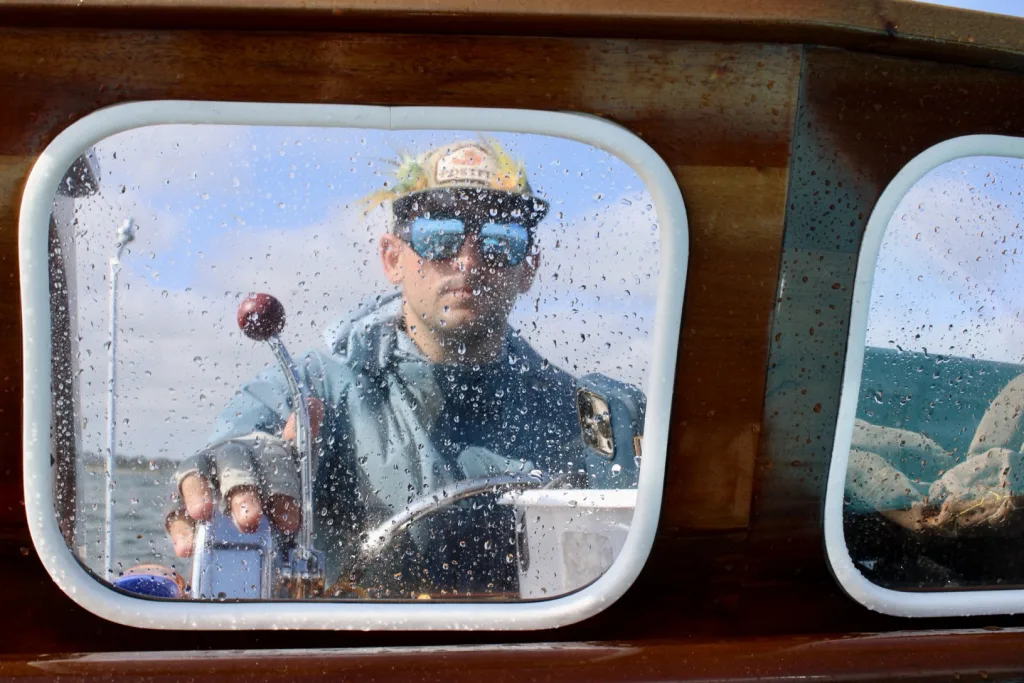
Between the small unstable vessel and a captain in the clutches of albie fever, I ended up in a heap of knees, elbows, rods, and Red Bull cans in the back of the boat. After gathering myself, I held onto the back of the single seat and crouched behind Jack. The little whaler was zipping up the island’s coast toward a feed of albies, that I had not yet spotted through the spray. A modern 70hp Yamaha outboard was propelling the 65-year-old craft close to 40 mph. Through the mist, the feed came into view.
As the mess of birds and white water became visible, there was no mistaking that we had found a pack of large albies. It was the most violent albie feed I have seen. The eruptions of the feeding fish were so large, that the birds hovering above them had to avoid being swamped. Each savage strike was preceded with a dark green V-shaped wake and the unmistakable scythe-like tail of an albie. The result was a wide patch of simmering water, fins, and feathers. Jack killed the engine and we quietly slid into casting range of feeding, buffalo albies.
Right then, it struck me that maybe “buffalo” was a good namesake for the false albacore. Had I been an industrial buffalo hunter in the 1870’s, I would likely be reaching for a single shot, large caliber rifle to fire a hunk of lead towards my target. My 8-foot rod, a heavy-duty surf reel, and a 1-ounce resin jig felt like the inshore-fishing equivalent.
This far-fetched thought could have been the reason I lost my footing and made a poor first cast. Jack, focused on the task at hand, shimmied around me to the front of the boat and delivered his cast.
“Tight! Tight! Big fish!” exclaimed Jack.
A few seconds after his jig had hit the water, line was melting off his reel. Jack had the rod butt jammed into his waist and was straight-arming the rod with his top hand, bracing on the guard rail with the other. There was nothing he could do except let the fish get tired. Meanwhile, our boat had drifted into pure chaos. The albies started zipping directly under the boat towards our starboard side looking like a squadron of fighter jets cruising below us. I watched 3 or 4 green-and-silver flashes whiz just under the hull. Without so much as a ripple, the pack of albies ripped through the water, just a few centimeters below the surface. Another small feed had begun to form 30 yards to our right side. By the time I collected myself and shot a cast towards the feed, Jack’s fish was still taking line at the same rate and in the same direction.
My 1-ounce JoeBaggs resin jig landed about 10 feet outside of the feed with a splash. As soon as my jig hit the water, a large silver orb turned and darted towards the lure. I began to rip my jig back towards the boat, when a burst of water erupted on my jig and my line went slack. The fish had missed, but it had attacked with such force that my lure was knocked in the air and landed another 10 feet closer to the boat. Without missing a beat, the albie located the jig and attacked again. The albie swung behind my offering from the flank, struck and missed again. I kept my retrieve steady. Now a few body lengths away, and facing completely opposite my jig, it turned and sped back. Three times over, it would locate the jig, chase down from the flank, reposition and attack from behind. Finally, on the fifth swipe, with my jig just a few feet from the rod tip, I came tight. At first the albie made a short, hard run then stopped. A quick, almost vertical dive followed, before a few more sharp turns. The albie then zipped to our starboard side, back toward the feed, and I realized it did not know it was hooked! I tightened my drag and watched its head turn toward the pressure. I saw the gleam of its massive eye and the shine of its giant gill plate before it took off and disappeared in the opposite direction. In the span of a few seconds, I had watched the albie track down and strike my offering from multiple angles, before disappearing into the blue with my lure. It was as intense a strike as I had ever seen, and an excellent demonstration of elite predation.
The albies here seemed so much more aggressive, albeit harder to find, than their mainland counterparts. Did their more pelagic and remote environment make them more aggressive? Why did the albie seem hell bent on T-boning the lure? All of these questions raced through my head in seconds before being silenced by the singing of my drag.
Jack had not yet made any progress on his fish, and it was still on its first run. I settled into my own fight and caught my breath. Now aware it was hooked, the albie made no change of direction. After taking nearly half the line on my spool, it veered to the right and took off again. My line was now slicing across the horizon, forcing Jack and I into the hardtail shuffle around the small boat. Following a few rounds of braided-line limbo we boated our fish.
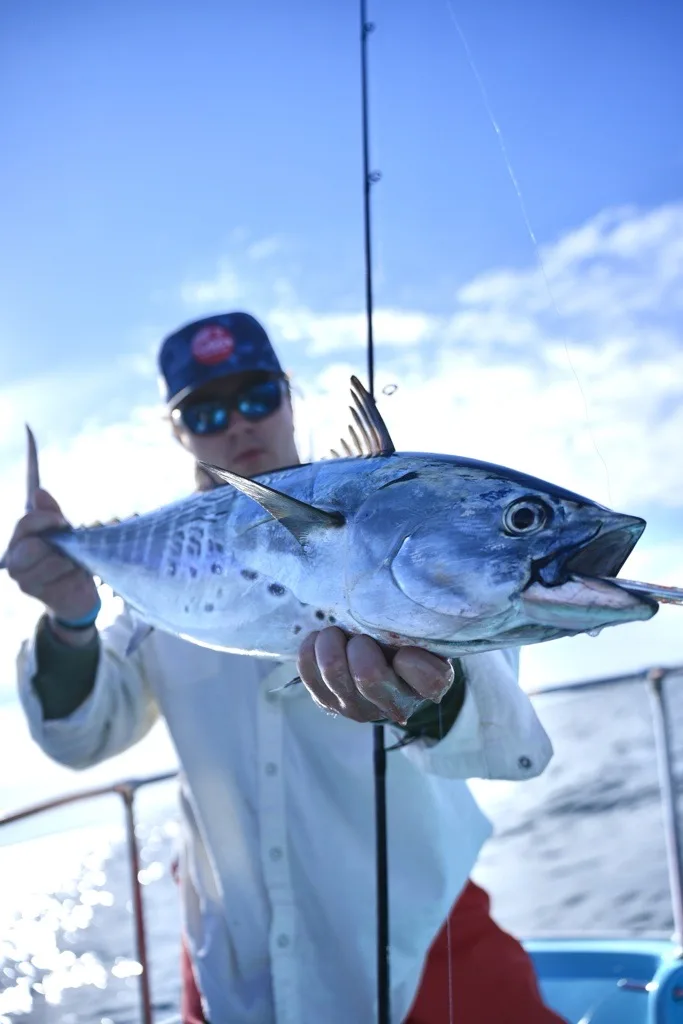
As Jack plunged his arm over the gunwale, he rose with a triumphant yell. In his right hand, Jack lifted a long, finlet-covered tail out of the water, followed by what can only be described as a hunk of false albacore.
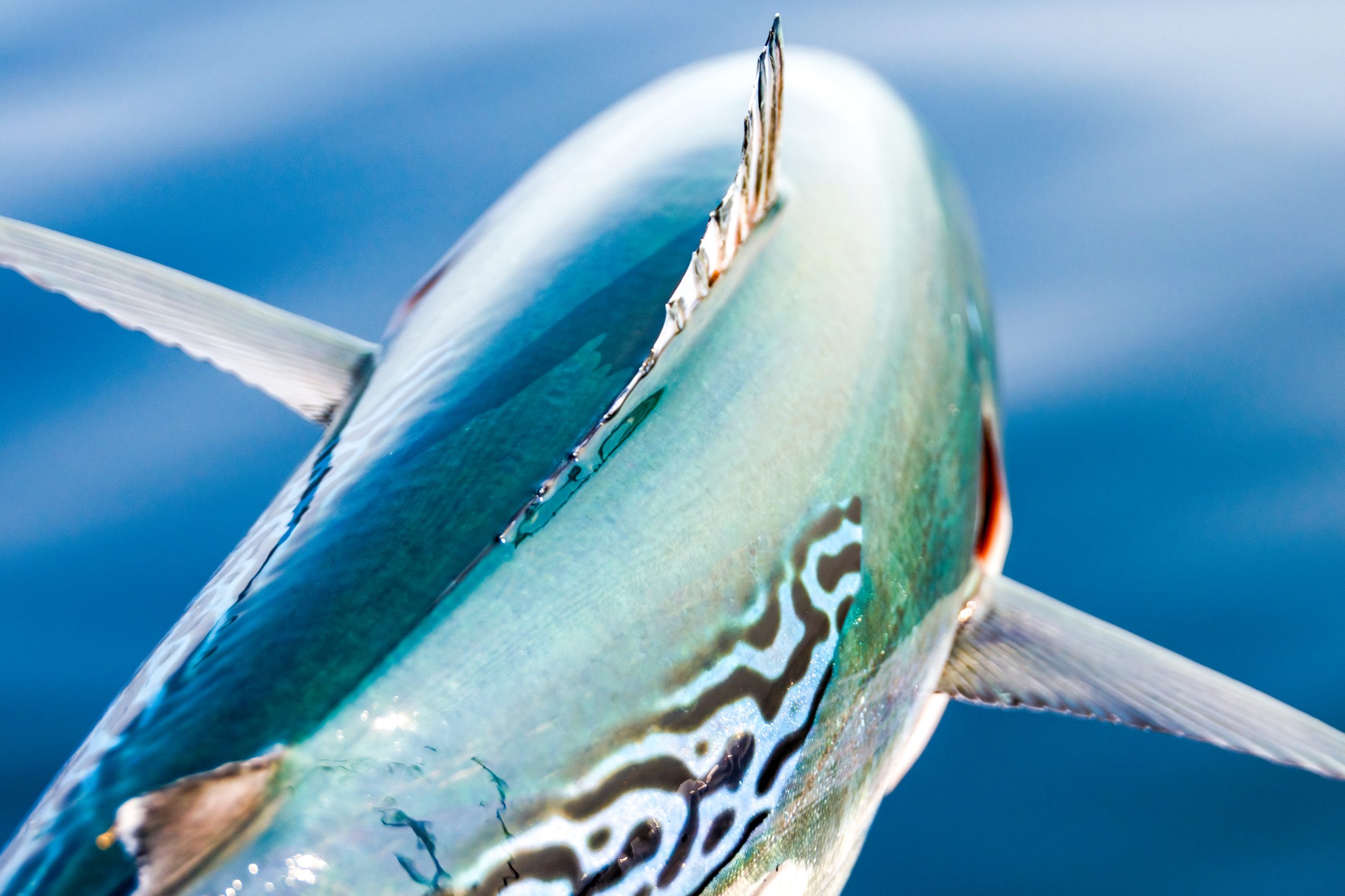
If there was ever a false albacore that fit the moniker of buffalo, it was the one currently in Jack’s hand. Its giant round eye was embedded into a metallic silvery head. The head was monstrous. As if forged from metal, the greens and silvers shimmered in the sun, and dark green, worm-like patterns, crawled across its broad back. A tall dorsal fin stood erect on the mound of its shoulders. Thick, deep purple bars ran vertically from belly to back. In the Nantucket sun, the albie was such a spectacular sight, that I forgot I had one of my own pinwheeling just under the boat.

After boating my own round mound of albie, Jack and I were elated. We shared whoops and yells that could probably be heard across the Sound. Dancing across the deck of the boat, our awkward missed high five turned into a soggy hug. Our wet little Whaler was as happy a boat as you could find on the water that day.
Within 15 minutes of releasing our little tunnies, Jack and I spotted another feed. After sliding within range, I made a quick cast and was tight before I could reel up the slack. Unfortunately, there would be no epic battle this time, the fish immediately ran across the bow and dove, breaking me off in just a few seconds. Jack picked up his fly rod, and I spun the boat around. Jack feathered out a long cast and after a few strips, came tight.
Jack had no choice but to hang on for the ride. I scrambled around the deck, clearing the small space so Jack could boat our third albie of the day. Jack’s albie on the fly would be our largest of the day, and by far the most colored up. Spectacular bright greens, with dark grape bars, the albies seemed to be showing off. In the minutes following, I would boat our fourth albie of the day on the same squadron of fish.

After nearly 14 hours on the water, we returned to Nantucket harbor. Jack and I trudged into a local watering hole for some cold beers and much-needed nourishment. Salt-caked skin, a deep sunglasses tan, and an awkward walk signaled a day well spent chasing fish. They say it hurts more to stay on a mountain bike, than it does to fall off one. I would like to add 17-foot Whalers in fall northeast chop to that list. As Jack and I reminisced about the wild day on the water, and planned for another few days of hunting for outsize albies, I decided buffalo was as fitting a nickname as any for the false albacore.
Sitting with a good friend on a small island in the middle of the Atlantic Ocean, after a day of physically demanding fishing, I could not help but feel connected to the sportsmen of the past. I wondered if industrial buffalo hunters, or the Nantucket whalers who worked from similar sized dories—felt the same way we had today, elated and in awe of their catch and fulfilled by the adventure.
Of course, Nantucket whalemen, and industrial buffalo hunters were bound by the necessity of industry. They hunted oil, skins and hides for profit, numbers, and money. Jack and I were here for none of those reasons. We were here as sportsmen. For us, the prize was not kegs of oil or buffalo pelts, but the opportunity to observe a fantastic predator in its element, to understand and appreciate the false albacore as a sport fish. To call ourselves sportsmen, and to treat our catch accordingly was better than any prize we could have pulled from the sea that day.
READ MORE