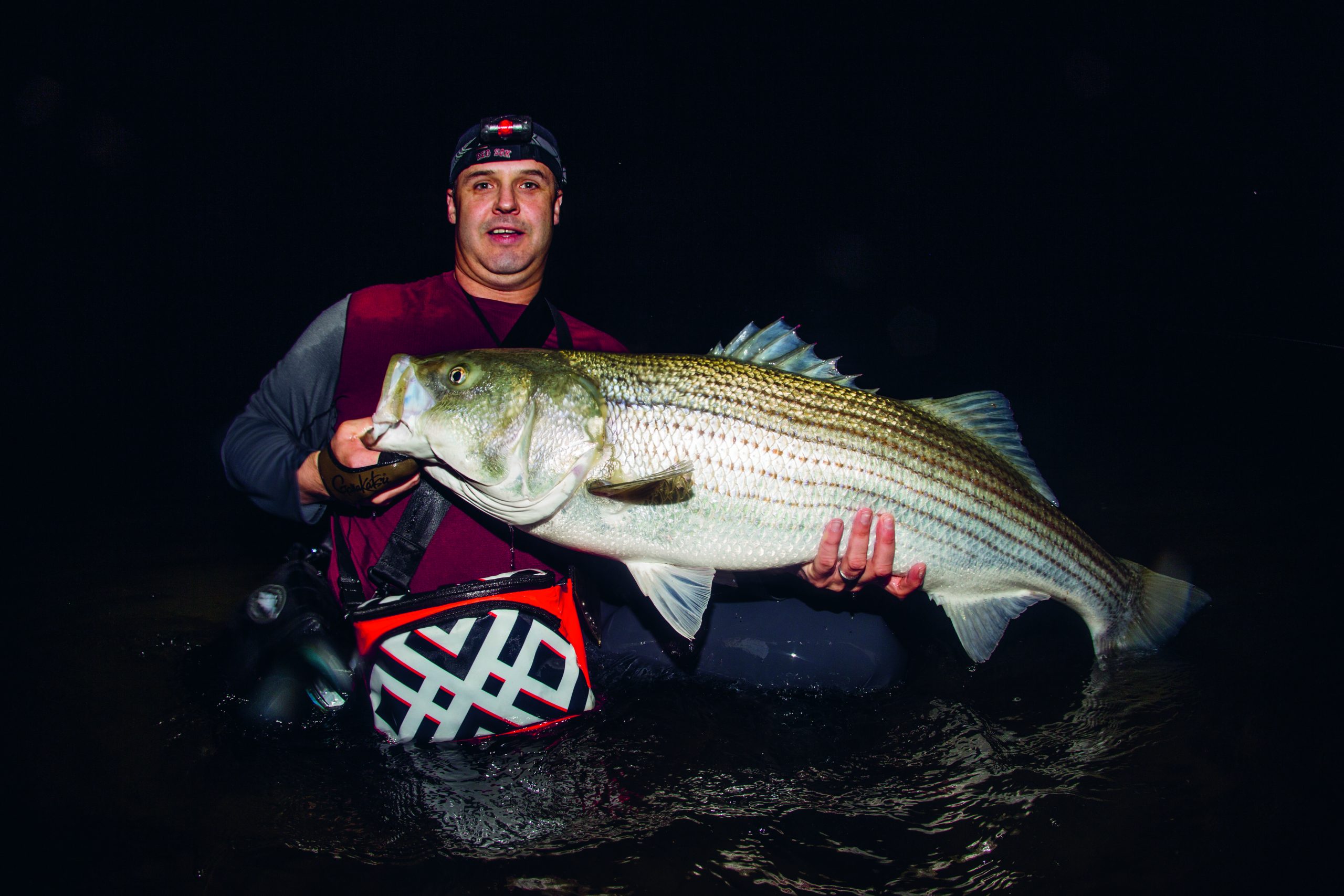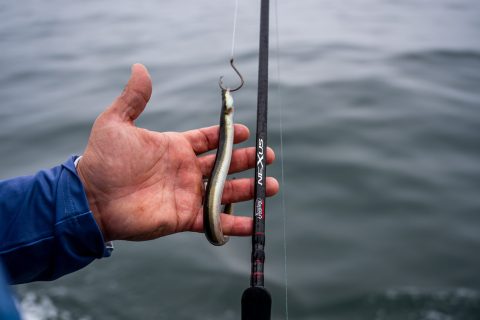
For fishing live eels while complying with the striped bass regulations, most captains recommend a medium-gauge wire circle hook like the BKK Hybrid Heavy Inline or the Gamakatsu Kraken Outbarb.
If you spent all your surfcasting years before 2020 using J-hooks and swinging for the fences when a striper ate your eel, the last few seasons may have been an adjustment. Some anglers have abandoned eels altogether due to circle hook frustration and eel price inflation that has the slimy baits costing as much as $3.50 apiece at some shops. However, eels are too effective not to use, so we polled some of the striper coast’s dedicated eel fishermen on their go-to hooks for this essential striped bass bait.
Why are Circle Hooks Required for Striped Bass Fishing with Bait?
In an effort to reduce catch and release mortality in the striped bass population, the Atlantic States Marine Fisheries Commission mandated that states require the use of inline circle hooks when fishing natural bait for striped bass. Circle hooks have the point turned into the hook shank at a 90-degree angle. This reduces the likelihood of deep hooking a fish, thereby minimizing the damage to a hooked striped bass.
Circle Hooks for Block Island Cows
For offering up eels to the heavyweight bass of Block Island on three-way rigs or weightless, Captain Joe Diorio ties on the BKK Hybrid Heavy Inline Circle, opting for 7/0 for small eels and 8/0 for large.

Circle Hooks for Trolling Live Eels
Between his home waters off northern New Jersey and the winter big bass haven near Chesapeake Bay, big bass guru Chuck Many puts up hall-of-fame numbers aboard his boat the Tyman thanks to eels. His go-to hook hasn’t changed since he was already using a compliant, inline circle hook before the regulations went into effect. His hook is an 8/0 Gamakatsu Inline Circle, preferably in red. Chuck says he likes a lighter hook so that the eel swims better while slow-trolling or drifting.

Circle Hooks for the Surf
Surfcaster, podcaster, and editor in chief of Fishing Tackle Retailer and The Fishing Wire, Toby Lapinski has two go-to circles, depending on whether or not the eel he’s throwing has a pulse. For dead eels, Toby goes with a 10/0 Mustad 39944-bn—the same hook he uses for chunking bunker. For live eels, he likes a smaller 6/0 or 7/0 Gamakatsu Inline Octopus Circle.

For my own surfcasting, I’ve had good luck with the BKK Hybrid Heavy Circle in 7/0 or 6/0, depending on the size of the eels, and the Gamakatsu Kraken Outbarb in 6/0. Both are super sharp, which is important because of how often surfcasters deal with slack in the line when trying to hook fish on live eels.
For Casting Eels from the Boat
Along the Elizabeth Islands of Massachusetts, OTW Publisher Chris Megan has been casting eels to skinny-water stripers since the mid-1990s. Since 2020, he’s been using the VMC 8386 Tournament Circle Hook 3X in the 5/0 size.

Tips for Hooking Stripers with Circle Hooks
I faced a frustrating learning curve when switching to circle hooks for fishing live eels, especially from the surf. Hook a live eel on a circle hook by going through the lower jaw and out an eye socket. While gruesome, this will hold the eel on the hook best, especially when casting.
In the boat, which is usually drifting away from the biting striper, it’s easier to get a solid hookset with circle hooks simply by holding the rod still and letting it load up or by reeling steadily. In the surf, bass striking an eel often swim toward the angler, or waves, current, and wind can create bows in the line, all of which can lead to a less secure hookset. After some heartbreaking misses and dropped fish, I’ve gotten much better at hooking stripers on circle hooks, and the key has been eliminating all the slack in the line before lifting the rod.
When a bass takes my live eel in the surf, I lower the rod immediately, and after a short count (no more than 5) begin reeling steadily at a moderate-fast pace. I reel until I can feel the bass shaking its head. Then I’ll lift the rod slowly while continuing it turn the reel handle. The goal is to eliminate any slack between me and the fish. When the drag begins to slip and the rod is fully bent, then I know the hook is set and the fight is on!
READ MORE