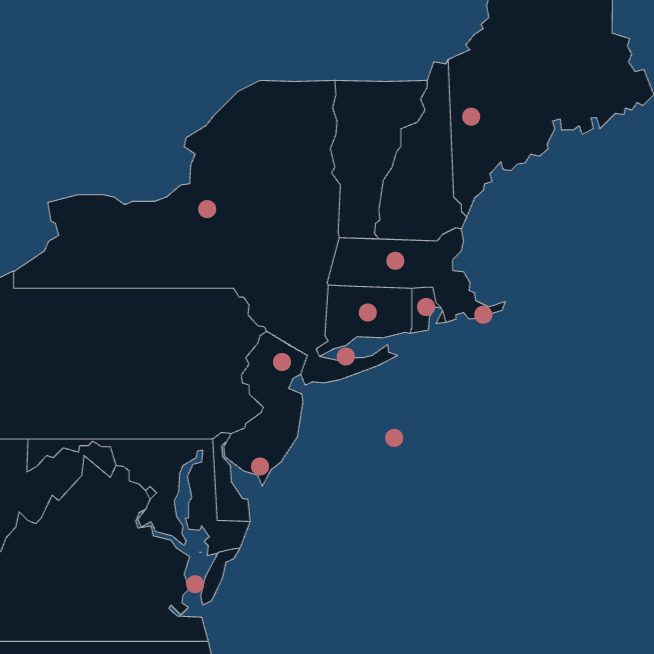


If you have lived in New England for any length of time, chances are you have crossed the Connecticut River. Rising up from a natural bog spring just south of the Canadian border in the town of Pittsburg, New Hampshire, the Fourth Connecticut Lake forms high up in the mountains at 2,660 feet above sea level, holding the distinction of being the headwaters for the Connecticut River. It is from this small lake that the Connecticut River starts its 410-mile journey through New Hampshire, Vermont, Massachusetts and Connecticut before discharging into Long Island Sound. Acting as the boundary between New Hampshire and Vermont, the Connecticut River is the longest river in New England and is widely known for its diverse fishery. Holding everything from trout and salmon to sturgeon and stripers, the Connecticut offers many opportunities for anglers to fish from both boat and shore. This past fall, with the foliage nearing its peak, I had an opportunity to head to Pittsburg, New Hampshire, to join the crew from Lopstick Cabins and Outfitters to explore this wild river with a fly rod in hand.

A deep pool above a series of rapids gave up a number of brookies and rainbows.
A lopstick is a tall tree trimmed of all but its topmost branches in order to serve as a landmark or marker. When settlers or woodsmen navigated through the Great Northern Woods, the practice of stripping all the limbs from some of the tallest trees except the very top branches helped create checkpoints. After five hours of driving from Cape Cod, I too was looking for a lopstick tree because our cell phones and GPS were spotty at best when arriving in Pittsburg, New Hampshire.

Although it was dark by the time we found our cabin, it didn’t take the sun’s rays to illuminate what made this place special. The lake was just outside our cabin window and the loons were quick to welcome us on that early October evening. The air had already turned to autumn in Pittsburg and the three of us were anxious to get unpacked and prepped for an early wakeup call to meet our guides, Bill Bernhardt and Greg Inglis from Lopstick Outfitters. We were to meet at 6am at the top of a trailhead that would lead us down to a smaller portion of the Connecticut River, where we would wade across what appeared to be more of a stream than a river. The guides knew this stretch held landlocked salmon, and with the heavy rains from the previous two days, our hope was that these fish were on the move. Since Lopstick Outfitters is an Orvis-endorsed shop, the fly rod I was to throw was a 6-weight Helios 2, which turned out to be a rocket ship—not that we had to throw that far. The fish we were targeting could range from 1 to 4 pounds, with the occasional 6- to 8-pounder in the mix, and as always, I was anxious to get after it. With Bill and Greg on either side, I started wading out, only to be reeled in and reminded that I needed to fish my way out.

All too often, the best fishing spots are just in front of you when entering a stream or river, but I have always been one to migrate to the obvious spots that looked to hold fish.
With my enthusiasm in check, I started methodically working the seams of the river, fishing behind each obstacle that slowed the normal pace of the water. These natural breaks in the river were opportunistic pockets for a trout or salmon to hold and ambush its next meal; with time on the water, they revealed themselves like lopstick trees to an explorer. I started out fishing a nymph with an indicator and patiently worked each boulder or obstruction that created the desired seams I was looking for. I tried less than a foot on either side of the pocket, but my indicator would follow the crimson and amber leaves downstream without so much as a sniff. When the indicator found its mark on the edge of the slower water, the nymph was able to drop down into the strike zone just off the bottom, drifting as naturally as possible. (When dead-drift nymphing with an indicator, an occasional mend in the line is a must so that the leader doesn’t overtake the fly on its journey downstream, thus dragging it from behind instead of presenting the nymph as naturally as possible.) With my rust off the fly rod and several nice fish released on the nymph rig, it was time to put away the appetizers and switch over to the main course … big streamers.

Over the years, I have had my opportunities to wield a fly rod from Canada to the Caribbean, but I would be the first to tell you that I am moderate at best when it comes to throwing the long wand. I have fished with many great fly fishermen, and that group now includes my Lopstick guides, who make throwing a fly line look effortless. Part of my problem is I go great periods of time not breaking out the fly rod, but on this occasion, much of the Upper Connecticut River was fly-rod-only. It was sink or swim for me and I chose to sink with the streamer!
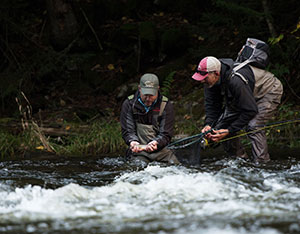
I had fished big streamers with guide Chris Jackson on the Deerfield River in Central Massachusetts the year before, with great success for big browns. So, when Greg indicated we were breaking out the streamers I jumped at the chance. Greg was quite adept at tying his own flies, and when he saw something on the river he wanted to replicate, he made short work of it. The plan was to land my custom “ginger ale” streamer (that Greg had tied the night before) upstream and let the current swing it down, presenting the good-size streamer as naturally as possible. Like the nymph rig, I was working the water from my feet out, with a definite target spot in mind that Greg knew held fish. I so wanted to strip out more line and get after that one spot, but if Bill and Greg taught me anything, it was patience is in fact a virtue. More often than not, the hits would come toward the tail end of the swing when the streamer would fall off at the end of the drift before coming tight with the main line. Often, I wanted to cut my drift short and snap up that fly line to find another home, but Greg had me hold the drift until the streamer settled out. It was right then that I started lifting the line when a beautiful landlocked salmon slurped my steamer, and I was on.

It wasn’t the biggest fish of the day, but it might have been the prettiest. Either way, the salmon didn’t disappoint, coming out of the water four or five times before coming to rest in the net. I fished the next two days, both above and below the First Connecticut Lake, catching countless brookies and rainbows with the occasional salmon mixed in. I watched as friends and fellow On The Water crew members, Adam Eldridge and Eddy Stahowiak, got in on the action and landed some of the nicest rainbows of the trip. At night, we took in the local atmosphere with our guides, sharing fishing from conquests past while enjoying a great dinner at the Buck Rub Pub, then retreating to our cabin overlooking the First Connecticut Lake. On the last night, Eddy and Adam got the fire pit going, we moved closer to the fire in our Adirondack chairs, and all agreed that we had just enjoyed God’s country.
[…] nearing its peak, I had an opportunity to head to Pittsburg, New Hampshire, to join the crew from Lopstick Cabins and Outfitters to explore this wild river with a fly rod in […]
Great article,
By far one of favorite places. I try to travel north (5hrs or more north of Boston) 3 times between late spring and early fall. Where some locations come and go on my radar, I have fished Pitsberg at least onec a year for the last 7 and always stay at the Loppstick cabins. Like a lot of you other readers out there I fish a lot of different styles and enjoy the targeting of multiple species. I always trailer my 16 deep V alluminum fresh water boat when traveling to Pitsberg. I spend one full day sun rise to about an hour before sunset in my waders fly fishing and one trolling one some times two if the action is slow on my first choice of 5 buitful lakes.
The 3 Connicut’s, Frannsis, and the smallest but a trip saver because of the amount of hold over stocked trout Back lake. As much fun as both days are what brings me my most enjoyment is how I spend the last hours of day light each night there, wadding in and spinn casting rate around the boat ramp at the 3 rd Conn lake. There is a huge drop off a few yards out and I’ll cast out a large spoon or inline spinner wait for what seems for ever to hit bottom then retrieve. I’ve cought 5 lake trout 2 with some decent size there. If you enjoy a awsome flyfishing, trolling and even the chance to cast from sure for big lakers then Pitsberg is for you.
Fly fishing only,
There are locations on the Connicut
between the 3rd and 2nd Con. lake.
It is also fly fishing only.
Have been told it’s only predactive in early spring and fall.
Below lake Francis is open to all gear lures and bait.