
Start your bottom-fishing season with Connecticut’s spring combo.
The month was April, and if my memory serves me right, it was a typical early spring day when my Dad, a friend of his from work, my brother and I all carefully made our way out onto the breakwall at Rocky Neck State Park in East Lyme, Connecticut. In the 1970s, sandworms were cheap and they were all the bait you needed when looking to put a few winter flounder in the pail. Because the only bycatch I can ever recall anyone hooking in those years were tomcod, our tackle was simple and consisted of medium-weight spinning gear and simple, store-bought flounder rigs.
About two hours into the tide, a shout from my father’s friend, combined with the sound of mono peeling off his spinning reel, commanded our undivided attention. Since he was perched on a rock outcropping with his rod held high, I could clearly see the trajectory of the large fish he had hooked and remember thinking it was quite odd that the fish was not only running parallel to the seawall but actually taking a turn and coming into the rocks!

As his line parted and the rod came straight, we all sat silent, staring into the water, wondering just how big the fish had been. While that was the first time I had ever witnessed anyone absolutely “freight trained” into the rocks by a big blackfish, it would not be the last time I would try to combine some winter flounder fishing with togging.
The main difference today is that while there are some areas, such as shallow shellfish beds and certain breakwalls, where both species’ habitats overlap, in most cases I now make a change of location when my target species changes. This is primarily due to the fact that in Connecticut waters, the flounder are simply not as prevalent as they once were.
As a rule, winter flounder begin the month of April in the upper reaches of bays and estuaries, where the dark, muddy bottoms soak up the sunlight and warm the water fastest. Later in the month, they migrate down the estuaries and out into Long Island Sound.

Spring tautog are on an opposite course, beginning the month where they spent the winter, out in deep water, and ending it spread out and feeding in the shallows.
Water temperature plays an important part in deciding where I concentrate my efforts in the spring. For the first two weeks of April, my main target is winter flounder, and I look for back bays where the water is close to 50 degrees. It might mean scheduling a “banker’s hours” trip, taking advantage of a running tide in the early afternoon when the sun has made the water its warmest. During this time of the month, the only effort I give to blackfishing is to run out at slack tide and try a quick drop on a deep wreck or rockpile. I have not found success with spring blackfish until the water is at least 48 degrees, and in early April that is hard to find out in the Sound.
By mid-April, however, it can be absolutely astounding just how quickly the schools of tautog migrate from deep to shallow water and go from a state of near dormancy to an all-out feeding frenzy. In Long Island Sound, when it comes to temperatures for spring blackfish, the magic number is 50. When it’s reached, it is time to schedule some days out of the office!

Most of my recent combo trips for flounder and tautog have taken place in Niantic Bay and Jordan Cove in eastern Connecticut. While some years have certainly been better than others, a breath of life appears to be coming back to the flounder fishery in this area. As for the blackfish side of the equation, this slice of the coast has plenty of options, from the rock piles near the warm-water discharge of the Millstone Power Plant, to some shallow wrecks and breakwalls.
An even more reliable destination for this April combo would be the waters of central and western Long Island Sound. Both Milford and Branford have had their share of winter flounder action, and the three breakwalls that guard the entrance to New Haven Harbor are close enough to try for blackfish. Each spring, some of the largest tautog landed in the state of Connecticut are pried away from these walls.
Farther still to the west, the nooks and crannies that make up the Norwalk Islands have given up some fine winter flatties, and there are plenty of wrecks to the southwest on which to target blackfish. Just be sure to remain in Connecticut waters during your search for tautog, as New York has not, of late, had a spring component to their blackfish season.
The bottom line when bottom-fishing Long Island Sound during the spring season is that the farther west you fish, the warmer water you will find. In years where the temperatures run low or there is a heavy dose of cool spring rains, be careful to plan your trips accordingly.

Fishing on the drift has become my go-to method for finding the sometimes scattered schools of winter flounder and I almost always deploy a “flounder pounder” to slow my boat and improve my bait presentation. I made my current pounder using a small tub of Quickcrete with a galvanized eye ring, but I have sometimes used a window sash weight or small mushroom anchor for this purpose. The flounder pounder is dragged behind the boat to both slow the drift speed as well as stir up the bottom. The silt, worms and small invertebrates dislodged from the bottom are carried down-tide and seem to attract the winter flounder. I use some clothesline and a brass clip to attach the pounder to a stern cleat, but no matter how you attach your pounder, just make sure to remember to pull it back into the boat before running up-tide for another drift!

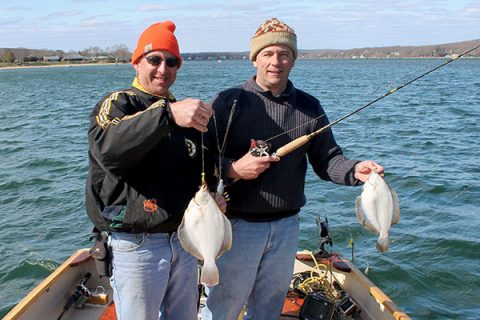
Since the typical Long Island Sound winter flounder will run 12 to 14 inches with an occasional 16- or 17-inch fish in the mix, I still use the traditional Chestertown hooks for most of my rigs. In fact, in recognition that this is still a recovering fishery, we usually do not keep flounder unless they are at least 14 inches long. In the rare cases when I am working a location where winter flounder and blackfish habitat overlaps, I will use the stronger Kahle hooks, which I know have become the standard up north where much larger flounder are targeted. All of my hooks are dressed with small, yellow Mister Twisters or Gotcha curly-tail grubs. This has made a big difference, especially when fishing on the drift.
Sandworms are still my most productive bait for Connecticut winter flounder. Both nightcrawlers and clams are distant runners up, and I believe the flounder fishery is the one area where the added expense for seaworms is totally justified.
For blackfishing in the spring, I always make sure to have some clam on hand, just in case the bait shops have not yet stocked up with green crabs. One of the challenges of spring blackfishing is that sometimes, due to the short season, shops will not have a supply of fresh crabs or they will have limited hours early in the season. If you have already purchased a frozen block of skimmer clam, you can get an early start on the day even if the shops do not open until later in the morning. Clam seems to appeal especially well to blackfish when the fish are still located in deeper water. Obviously, if you have already purchased some sandworms for winter flounder, any leftovers can be offered to blackfish.

While I have caught plenty of blackfish in the spring on soft baits, don’t believe the myth that hard baits will not work. My own experience, confirmed by the best bottom fishermen I know, is that some of the biggest tautog fall for crab each spring. When fishing shallow water in particular, both Asian and green crabs cannot be beat. If you know a bait shop that stocks hermit crabs, or if you can beg or barter for them from a lobsterman, they also are top notch for tautog.

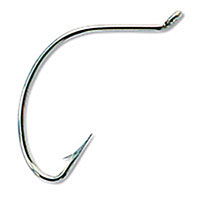
My rig of choice for blackfish in the spring depends on the depth of water I will be fishing. When shallow, a simple single-hook rig consisting of a dropper loop for the sinker and one dropper for the hook is all I employ. Hook selection largely depends on the bait I am using, with my all-time favorite for presenting a crab being a 3/0 Gamakatsu circle hook. If the offering will be clam or sandworm, then my preference is a 2/0 Mustad baitholder. In deep water, I typically offer two baits on a high-low rig, favoring crab on the bottom hook and some clam or sandworm on top. Light-tackle enthusiasts will find this a great time of year to use the relatively new method of catching blackfish on jigs baited with crabs.
The prospect of a two-flounder limit may be enough to prevent some Connecticut fishermen who remember the past bounty of this fishery from even taking their boats out of winter storage. It is also true that the unpredictable New England weather can make fishing for spring blackfish seem more like a fight against time, with water temperatures racing the season closure to the 50-degree mark. But, chasing winter flounder has always marked the unofficial beginning of the saltwater season for me and will always bring back fond memories of fishing with my Dad. That, combined with the challenge of catching some hard-fighting but elusive blackfish, makes both success and the fillets taste that much sweeter!
I’m heading out to niantic area on my hobie for some winter flounder pretty much for the first time, I. Have no problem with spring blacks, got some nice ones last season in Branford. What is the right temp. For winter flounder.
I want to know what type of boat you are using thanks John
That’s an amesbury sea dory, I recognize it because I own the same boat! Great boat for in shore sound fishing