
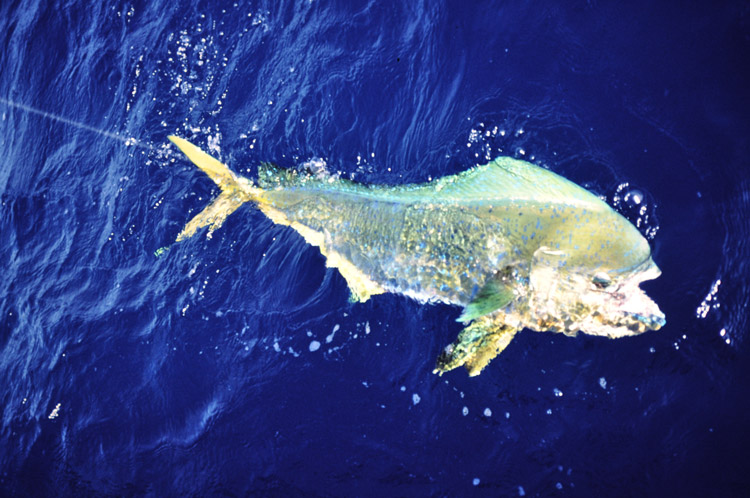
If you want to catch summer dolphin on fly tackle, get up early. At first light, the ocean is vibrant with life. Baitfish are driven to the surface by predators, like dolphin, that have rested all night. Now it’s breakfast time and the green hornets go on a feeding binge. Fly rodders do best at dawn before the fishing grounds get crowded and the fish get pounded with lures and baits, boat noise and wakes. As the disturbances increase, the fly-fishing action crumbles and stops, and by mid-morning the prime action may be just a memory.
Dolphin are usually more abundant around the 20-fathom line, but they can also be found thick as fleas around inshore lumps and ridges only a few miles from coastal inlets if the water temperatures are warm enough. Although dolphin can be found along Sargasso weed lines, the fly-fishing opportunities around fish trap and lobster pot markers are much more predictable.
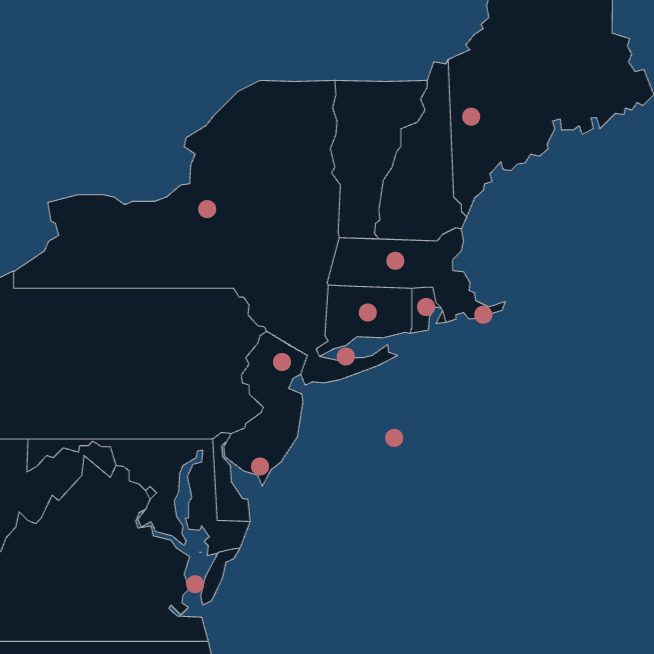
Because I fish out of Manasquan Inlet, I like to work the lobster pot markers along the edge of the Mud Hole or the grounds near the Barnegat sea buoy just as the sun pops out of the ocean. The East End and South Shore of Long Island and the South Jersey Shore also have numerous pot markers and sea buoys that attract dolphin. These are known locations, easy to run to without wasting a lot of time searching as when trying to locate an ever-changing weed line, rip or temperature break. Weed lines are a bonus to be enjoyed if found, but not as the only type of surface structure to find fish. A wind change from one day to the next will scatter the weed and the dolphin.
At first light, fly rodders can usually out-catch the trollers because boat noise
is minimized and the fish can be chunked into a feeding frenzy that can last for quite a long time. Dolphin spook easily so use the sun to your advantage by always approaching the marker from the west side and at idle speed to get within fly-casting range. Use the breeze to drift the boat past the marker with minimal boat shadow falling on the fish.
You’ll need at least one 5-gallon bucket of diced butterfish. Toss a handful of chunks toward the marker. If the dolphin are there, you’ll see them flash at the baits right away. Toss your fly near the marker and let it sink for two or three seconds, then strip with short, quick sweeps. The strikes are usually quick and hard.
I like to have two 10-weight rigs ready to go; one with an intermediate line, the other with a 350-grain sink tip. Rods like the Temple Fork 8-foot Mini Magnum are a good choice because they have plenty of lifting power and they can turn fish away from entanglements like the pot marker. “Grasshoppers” (smaller dolphin) won’t take much line, but a 15-pounder will make several long runs, so reels with good drags like the Islander LX 4.0, Ross Momentum 6 or Nautilus CCF 10 are good choices. Both outfits should have a 20-pound-class tippet and a 40-pound bite tippet to avoid cut-offs – dolphin have small, but sharp teeth. The first few fish you catch will be near the surface; perfect for the intermediate line, however, the school will eventually go deep and stop feeding on your near-surface presentation. Before moving away to the next pot marker, make a few casts with the 350-grain sink tip to catch another fish or two before the school totally shuts down. An added bonus is that the deep presentation will also catch larger gaffer-size dolphin, even while the little grasshoppers are still feeding near the surface.
During an aggressive bite, dolphin will chew standard flies to shreds so I prefer acrylic Surf Candies tied extra large on 2/0 hooks to about 3 or 4 inches in length; usually with lots of flash and a top wing of bright chartreuse or pink. Other patterns
that work well are Jiggies and Clousers, and marabou chum flies enjoy some popularity. Regardless of the pattern, have a good supply ready to go. When the bite is hot, it’s not unusual to go through a dozen flies or more.
Gaffing small dolphin is a real challenge because of the fish’s slim profile and because of its wild boat-side antics. Experienced dolphin fly anglers grab the leader and simply swing the little grasshoppers on board to drop them directly into the cooler then quickly slam the lid closed. Dolphin flip-flop like maniacs and make a mess of the deck if you miss the cooler. Nicknamed gaffers, dolphin over 10 pounds are best handled with a gaff, unless they are going to be released.
Dolphin are great fly-rod gamefish, fun to catch and delightful at the dinner table. They sure spice up the summer fishing scene, and can usually be counted upon for steady action.
Pete, I would love to tie into a Mahi next week, while I have the week off. I will be running by myself, so could you give me some areas to try out of Barny or the Squan. I only have an 8 weight medalist, so I will be using my TFO spinning rod. Thanks, Wayne
BTW, I still use my little white book you wrote in 1984.