

Above: photo provided by tom lynch • angryfish.tv
It starts with the weather. An onshore wind or an extreme tide brought on by the new moon will concentrate the baitfish along a stretch of shoreline. Striped bass, often on their spring or fall migration, recognize the potential of the conditions to create easy feeding, and they move on the bait en masse.
Making the most of the fleeting conditions, the bass throw caution to the wind, attacking anything that resembles their prey, stuffing their bellies beyond capacity, and then eating some more. This is where the fishermen come in. Some will have seen the blitz coming, seeing the tinder box of abundant baitfish and waiting for the match strike of incoming weather. Others will have been called into the action by a friend, and still others will have just gotten lucky and found themselves at the right place at the right time. Most casts bring a strike, and when the action finally ends, the fishermen head home with cut and swollen hands, aching arms, and a story they’ll tell for decades.
Some blitzes last an hour, some last a day, and some last nearly a week. The best ones are given names like the Snowstorm Blitz on Block Island, the Columbus Day Massacre on Martha’s Vineyard, or the Eclipse Blitz at the Cape Cod Canal.
Some happen in the middle of the day, and some happen in the black of night. Some blitzes have spectacular surface action, while others, especially the nighttime ones, happen near the bottom and out of sight.
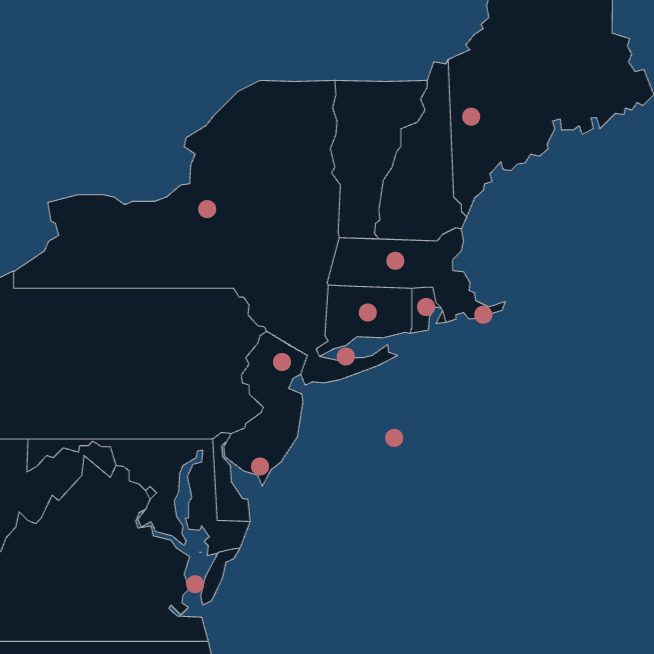
Among Northeast surfcasters, the only criteria for a blitz are big numbers of baitfish, big numbers of striped bass (or maybe bluefish), and a crowd of fishermen. The location, the baitfish, and the time of year are all highly variable, and to demonstrate that, we collected blitz stories from surfcasters throughout the Northeast.
– Jimmy Fee
High Flier Blitz
by Steve McKenna

It was about 6:00 p.m. when I left my house at Pete’s Place to walk down to the southwest corner of Cuttyhunk Island. It was about a half-hour walk, and I wanted to give myself enough time to get there with ample daylight so I could check around for structure and start fishing just before dark. I had fished this section of the island the night before and caught several decent fish, so I was excited about my chances. I would be fishing alone because all of my Connecticut Surfcasters housemates were equally paired up, and I happened to be the odd man out. I didn’t really mind, though, as they had invited me on this trip and I was thankful to be there. It was my first time surfcasting on the island.
It was a beautiful late September evening with clear skies and light southwesterly winds as I walked along the only path to the western side of the island. This fairly straight dirt road closely parallels the southern cliffs most of the way to my destination. The cliffs were high, and my hosts had mentioned that there was only one access point down the cliff to the south-facing shoreline. This access had been previously marked by surf-fishermen who wanted to be able to find it in the dark. They placed some flotsam, which included a 6-foot-tall high-flier that still had some reflective decal left so it could be easily spotted with a surf man’s neck light, even on the darkest of nights.

About ten minutes into my walk, I spotted the junk piled up on the bluff. I left the path and walked over to it while scanning the water below. The pathway down to the rocky beach was a gradual mudslide with steps, but it was only about a 5-foot drop. I was going to continue on to my destination, but something told me to go down to the beach below and make a few casts.
As I scanned the water, I thought to myself that it looked really “fishy” due to all the boulders in the water as well as a cove off to the north with a pronounced point on the opposite side, all within easy walking distance. As I clipped on a 5-inch Red Fin, I noticed baitfish spray out of the water, directly in front of me about ten feet out. It was small bait, but still a good sign.
I made about three casts toward where I saw the baitfish when a small schoolie grabbed my plug. I continued to fish, moving to the left and then the right. I picked up another small fish about 20 minutes after the first one. The sun had set, and it was time for me to make my way to the southwest corner. But, because I had just caught two stripers (albeit small), there was some bait present, and the water and structure looked so good, I decided to stay a bit longer just to see what would happen after dark.
I changed lures over to a 9-inch black Slug-Go and continued casting. A few casts later, it was slammed by a good-sized bass. I eventually landed it and measured his length against the 40-inch mark on my rod. The striper was several inches past the line and had a healthy girth. I estimated it at 35 pounds.
The bass had ripped my Slug-Go apart, so I replaced it with an identical one. I made another cast into the same area and got hit immediately. About five minutes later, I had another 40-plus-inch bass lying at my feet. I removed the hooks, quickly measured the fish, and released it. I had to change the Slug-Go again as it too was destroyed. I repeated this scenario several more times, catching and releasing another 6 stripers all well over 40 inches, with two over 40 pounds. I continued to fish, and the stripers continued to hit my black Slug-Gos. The fish were getting smaller as the night went on, and the next several were between 35 and 40 inches, maybe 16 to 28 pounds.
At that point, I faced a minor dilemma, as the 12 pre-rigged Slug-Gos in my bag had all been destroyed. I decided that the Beachmaster Wadd needlefish I had most closely resembled a 9-inch Slug-Go’s size, so I clipped it on. The needlefish plug hit the water and I made about three cranks of the reel handle when it was smoked by a 25-pound bass. I continued to catch several more decent stripers with the needle. When I finally took a break, I guessed I had landed and released about 25 bass from 15 to 40 pounds, with plenty of hits and misses. I was ecstatic and tired—sweat and condensation drenched the clothing underneath my waders and Grundens top. It was about midnight, so I decided to pack up and go back to the house for something to drink and a change of clothes.
After refueling and resting, I decided to go back to the spot, but not before leaving a note for my housemates about my good fortune, along with directions to the “high flier” locale.
I arrived at about 1:30 a.m. The water was low, but the tide was still ebbing out and, to my surprise, I still had the spot to myself. The needle was still on my rod, so I let it fly. After a few casts, I had another hit and set up; the bass fought hard and it took more time to land it. It was another good one, about 46 inches long, with a big stomach. I attempted to revive it, but the big fish was spent and wouldn’t swim away, so I made the decision to keep it.
I caught another few fish when I noticed two, then three, lights bouncing down the path to the shoreline. I hoped it was my housemates or a couple of buddies from the Connecticut Surfcasters Association. One of them approached me while the other two walked into the surf and proceeded to fish. I called out to him, and learned it was my friend, Toby. I filled him in, and he related that he had been to the house and saw my note. He also noticed the fish lying on the beach and weighed it on his hand scale—38 pounds. He then moved to my right and started casting.
I continued to fish, catching and releasing a few more teen-sized fish, and at about 3:00 a.m., decided to call it quits. I was exhausted and totally satisfied with my second night of fishing on the island. Later that morning. I found out that my friends continued catching well after I left, landing many more good-sized stripers.
Striped bass blitzes from shore are rare, and when they do occur, there are usually crowds of fishermen and smaller fish. Even rarer are blitzes with big bass and few fishermen. On that September evening, I totally lucked out by being the only fisherman for several hours while a school of striped bass fed along a desolate stretch of shoreline on Cuttyhunk Island.
Tropical Storm Jose Melee
by Dave Pickering

On September 19, 2017, tropical storm warnings were posted for the southern New England coastline as Hurricane Jose barreled toward our shores. Based on past success on stormy days, I had to fish but needed to be in a protected area. So, I decided to head to the Cape Cod Canal, which is fishable in just about any weather.
Upon arriving at the Canal, I was greeted by a howling wind, off-and-on driving rain, fog, and a faster-than-normal flow of moving water from east to west. As I rode my bike northward along the service road, I scoured the water’s surface for signs of fish. I rounded a bend, and there it was. Schools of mackerel were pinned up against the shore and getting blasted by large stripers. And, there was not a fisherman in sight. It was an angler’s dream—finding big numbers of fish and no other fishermen!
I scrambled down the rocks to where the frenzied mackerel were being driven into the rocks and on to the shore. At times, large stripers were so close that I could have touched them with my 10-foot rod. I snapped on a Daiwa SP Minnow in a mackerel color and started casting parallel to the shoreline, the zone where most of the stripers were feeding. Right away, I hooked up with a big fish that went on a drag-screaming tear down the current. I finally got that first one ashore, and it measured 40 inches—a size that proved to be the norm on this day of big fish. I proceeded to hook up on cast after cast because the fish seemed as charged up as the weather. As the tide continued to drop, more and more mackerel were washing up as more and more keeper bass were after them. This went on for an entire tide with almost nonstop mayhem. As the blitz proceeded, a few other fishermen came down to get in on the action, and they were also catching on just about every cast.
After several hours, the tide began to slow, and the action slowed with it, but not before I landed dozens of stripers in the 38- to 45-inch range, and a lone big blue. When the action ended, the shoreline was littered with thousands of dead mackerel that had to choose between beaching themselves and being eaten.
This was the biggest blitz of large fish that I have ever experienced so close to shore in the middle of the day. It was a prime example of how nasty weather can light up the fishing.
Steve M writes well and I could smell the salt air…thanx Fee