


Back in 2002, my fast-developing addiction to surfcasting had led me to Montauk, the Mecca of my favorite pursuit and home to some of the most hardcore and pioneering fishermen on the planet. Taking spare commercial fishing jobs to fund my addiction, I quickly fell in love with another of Montauk’s famous gamefish: the summer flounder.
Working on the half-day fluke boats, I became obsessed with developing the most effective technique for targeting these hard fighting and sometimes finicky fish. As fluke regulations continued climbing to near-ridiculous proportions, all keepers suddenly needed to be pushing “doormat” status simply to make it into the box. Perhaps more importantly, it became important to weed out the countless short fish littering the bottom.
After several summers of trial and error, a few fishing buddies and I landed on a rig that seems to accomplish just that. With a few modifications to the “fluke ball” rig, we have been able to fish large baits that weed out smaller fluke, all the while keeping it in the strike zone of trophy-sized flatfish. As the rig began to prove itself as a big-fluke catcher, we jokingly began calling it the “fluke bomb” rig, and the name has stuck.
When creating this rig, the first piece of traditional fluking equipment that had to go was the hook. The traditional fluke hook (Kahle-style hook) came into popularity when summer flounder size limits were between 12 and 13 inches, and those little offset gold hooks did a number on those pan-sized fish. Now that the measure is nearly twice that size, these small hooks leave a little something to be desired. In fact, with the current size restrictions on fluke, those under-gunned hooks actually do more to hurt your cause than help it. In order to understand this point, you’ll need to visualize what the mouth of a 22-inch fluke actually looks like. It is much closer in size and shape to a striped bass or bluefish mouth.
A shiny chrome ball weight is central to the rig. I’d seen these chrome “fluke balls” while working in various tackle shops through the years, and I’ll admit, I largely passed them off as a gimmick. Usually you’ll see them with two swivels soldered at 12 o’clock and 9 o’clock, and a hook-and-skirt attached directly the swivel at 9 o’clock. The set-up looked like a poorly designed bucktail jig to me, and I doubted it would be as productive as the Spro bucktails that are my favorite for bucktailing fluke. However, seeing just the chrome ball itself for sale in all the relevant weights spawned an idea for a new fluke rig to solve a reoccurring problem when deep water, strong currents or large numbers of anglers prevent bucktailing from being a viable option for doormats.
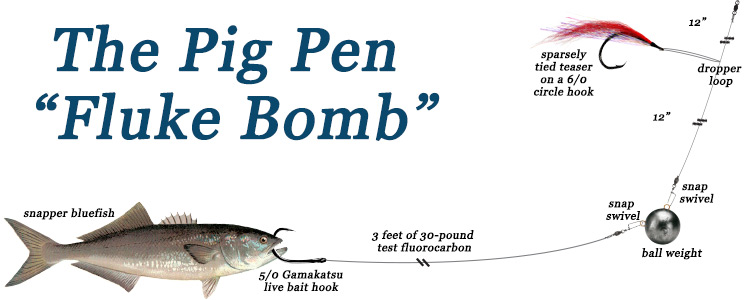
My “fluke bomb” starts out with a 50-pound-test barrel swivel attached to a 3-foot section of 30-pound-test Seaguar fluorocarbon leader material. Put a 6-inch dropper loop at the halfway point of the leader material and attach a large teaser with lots of flash. I like a bucktail/marabou combination tied on a 6/0 Gamakatsu circle hook. I go with chartreuse and white most of the season, but from time-to-time, other colors like red, blue, orange and yellow will draw attention from the large fluke in the area – especially late in the season. This large, flashy teaser above acts much like the teasers used marlin fishing – drawing fish in for a closer look only to have the large trailing bait seal the deal. At the end of the leader material, I attach a snap swivel to which I clip a fluke ball of enough weight to hold bottom. I then cut second 3-foot length of 30-pound-test fluorocarbon, attaching it to the 9 o’clock position on the fluke ball with another snap swivel. Tie the hook for your main bait onto the trailing end of the leader material; the exact hook will vary depending on the bait being used. For “snapper” blues (juvenile bluefish), I like to use a 5/0 Gamakatsu live bait hook.
The bait I use for this rig follows a simple but easily overlooked philosophy – use the largest bait available to doormat fluke at the time of your trip. These options vary though the season, so you’ll need to adjust your bait choice based on the time of year. In spring, my bait of choice is a large squid, rigged whole. As the season progresses, snapper blues quickly become my favorite bait. I’ve experimented with many techniques for rigging the snapper, and I continue arriving at one of the simplest and first I ever learned: rigging the snapper in the same manner you’d rig a shiner for largemouth-bass fishing – from the bottom lip through the top.
Catching Snapper Bluefish for Bait
One of the nice things about snapper blues is that they are easily acquired, and even headboat anglers can catch a supply of them before the boat leaves the dock. Getting to the dock about an hour before departure should give you plenty of time to load up on bait for the trip.
An inexpensive and durable 5 to 6-foot, ultralight spinning setup and small assortment of trout metals are perfect for quickly loading up on snappers. I use a 5-foot, medium-light action Ugly Stik spinning rod with a Cabela’s Fish Eagle FE500ULB spinning reel. Long casts and intermittent twitches during a quick retrieve with an 1/8-ounce silver Kastmaster from the stern of any fluke boat should attract plenty of attention from the ever-present summertime snappers.
Fishing the Fluke Bomb

When fishing the fluke bomb rig, I use an Avet SJS on a medium fast-action Lamiglas Tri-Flex blank. I really enjoy this set up for a variety of reasons. First of all, I enjoy the positioning of the drag lever on the Avet. It’s setup like a conventional offshore drag, allowing me to effortlessly engage and disengage the reel with my thumb. This is a near essential reel characteristic for properly fishing this technique, since you’ll be constantly letting out and picking up line in order to stay in contact with the bottom. The Tri-Flex from Lamiglas pairs nicely with the Avet and the fast-action model is ideal. The responsive tip allows for the rig to be bounced effortlessly along the bottom and the meaty
backbone of the Tri-Flex will wrestle even the most stubborn flatfish off the bottom.
Check the bait to make sure the presentation is natural before sending it to the bottom. I will pay out just enough line so that the rig is in the current, but I can still see it, in order to check if the bait is spinning unnaturally. Upon hitting bottom, I leave the reel in free spool, applying pressure with my thumb as I hop the rig along the bottom with gentle lifts of the rod tip. How much action to give the rod is heavily dependent upon the size of the swell – the goal being to bring the fluke ball 2 to 4 feet off the bottom, causing the large trailing bait to “wave” enticingly in the current.
Keeping the reel in free spool accomplishes two important things for the angler. It allows for easy adjustments as the depth changes and the boat pitches, and it makes it easy to instantly give slack line to an attacking fish. Lowering the rod tip and “thumbing” some line off the spool is crucial to getting good hook-ups when using large bait. After lowering the rod and giving a biting fish some line, lock up the reel and give your best Jimmy Houston impression. If you swing and miss, which will happen with any technique from time to time, immediately put the reel into free spool and drop back 10 to 20 yards of line. With the fresh taste of snapper blue on the brain, the doormat will often be willing give chase in order to complete the meal. With a little practice, this technique quickly becomes second nature and is one of the most surefire ways to boat double-digit doormats all summer long.
Believe it or not, another nice bait I’ve found for weeding out the guppies is full herring on a similar setup. I keep a couple dozen in the freezer from the winter run. Largest fluke I’ve taken has been on one, 9lb6oz. Mind you, it’s still frozen bait…
try a small blue claw crab
just so readers aren’t confused you use an Avet SXJ correct? That is my choice for fluking.
[…] sounds neat, saw it the other day on another forum http://www.onthewater.com/deploy-fluke-bomb/ Misguided 21' Boston Whaler Outrage Marlinhunter36@gmail.com Reply With […]
How can you use a circle hook and regular hook together. If you hit the fish instead of reel straight in it wont set the hook. The opposite is true on regular hook. If you just reel straight in you wont set it
Good point
The hook on the teaser seems pretty irrelevant as will be taking the snapper blue
were can I buy the chrome balls online ?
https://www.terminaltackleco.com/new_category
try theses guys
Where can I purchase the chrome ball rig???
just got them at Walmart – 6,8,and 10 oz. with teaser rig start at 7 bucks.
What Walmart I am down here in Virginia. Do you have the address of the Walmart you got the chrome balls?
eBay. Search for “fluke ball”. You can find them chrome plated, painted, or “as is” from the mold in sizes from 2 to 16oz.
You want brass balls? I got em right here.
Big Balls can be purchased at your mom’s.
Try Atom tackle. You may need to buy a complete rig and the strip it down or customize it yourself.
where is ATOM tackle located
Captains May I take the time to add to what was already said about fluke fishing with sanpper blues.
Dont let the snapper die in a bucket or on the deck. They die with their gills open and the bait will spin when used. Not good!
Smack the snapper on the deck or hit it in the head.
Butterfly dead snappers if running low on live ones.
Do you use live snappers or dead ones?
Both will work, but if you can keep the snappers alive until you get to the flukin’ grounds, that would be the best.
Thank You guys that was some great information
Can’t believe he called the fluke bombs a gimick. They catch no doubt. Especially tipped with fluke belly. You softly tick it off the bottom. Bang it too hard and it’ll scare fish. Big lifts without dropping it so fast it bangs the seabed.
I use the shmorgisborg technique fluke belly or squid with a little live bait: minnow or snapping blue to get some motion
Where are you guys finding Snappas small enough for fluke bait? I only catch fairly large ones, don’t see them that small.
Skipjack (local name) are around in the fall, they hit anything like other blues, I find them pretty much anywhere. You actually can miss them, it’s hard to think such a large fish comes from something the size of your hand. I use trout lures, they are cheap enough, and I put them on a light rod. Go to Wal-Mart buy a kids rod, even if it’s pink, throw on a trout spinner, cast it out and retrieve. Usually the month of August you’ll find them. If you want this year, I’ll do a video and post back on here.
I always have trouble finding the blues, any where specia?
That would be great .
Very nice rig. Tried it this weekend with much success. Squid strip and gulp on bottom hook and gulp on teaser. Can’t wait for snappers to roll in for live bait on bottom hook. Tried whole squid, no takers.
Good point
The heck with chrome balls, I have brass balls!
The non – chrome plated fluke balls are lower cost than the chrome plated from the source l found. Is it okay to go cheap and use the lead color ball or is the shiny chrome ball required?
I plan on using this rig when more than 6oz is needed to hold bottom. I don’t like going above 6oz with bucktails.
What are the best sized snapper blues to use?
Something I am trying to determine is what is the best depth of water to fish for doormat fluke? I have caught keepers anywhere from 4 foot and up to 100 feet, what depth is optimal to target the big ones?
I can’t find these chrome balls with the double eyelets anywhere does anyone have a source I can contact to get some.
Thanks
I got mine at Peace Token Tackle in Rio Grande, NJ (Near Wildwood).
Try jigsrigsandstuff.com. They come prerigged with the trailer in different colors and weights. Price is reasonable.
Will peanut bunker work instead of snappers?