


The ocean had been good to me. Earlier in the day, I had run out to a wreck that lay off Fire Island, and put a bunch of good sea bass on ice. None of the fish were less than 15 or 16 inches in length; the biggest weighed close to 4 pounds. Now, their last earthly remains lay before me, gazing up from the kitchen sink’s featureless basin. My first thought was that sea bass have really big heads. My second was that I hated to waste all of the meat that was still in those heads and stuck between the bones of the filleted-out racks.
So I didn’t.
In just a few minutes, I had a big water-filled stock pot on the stove. As I waited for the water to boil, I cut the gills out of the heads and threw them away, along with the sea bass’ innards. Once the water began to seethe, I dropped in the cleaned heads and racks, along with some roughly cut carrots, celery and onions, and let the whole thing simmer for an hour or so. Then I shut off the stove and let the broth cool.
The result was about two gallons of a wonderfully flavorful fish stock, that was so rich with gelatin that it congealed as it cooled. Strained and frozen in plastic containers, it later formed a rich base for fish and clam chowders.
Later, I prepared a Chinese-style dish by placing a sea bass fillet in the bottom of a bowl, then filling the bowl with boiling stock mixed with ginger, soy and some thinly-sliced scallions. The hot stock cooked the fillet perfectly, creating a unique dish that can be served as the first course of a multi-course meal or served alone when folks want to eat light.
After all of the stock had been drained from the pot, a disarray of heads and bones remained behind. It didn’t take long to strip them of their meat, which my wife, Theresa, used to make fishcakes the following evening.
All of that would have been wasted if I had merely filleted the fish and disposed of the rest, as anglers normally do.
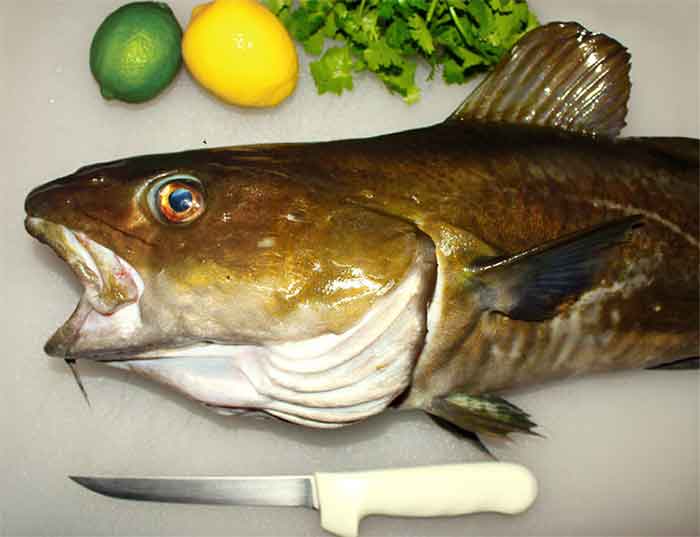
Heads
- The heads and racks of bigger fish yield big flakes of meat. Use the head to make a stock, then remove the leftover meat and add it to fish cakes or a chowder.
Skins
- Fish skins (with scales removed) can be scraped down, cut into small pieces and deep-fried. If done correctly, the result is similar to Spanish chicharrónes, which are similar to crispy pork rinds.
Fins
- The fins contain cartilage, which adds flavor and helps thicken fish stock.
Cheeks
- Cheeks are a particular delicacy. Cut out, they form thin, perfectly boneless fillets that can be simply breaded and fried, poached, or incorporated into more complex dishes.
Tounges
- Tongues are another edible part of the fish that most Americans seldom think about eating. “Tongues” come from the section of flesh and cartilage that makes up the throat of the cod. Cut them out with scissors and fry ‘em up.
Gills
- The gills are one of the few things on a fish you don’t want to eat. Most chefs reccommend removing them if using the head for a stock, as they can add a bitter taste.
Roe
- Dining on the ripe roe sacs of fish is a tradition for many coastal cultures. Shad roe is the most common encountered in the Northeast, but blackfish, sea bass, white perch, and several other local fish can also provide good eating roe.
Just about any white-fleshed fish lends itself to such treatment. The first time I ever made fish stock, I used a striped bass. Blackfish also work well. Cod are the classic chowder fish, and other members of the greater cod family, including the various hakes (those that we call whiting and ling), pollock and haddock are also natural choices. Although I’ve never tried making stock out of sea robin, it’s traditionally used in French bouillabaisse, and should serve just as well on this side of the ocean.
The heads and racks of bigger fish, such as stripers, large blackfish and cod, yield big flakes of meat when the stock-making is done. Those big flakes are perfect for chowders, since they hold together well throughout the long cooking process.
Smaller fish yield finer-grained flesh that can easily fall apart in a soup. Their meat is better used for fish cakes, where it can be combined with other ingredients and bound together with eggs. However, there are no hard-and-fast rules. Codfish cakes have long graced fishermen’s tables in New England, and you should feel free to make a black sea bass chowder any time that you want one.
Stocks and chowders provide an easy entrée into the world of snout-to-tail dining, but that world just begins with boiled racks and heads.
Two very underappreciated parts of the fish are found in the heads not destined for chowder. Cheeks are a particular delicacy. The “cheek” is the pad of flesh that extends from behind and below the eye of a fish back toward its gill covers. Cut out, they form thin, perfectly boneless fillets that can be simply breaded and fried, poached or incorporated into more complex dishes.
Cod cheeks have been eaten for generations, and sometimes even show up in fish markets, but cheeks can be taken from just about any fish large enough to make the effort worthwhile. They can even be taken from fish that are too strongly flavored for fish stock or chowder, such as bluefish and tuna.
“Tongues” are another very edible part of the fish that we seldom think about eating, but are very popular elsewhere. I put “tongues” in quotation marks since the term is deceiving. When a cook talks about preparing cod “tongues,” he’s not talking about the muscular organ in a cod’s mouth, but the section of flesh and cartilage that makes up the throat of the cod.
When I hunted caribou in Newfoundland a few years ago, I was surprised at how often cod tongues showed up on the menu. The original Newfoundland settlements were built around cod, and, ever since the 16th Century, the seafaring citizens of that sea-girt land have made them a big part of their diet.
Sautéed cod tongues show up on Newfoundland restaurant menus as appetizers, as parts of mixed seafood platters, and as the main course. Although the taste was fine, I have to admit that I didn’t care for their somewhat gelatinous texture. However, many thousands of Newfoundlanders disagree. They dip their cod tongues in flour, fry them with fatback, and have made them a celebrated island tradition.
Dining on the ripe roe sacs of fish is also a tradition all along the coast. Up on the Hudson River, and on many other rivers as well, feasting on shad roe is a treasured rite of spring that dates back to colonial times. In recent years, overfishing, water quality problems and dams blocking fish passage have caused many shad runs to dwindle. As a result, managers have prohibited shad harvest in many waters, including the Hudson (although harvest continues in the nearby Delaware River), which often makes shad roe difficult to obtain. However, a number of fish offer alternatives.
Theresa and I first experimented with eating roe about 30 years ago, after we pulled a bunch of May blackfish from an inshore wreck. The females’ roe sacs were big, ripe and swollen, and called out for a simple cooking approach; perhaps nothing works better than giving the sacs a light coat of flour seasoned with pepper and salt, then sautéing them briefly in butter, being very careful not to cook them too long.
The result is a rich, slightly moist, slightly briny mouthful that can be served alongside the fish during dinner or, served atop some soft lettuce leaves, enjoyed as an appetizer ahead of the meal.
Another alternative is to poach the sacs in butter, water, fish stock or white wine until the roe turns opaque. Each results in a very different dish. Water, preferably with some herbs added in, preserves the pure taste of the roe; fish stock enhances its underlying “fishy” nature. Butter adds richness, while white wine adds an entirely new layer of flavor that reflects the wine being used. Sauvignon blanc adds an acidic tartness and notes of citrus, while a dry Riesling or steelfermented Chardonnay imparts hints of fruit. Some wines should be avoided, such as sweet varietals, including those labeled “semi-dry,” and oaked Chardonnays that might mask the clean, sea-fresh taste of the roe.
Today, New York’s blackfish season is closed during the spawn, although other states’ seasons are open. However, ripe roe can still be obtained from weakfish and black sea bass. Sea robins, white perch, winter flounder and, very occasionally, striped bass, can also yield ripe roe. If you fish in fresh water, roe from pike, pickerel, yellow perch, trout and salmon can be harvested along with the fillets. Never experiment with roe from our local blowfish. While their meat is free of the deadly tetrodotoxin found in the infamous fugu, small amounts of toxin can concentrate in their eggs and internal organs.
Except for that one warning, the world of snout-to-tail dining is one that anglers should feel free to explore. I’ve only touched the surface, describing a few simple ways to get more enjoyment out of the fish that you catch, but there is plenty of room for experimentation. Maybe you’d like to make fish roe omelets or try the “tongues” of bonito and stripers. In eastern Asia, “fish maw,” the dried and/or deep-fried swim bladders of fish, is considered a luxury food akin to shark fins and abalone that are made into soups and fish stews.
Your imagination and the Internet are your friends. Work with them, and you’ll find new ways to enjoy fish that you’ve been eating for years, and will prepare meals that were once the sole province of specialty restaurants and celebrity chefs.
Enjoy!
Thank you for the great read. We in the states waist so much of the meet of the fish where in other countries they eat the whole thing. Fish head soup is delicious. Also scup when scaled, gutted and fried or grilled is delicious and produces more meat then just filleting it.