
The other night my daughters reminded me that nighttime can be scary, because everything looks unfamiliar, and who knows what lingers in the shadows? I was terribly scared of the dark as a child, and admittedly uneasy of night’s blackness in early adulthood. So I sympathized with my daughters as I turned on their globe light to ease their fears, and told them that nothing was lingering in the shadows. As they drifted off to sleep, I thought about how I shed the fear of darkness and started embracing the blackness of night.

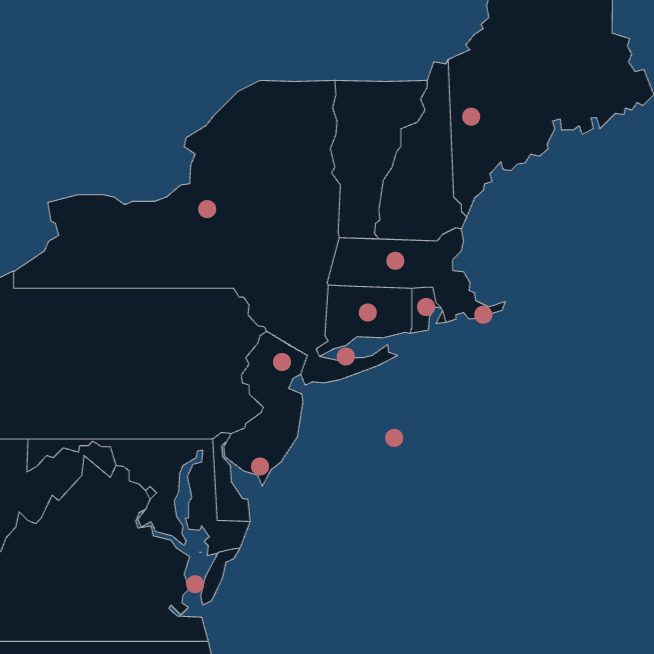
That’s right, I now enjoy night’s dark presence. It really became my best friend four years ago when I started surf fishing the shores of Martha’s Vineyard during the night with my father and brothers. We were drawn to the island in the pursuit of landing more and bigger striped bass after reading stories about how good the fishing can be during the spring. We fished at night because conventional surf-fishing wisdom holds that larger bass are willing to feed in the shallower water close to shore during the security of night. Now, I’m not a total chicken, so standing on the beach at night with my family by my side was doable. However, I still felt a little uneasy about what may (but rarely does) linger in the shadows. In addition, I had only surf fished during the day on soft, sandy New Jersey beaches, so attacking the rocky shores of Martha’s Vineyard at night frightened me to a degree.
Night one on the beach was alright. We hired Captain Phil Cronin of Capawock Charters to give us a guided tour of the island and set us up at a good spot for our first night. Phil is a great guide and primarily charters fly-fishermen by boat, but he agreed to provide what we asked for at a very modest price. We ended up fishing a mullet run on the Vineyard’s famed Lobsterville Beach. The day quickly faded into dusk, which gave way to night. No waves, a soft-sloping pebble beach, plenty of light pollution from adjacent houses, and bass feeding on mullet at our feet eased me into the idea of walking the beach with less than ideal visibility. What I noticed more than the absence of light was the absence of people. Most people had left the the beach around 10 pm, and by midnight the only souls left on the beach were us four fishermen and one other holdout. Now, the catching had dropped off significantly, so I dismissed the mass exodus more to that than anything else.

Three days later, as we stood on Lamberts Cove beach, thigh deep in the middle of a beautiful boulder field, heavy cloud cover with a light mist crept across Vineyard Sound. The bite continued to be consistently good, daring us to stay later and later. My nervousness grew as the blackness pushed closer and closer, marked by the progressive extinguishing of lights on the opposite side of the sound. At the same time, my desire to stay on the fish increased. After the fog rolled in, using sight to guide any action wasn’t an option because seeing my own hand in front of my face was impossible. It was black as black can be, and I stood there motionless for what seemed like an hour. Half gripped by fear and half wondering how to get out of the situation without feeling like I ruined everyone else’s fun, I struggled to keep calm.
In my mind I imagined everyone standing around the truck laughing about leaving me out there to fend for myself. However, I knew they couldn’t slip past me without a light on, so they were out in the surf somewhere. As I stood motionless praying for a ray of light I became aware of the warm cork handle of my rod in my hand. Then I noticed the weight of the 6-inch Slug-Go, bobbing in the wind at the end of my rod. I felt the cold water on my thighs and heard the wash several feet behind me. It dawned on me that I knew how to fish, so why would I need to see to fish?

I mentally walked through the steps of casting and focused on the feeling at each phase of a perfect cast. I went through my casting cadence and launched my lure into nothingness. Wow, that first cast felt like it went twice as far as any cast I ever made in the presence of daylight. Suddenly, I was fishing! Now what? I couldn’t watch the lure’s action or how the line was tracking in the water. All that was there was a slight feel of a weightless Slug-Go slipping through the water. I wondered how a fish could ever find my offering in that kind of darkness, but I knew the fish had been there before the fog rolled in so I kept casting. BAM! The first explosion was like a jolt of electricity traveling up my arm, across my chest and stopping my heart. I have no idea how close the fish really was, but I felt the spray of water hit my hands. Unquestionably the coolest fish I had taken from the beach! A solid bite lasted for several hours as my buddies and I were inducted into true nighttime surf fishing. What happened that night transformed how I look at surf fishing, and the blackness of night.

A cool aspect of surf fishing is the personal progression from being a newbie or “googan” to becoming an experienced surf “sharpie.” Everyone is somewhere on the spectrum, gaining knowledge, learning, and growing to become a better fisherman. I have learned many things about myself and fishing since becoming a nocturnal surfcaster and embracing blackness. The absence of sight forces a fisherman to focus on the other four senses to successfully guide him. With no light, minutes feel like hours, and there is plenty of space for the mind to focus. This gives ample opportunity to pray, think about family and friends, and learn how fishing should feel when done properly.
Things are learned quickly in the forced concentration that comes with operating in the dark – like how skimming a needlefish plug across the bottom with a slow, steady retrieve, rather than using a jigging action, produces more strikes, or how using a bucktail jig as a mapping tool to identify hidden drop-offs or adjacent boulders creates a terrain map that can guide you to fish. You learn how to sense when you’re reeling slow enough to create a wake on the ocean’s face with a Sharp Eye swimmer, which produces more fish than swimming it below the surface. The craziest thing I’ve learned, and cannot figure out, is that color seems to matter to striped bass, even when it seems there is no light available.
The most practical thing about night surf fishing is that very few people participate. Between the hours of 10 pm and 4 am, I have fished world-famous coastlines with only the guys in my party to share it with. For hours we fish uninterrupted, enjoying the beach to ourselves. Sure, there will be crowds at dusk and again at dawn, but between the two very few people prowl the coast. You can also gain access to many beaches that are off limits during the day for one reason or another. In my opinion it truly is the best time to really enjoy and get the most out of the sport of surf fishing.
Prepare
Fishing in the dark requires caution. The first rule is to always bring a fishing partner. If that is not desirable to you, at least be sure to leave a detailed fishing plan with a family member or friend. The fishing plan should have beach arrival time, location (a marked map is ideal), a cell phone number, and beach departure time. If the plan changes during the trip, be sure to e-mail or text changes to the person with whom you left the plan. (Calling someone at 2 am is not often well received, but you may want to consider it if plans change significantly!)
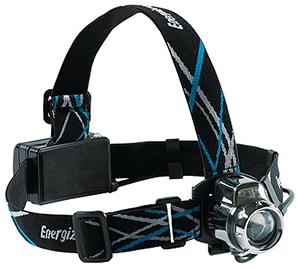
When entering the beach, mark the trail head to avoid wandering the beach looking for that small seam in the dunes that disappears so quickly after walking ten yards down the beach. Using a walking stick or a surf rod with an extra-tough butt cap to locate hidden rocks in shallow water or on the beach to help avoid unwanted spills. Pack a red light flashlight or headlamp for changing lures, tying knots, and adjusting tackle to preserve your night vision. Use a brighter, white flashlight for extra light to unhook fish and walk trails to and from the beach. A compass to provide direction is important when you can’t see land formations or lights. It is even more critical while walking sand bars or flats when there is minimal wave action. Losing direction is easier than imaginable when it get really black and fog hinders spotting land.
Don’t attempt to wade in a big surf at night because a larger swell can roll in and knock you down without warning. If wading is required, always wear a wading belt cinched tight over your waders. Also, consider using a wetsuit in place of waders because the suit’s buoyancy will keep you floating while waders filled with water can drag an angler down.
The regular surf-fishing advice continues to apply. For instance, include a cell phone wrapped in a sealed bag; touchscreens work under plastic and stay protected from saltwater this way. Adding a small roll of medical tape to bandage wounds or secure a splint is important. Yanking a 4X strong 4/0 VMC hook from a finger and bandaging it on the beach is usually a better alternative than driving 20 miles to the nearest hospital.
Being under-prepared can easily ruin a good night of fishing for everyone. Fishing familiar locations or scouting new locations during the day will also help avoid accidents. Taking the appropriate safety precautions requires very little effort and will provide hours of trouble-free night fishing.
Plan
At night, an angler cannot depend on circling birds, congregating bait, or busting fish to guide them to success. A good strategy is to identify striper feeding patterns associated with tide, wind, and bait movements. Fish tend to feed with a rhythm at night. Once they are located, fish the spot until the catching slows and then move twenty yards down the beach in the direction of the current. Usually the fish move with the bait, so once bait direction is determined, skipping down the beach can be a very effective way of staying on a good bite. Once the bite runs cold, walking back to where the action started can uncover a second round of good fishing action.

At times the popping sound of feeding fish can guide an angler to action. Pops can occur within feet of the shore, so fishing the shoreline thoroughly before wading in is the best practice. Many fish strike close to shore, so fish the plug all the way in and be ready for a quick strike right before pulling the offering from the ink.
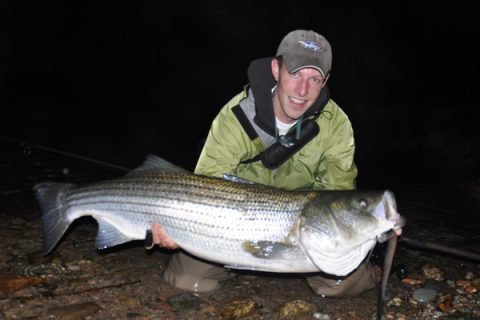
Capturing pictures of the trophy fish and great memories is a bit tricky at night, but point the camera in the general direction of the angler (hope they are framed right!) and take the shot. Digital cameras are ideal for this because you can check the shot before reviving the fish and heading back to the blackness for another trophy.
Partake
Four years after that first trip to Martha’s Vineyard, we are again planning to visit the island for nocturnal adventure. We will scout East Beach, Wasque Point, Squibnocket, Lobsterville Beach, and Lambert’s Cove at night. While we will bump into very few other fishermen, the ones we will happen upon are sure to stop and share a story, offer a tip, invite us to fish alongside, or show us a trophy. The glances and head nods of the day are quickly replaced with stories and camaraderie at night.
And now when my daughters get nervous about the shadows and request more light, I smile. As they drift to sleep I think of times when I have welcomed the opportunity to use my other four senses while prowling the ocean’s edge – enjoying nothingness and surfcasting while embracing the blackness.
You mentioned Colors matter but didn’t say what colors you used. Is that a secret or are you willing to share.
Black and purple!!!!!
Chicken scratch lures at lobsterville beach is always a good go to lure at night, but no matter where you go, you can’t beat live eels!
That article was thoroughly enjoyable reading! Camping in Montauk in October w hubby….. He’s a sharpie and I’m a googan, I guess! Anyway, thanks so much for a timely and well written article.
Very informative article. Well done
Having a guide is better, any recommendations for North Shore guide?
Plum Island, Crane Beach?
Thanks