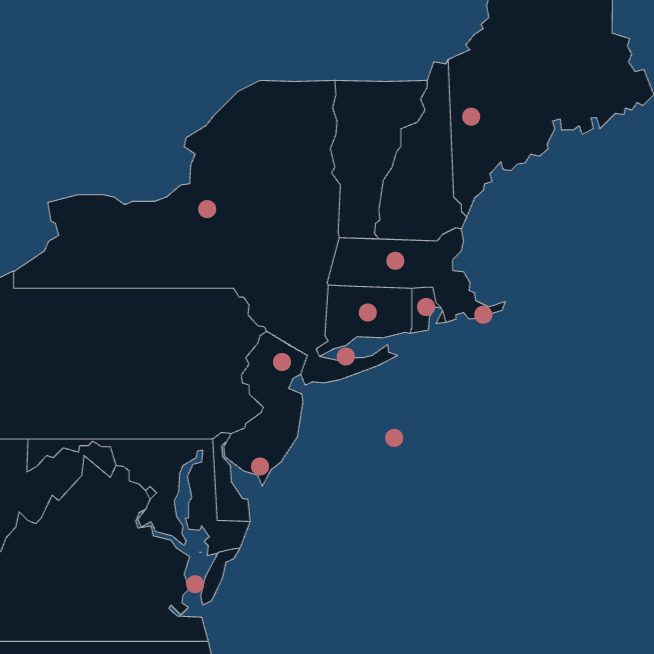


One of the most exciting parts about a trip to the canyons is that you never know what you might encounter out there. Many of the Atlantic Ocean’s largest predators follow the Gulf Stream north in the summer, hunting along the canyon walls and regularly showing up in the trolling spread of boats from throughout the Northeast.

Yellowfin Tuna
(Thunnus albacares)
(from Cooking the Catch II by Dave “Pops” Masch)
4 scallions, chopped
1 Tbsp. sherry (cheap, dry)
4 slices minced fresh ginger
1/4 cup soy sauce
1 Tbsp. peanut oil
1 tsp. dark sesame oil
1 clove garlic (finely minced or pressed)
Make a double batch of this magical elixir, and use half of the sauce to marinate 2 pounds of tuna in a plastic zipper bag. Serve the other half as dipping sauce for grilled tuna.
Yellowfin are the primary target species in the canyons of the Northeast, whether trolling during the day or chunking after dark. Their diet consists largely of squid and flying fish, with their pursuit of the latter sometimes taking them 6 feet into the air. Yellowfin have a weakness for spreader bars and skirted ballyhoo, similar to the weakness many captains have for fresh, seared ahi. Local yellowfin range from 5- to 10-pound “footballs” up to 150-pound “cows.”

Large eyes allow bigeye tuna to hunt at the surface in low-light conditions. Captains take advantage of this by trolling well after dark with the hope of bringing an “eyeball” into the spread.
Bigeye Tuna
(Thunnus obesus)
The bully of the canyons, the bigeye hits like a freight train and rarely raids a trolling spread without backup. The moments following a triple banger of 200-pound bigeye can bring utter chaos to the cockpit of even the most experienced offshore crews. Bigeye are most comfortable at depths of 400 feet or more. Unlike yellowfin, they do not venture to midshore structures. The bigeye of the Northeast canyons are most often large, 150 pounds or more, though it’s possible smaller specimens are misidentified as yellowfin or bluefin. Beyond the larger eye, the bigeye’s most distinguishing characteristic is its deep, nearly round body.

Blue Marlin
(Makaira nigricans)
Blue Marlin Lures:
Blue marlin hunt big meals—skipjack, mahi and yellowfin tuna—so captains hoping to hook them send out skirted lures as long as their forearms.


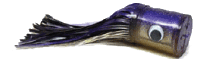
The “lady in the blue dress” isn’t nearly as abundant in the Northeast canyons as she is farther south, but the marlin that make it this far north are usually brutes. Every year, stories are told dockside of captains watching helplessly as a heavy-shouldered blue tail-walks over the horizon, trailing a full spool of line from an emptied 50-wide reel. Blue marlin feel better with 500 feet below them, but they will cruise the “flats,” hunting weedlines and buoys.

White Marlin
(Tetrapturus albidus)
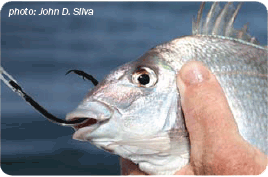 It can sometimes be tough to get a white marlin to bite a lure or rigged bait, and for those occasions, captains bring live pitch baits with them to the canyons, such as legal-size scup or even large eels.
Much smaller than its big blue cousin, the white marlin is one of the most popular targets in the canyons. White marlin range from 40 to 100 pounds, but anything over 80 pounds is a big one. They are great jumpers, well matched to 30-pound-class tackle. Trolling with small, natural baits is the best way to target whites. Fishermen must be on their toes and ready to drop back a bait to an attacking fish. Unlike tuna, which grab a bait on the run, white marlin try to disable a baitfish with their bill before eating it.
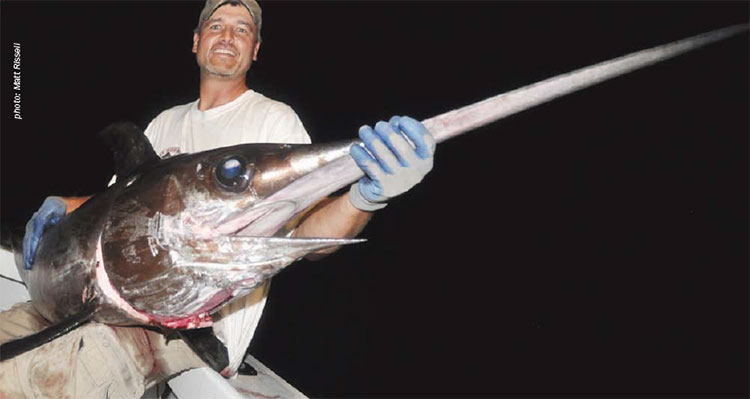
Swordfish
(Xiphias gladius)
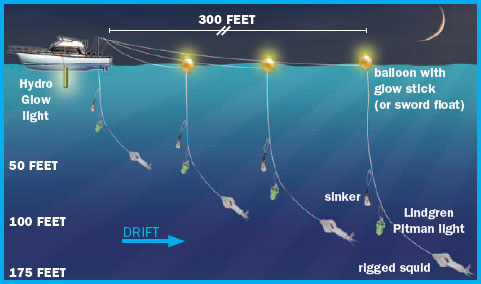
Captains who are serious about catching swordfish set out rigged squid baits at various depths with specialized floats because swordfish have a tendency to take a bait while swimming toward the surface.
(For more information on catching swordfish in the canyons, visit OnTheWater.com/swordfish)
Squid make up most of a swordfish’s diet, but they also eat deepwater fish. The average swordfish taken in the Northeast is between 75 and 125 pounds, but swords of up to 400 pounds have been taken in recent years.
Supporting Cast
In addition to the gamefish, the canyons are full of a wide variety of marine life that rarely ventures close to shore, so when fishing in the deep, be sure to keep your eyes peeled.

Sea Turtles
Several species of sea turtles follow the warm Gulf Stream water from their mating grounds near the equator to the canyons of the Northeast. The turtles can be seen swimming along the surface, occasionally tilting back their heads to take a breath of air. Sea turtle species that frequent the canyons include the loggerhead, green and Ridley.

Dolphins (Mammal)
Some of the greatest spectacles in the canyons are the acre-sized pods of dolphins, jumping and playing on the water’s surface. It’s not unusual for these big dolphins to hang around the boat, riding the bow wave and taking a good look at the unusual “fish” motoring through their canyons. Dolphin species in the canyons include (but are not limited to) the Risso’s, striped, spotted and common.

Skipjack Tuna
(Katsuwonus pelamis)
When the skipjack makes the occasional appearance inshore, its speed and size place it near the top of the food chain, but in the canyons the skipjack tuna is only a few links above the bottom. Yellowfin, bigeye and blue marlin all get fat on these oily tunas, so whenever you see them, be sure to send out a couple black-and-purple lures to tempt the fish below the skipjack.

Mako Shark
(Isurus oxyrinchus)
The mako shark has the power, the speed and the size to take down blue marlin, yellowfin tuna and just about anything else that swims at the edge of the continental shelf, it’s common to see them finning along the surface or even ripping through a trolling spread.
Hi there, I am watching your show for the first time tonight and thought I would send an email. My husband and I and another couple vacation in Nantucket every Sept. We will be going Sept 16-23 this year. Sometimes we go out on a charter boat fishing. I am wondering about your suggestions on who to contact for some good fishing, as well as what about some big fish. We usually fish at Great Point, from the beach. We have gone to a number of other places as well. Please share your thoughts on some good fishing places as well as what is good bait.
Thanks so much,
Patty