
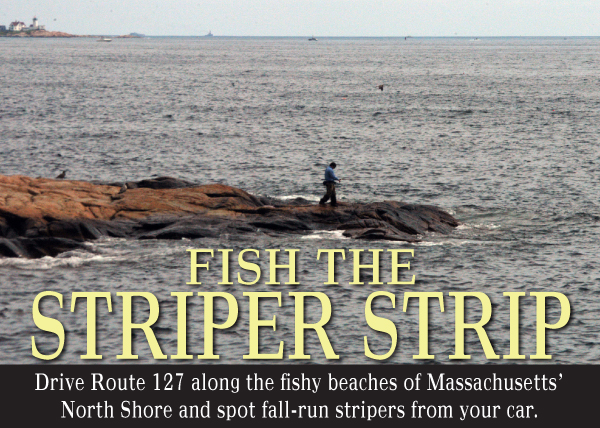
There’s a great deal to be said for taking a fish from the chest-high nighttime October surf, a time when most people are indoors, fast asleep. There’s also a great deal to be said for pulling up to the beach in business-casual attire on your lunch “hour” in broad daylight and seeing these same fish breaking in massive schools. After all, nothing beats a windfall, and a mid-October day spent looking for breaking fish on Route 127 offers the best opportunity for one outside of an apple orchard.
Each fall, peanut bunker, mackerel and a variety of other coastal baitfish inundate the waters of the south side of Cape Ann. The jagged coastline of “the other cape” from Beverly to Gloucester offers many sheltered coves that provide a harbor of refuge for baitfish as they push southward. Because it is slightly off the beaten path, this vast expanse of fish-holding structure is relatively neglected when compared to more popular North Shore surfcasting destinations like Plum Island and Crane Beach in Ipswich, and as a result, anglers have a unique chance for solitude and excellent midday fishing.
During this window of opportunity, an angler driving Route 127 will likely be able to find fast action somewhere along the coast. If you don’t see evidence of bait or bass in one spot, keep driving; the next beach could be loaded with breaking fish and diving birds. It’s like sight-fishing from your car. Of course, as is the case nearly everywhere, the odds of connecting with a big fish will increase at night. But for those with schedules that do not permit late nights or long hours, this stretch of shoreline is well worth the trip.
Access to the coast is straightforward. The 10-mile stretch of Route 127 that hugs the Atlantic shoreline from Beverly Farms to Magnolia offers decent sight lines to the water and good scenery throughout. Driving north from Beverly Center, the scenery around you will evolve from an urban landscape to the upscale suburbs of Manchester-by-the-Sea, all the way to the thriving fishing town of Gloucester. Reconnaissance can be done entirely by car, as the five beaches covered in this article offer great views of the water from their respective parking lots.
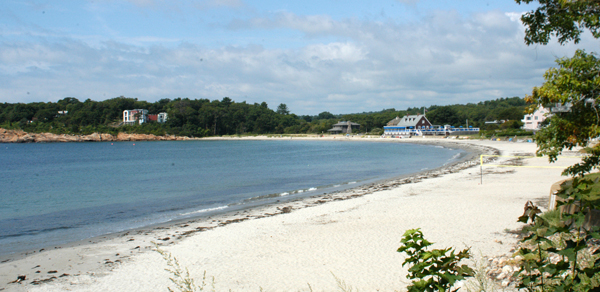
The entire south side of Cape Ann features abundant bait-holding structure that lures stripers and bluefish within reach of the shore-bound angler. Most of the coast is comprised of slippery rocks that abut water deeper than what you normally find off of the sandy beaches of Plum Island or Cape Cod. This provides a surf-fishing opportunity not typically found elsewhere. The water is deep and cold, and the rocky bottom provides excellent cover for migratory baitfish and other striper forage, including lobsters, cunner, harbor pollock, mackerel and crabs. The magnitude of “resident” forage means that stripers will hold here in good numbers, even when the migrating schools of fall baitfish aren’t in the area. In between these rocky points and craggy cliffs are a good number of sandy coves and relatively small but productive sand beaches. When stripers and bluefish corral schools of baitfish in these coves and push them up against the beaches, spectacular surface feeds will ensue, providing anglers with opportunities to catch a trophy bass during fall daylight hours.
Starting from Gloucester and heading southwest toward Beverly, here are five beaches that offer easy access and excellent opportunities for fall fishing.

1) Magnolia (Gray) Beach, Magnolia
Slightly off the beaten path, Magnolia is an upscale borough of the city of Gloucester that has as much quiet charm as any town in New England. There are few tourists or businesses here, just a few restaurants, a post office and a couple of small shops. What are here are stripers – and lots of them. Magnolia is a fisherman-friendly place, and it’s up to us to keep it that way. Clean up after yourself and others, keep noise levels to a minimum, and carpool when possible to avoid parking issues.
Magnolia Beach is a relatively large beach by Cape Ann standards, and it is located on Raymond Street just off Route 127. There is a small town parking lot here that requires a resident sticker, but parking is usually not an issue after Labor Day. You can also scout the beach from the lot and then find street parking, or you can park at the Coolidge Reservation, owned by the Trustees of Reservations, and make the half-mile walk down to the southern stretch of Magnolia Beach. It’s up to you.
Owing to its exposure to direct southwest winds and the “U” shape that keeps debris from being flushed out, Magnolia Beach can collect an astounding amount of organic flotsam. It may not smell great, but it does keep swimmers out, thereby clearing the way for anglers. A prolonged ocean storm will make this beach more or less unfishable, but on the first day of a storm, winds will push in bait and the fishing will turn on. Even if debris makes it difficult to fish with subsurface tackle, don’t give up – I’ve had great success with surface plugs here. During the fall, these waters are often thick with bait, as massive schools of peanut bunker take refuge in the sheltered cove. If your reconnaissance efforts indicate the presence of peanut bunker in the general vicinity, this should be one of the first places you look.
Immediately to the northeast of Magnolia Beach lies a half-mile of rocky coastline known as Magnolia Point. The rocks begin immediately east of the parking lot. Any fisherman who looks at these rocks will immediately see why and where the fish are likely to hold. The area is loaded with boulders, gullies and other fish-holding structure everywhere you look. The terrain here is a bit treacherous, so make sure you have the proper footwear. If you drive along Shore Road around Magnolia Point, you’ll come to another rocky cove. You can drive here to look, but you cannot park. If you see obvious signs of fish, then go back, park, and make the five-minute walk to these rocks. This is an excellent area to try live-lining freshly caught baits. The biggest shore striper I’ve ever seen was taken here on a live pollock.

2) White Beach, Manchester-by-the-Sea
Heading southwest from Magnolia on Route 127, take a left onto Ocean Street and you’ll see Kettle Cove on your left. Stay on course as the road bends, and you will arrive at a small beach with a sand parking area just above the tide line. White Beach is a small beach that is worth a look for one reason: It’s a very narrow cove, and when bait becomes trapped, it’s tough for it to escape. Bait will often stay in here for weeks, making it a good bet for repeat visits once you find success. Mackerel tend to stack up in this cove to feed on peanut bunker well into November. If you come across this scene, turn the tables on the mackerel and you stand a decent chance of hooking up with a memorable bass. Mackerel can be in the area until after Halloween, and the big bass will remain as long as big bait is around. Why wouldn’t they? I’ve caught bass here and all along the Cape Ann coastline well into November.
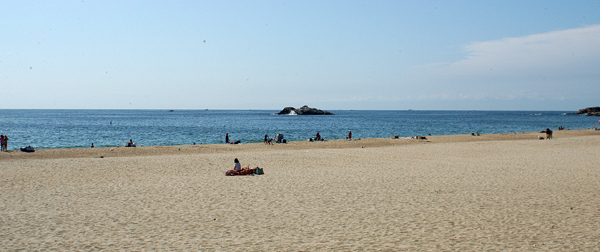
3) Singing Beach, Manchester-by-the-Sea
Continuing southwest on Route 127, take a left onto Beach Street in Manchester and follow it to the end. Singing Beach is probably the largest and most popular swimming beach on Cape Ann and can provide explosive fishing in the fall. What’s more, there is a large parking lot where non-residents can park after October 1. An angler can drive to the end of the cul-de-sac at the edge of the beach to scan for activity and then retreat to the parking lot only a few hundred yards away if the action looks promising. To park at night, use the free public parking lot at Masconomo Park, just a quarter-mile down Beach Street, and walk your way in. Singing Beach is very large, so there is plenty of room to spread out. I prefer pencil poppers and other big beach plugs here. This fishing comes as close to traditional open-beach fishing as anywhere between Cape Cod and Plum Island, so the tactics commonly employed in those situations will usually work. After dark, use eels or dark-colored needlefish plugs and large soft-plastic baits.
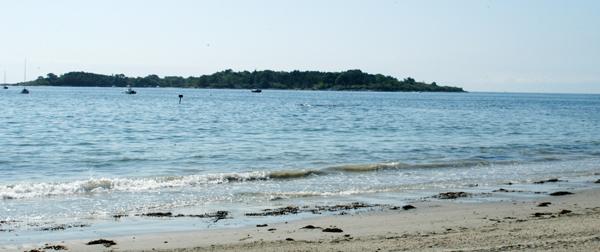
4) West Beach, Beverly Farms
Continuing on Route 127, you’ll see West Beach on your left just before reaching Beverly Farms. This smallish beach is a bustling swimming and socializing location for the residents of Beverly Farms. Don’t bother trying to fish here during the midday hours of June, July, and August, as the parking lot is privately owned and strict parking regulations are enforced. Before and after the summer months, however, fishermen are usually allowed to park for free and enjoy the fruits of the North Atlantic. The parking lot gate is locked from 9 p.m. to 8 a.m. year-round, making it a safe bet for sunset fishing after work. In the dead of night, fishermen can park at the Beverly Farms MBTA station and make the .4-mile walk to the beach.
At high tide, this beach looks unremarkable, as it reveals no conspicuous cover. However, half tide will reveal a large rock formation at the center of the beach that gives it added appeal to bait and stripers. At low tide, the beach extends all the way to the rocks, enabling a shore angler to climb to the top of the boulders and reach the relatively deeper water beyond. West Beach is sheltered, so bait will stack up here in the fall and generate some epic blitzes, especially during the month of October. Another great strategy at West Beach is to rock-hop along the northern border of West beach, which will position you farther east than on the beach itself and closer to deep water.
West Beach is as close as it gets to a fly-fisherman’s paradise on Cape Ann, especially during the peanut bunker run in the fall. I’ve seen fly-fishermen outfish everyone else 10 to 1 because of their ability to match the small bait. All of the usual suspects – Clousers, peanut bunker patterns, Crease flies, etc. – will take their fair share of fish. There’s plenty of room to fish and plenty of room for a backcast. Chunking works well here, too, as does just about anything else, but 4-inch soft-plastic swim shads are by far the most frequently used lures here. These are a natural choice because they imitate peanut bunker, and the way they are weighted keeps the hooks up and away from the seaweed-covered rocks. Tsunami and Storm are the two most popular brands, in white or bunker colors.
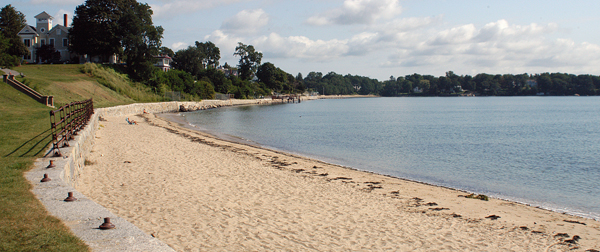
5) Dane Street Beach, Beverly
The last stop on the route (or first stop, if you’re working from west to east) is Dane Street Beach in Beverly. Just over the Route 1A bridge that separates Salem and Beverly, Dane Street Beach boasts good on-street parking and is worth a look. It is a wide-open sandy beach without any remarkable bottom structure other than some oyster beds just off the beach. The waters are generally shallow, although the south end of the beach is close to the Beverly Channel at the mouth of the Danvers River. Bait flushing out of the Danvers River on a dropping tide can be pushed along the beach. There are a couple stone jetties that provide likely places for stripers and blues to corral peanut bunker along the beach. Because the entire beach can be seen from Route 127, it’s a good location to scan for fish activity from your car before walking to the water’s edge. Access is easy, and there’s plenty of room to fish.
Regardless of how you fish, the south side of Cape Ann should be on your list of options this fall. The scenery is beautiful, and the smells of the cold North Atlantic mixed with the cool fall air remind us that life is good. For me, the anticipation that you feel as you drive from beach to beach, hoping to see a fish-feeding melee, is what it’s all about. Even better, when the bait comes in, it usually stays in for weeks at a time, promising some sort of action for those who seek it. Places to fish along the rocky, current-laden shores of Cape Ann are too numerous to list here, but if you try these spots on for size, you will eventually figure out your own favorite honey holes.

Bait Techniques
If baitfish are not visible and there is no obvious feed occurring, it does not necessarily mean that stripers aren’t in the area. Many rocky points and sandy coves along the south coast of Cape Ann are excellent places to fish with bait. Drift chunks of fresh mackerel or sea herring with a barrel swivel, 4 feet of 65-pound-test fluorocarbon leader, and a size 6/0 non-offset circle hook. Cast the bait out into an incoming tide and reel it in slowly enough to just keep pace with the current. On a dropping tide, cast your bait out and allow it to drift with the current, keeping just enough tension on the line to keep it out of the rocks. Draw the bait up to the surface every now and then.
Another option is to procure live bait on the premises. Harbor pollock, mackerel and cunner all make amazing live baits. Bring a light-tackle outfit with small hooks or small lures to catch mackerel and pollock, then live-line these captured fish by hooking them through the nose and heaving them out underneath a float.
This article is out of date. I used it this in July to look at every one of these beaches, and again last week just to make sure. Every one of these beaches has huge NO TRESPASSING signs, signs saying that you’ll be towed, or worse- arrested. This is especially true for Magnolia. I was spied on the whole time I was there, and then approached and asked to leave- and I was there after dark, with no light, and I parked on the street. The only one I could fish comfortably was white beach, and it’s so small that it’s not worth the drive for the beach alone. I love on the water, but you need to re-do this article to reflect the new reality of less access on all of these beaches.
Yes, articles from 2012 won’t reflect changes in the future. That’s what new articles are for. Dane St beach is literally a public st, open access 24/7.
Can you eat the mackerel in the Beverly area beaches?
Are these spots still “off limits” or have fishermen caught back for access? Asking from NJ where we have fought