
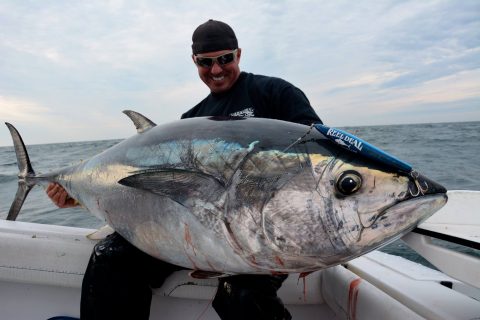
Whether fishing live baits for giant bluefin tuna 3 miles off the coast or trolling for bigeye and yellowfin on an overnight trip to the canyons, your fishfinder can help ensure you steam home with a fish box full of sushi. But remember – your fishfinder is only as effective as the transducer you connect it to.
What is the best transducer for tuna fishing?
Tuna are fast-swimming, pelagic fish of the open ocean. In both situations mentioned above, you want a fishfinder equipped with a transducer that can act like a searchlight and cast a wide beam. You’re looking for large individual fish and schools of baitfish roaming in the water column.
“When it comes to tuna fishing, wider coverage is almost always better,” explains Craig Cushman, director of marketing for Airmar Technology, a primary source for marine transducers. “Even if you’re fishing deep water in the canyons, you are really only interested in monitoring the top 250 feet or so of the water column when fishing for tuna.”
Cushman uses the metaphor of a Mag Light to describe different transducer options.
“You can have a narrow, bright, focused beam that illuminates small details in a smaller area, or a wider, diffused beam that may not travel as far but is better for searching with more coverage.”
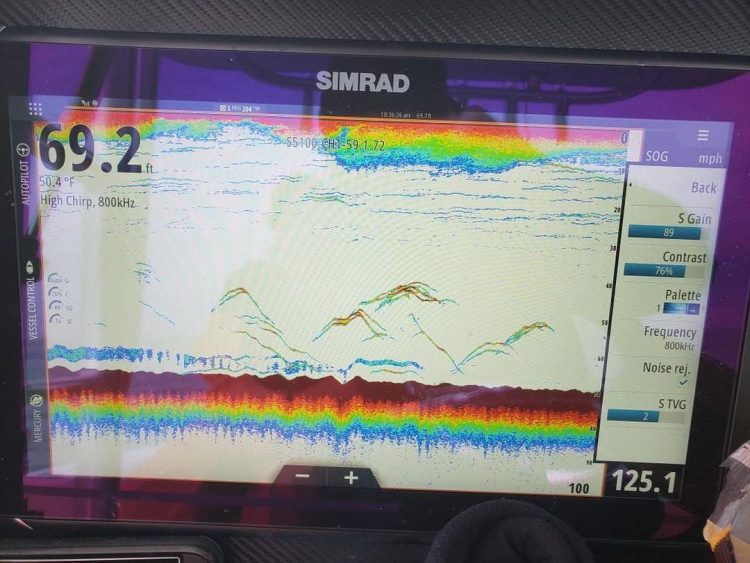
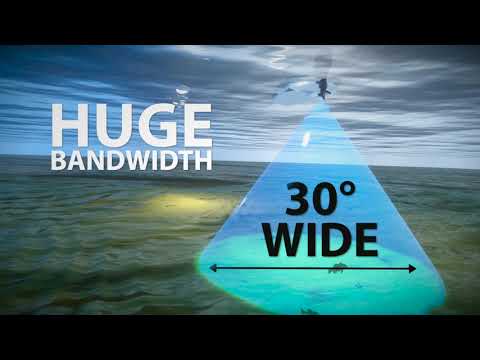
Lower frequencies travel farther and achieve greater depth, while higher frequencies will provide greater detail at shallower depths. Therefore, for tuna fishing, a high frequency, wide beam is ideal. For tuna specialists, a high-wide transducer like Airmar’s B175HW, which has a 25-degree beam width, or the TM165HW, which has an average beam width of 30 degrees, would be ideal choices.
However, most fishermen in the Northeast who are running midsize center consoles and similar fishing boats fish for more than just tuna. They will also target inshore bottomfish, like flounder, sea bass, blackfish, or cod.
“A fisherman in the Northeast who runs a center console and regularly fishes both inshore and offshore might opt for a combo transducer, like the B275LHW,” explains Cushman. “This is a wide-beam chirp-ready transducer that offers a high frequency range of 150-250 kHz with a constant 25° beam width, along with a low frequency that chirps from 42 kHz to 65 kHz. This combo is perfect for searching the upper water column with a wide beam for tuna, while also having low-frequency coverage for fishing the bottom in deeper water.”
“Fishermen can use both frequencies at same time, or choose one over the other,” said Cushman. “It all comes down to picking the right tool for the job at hand.”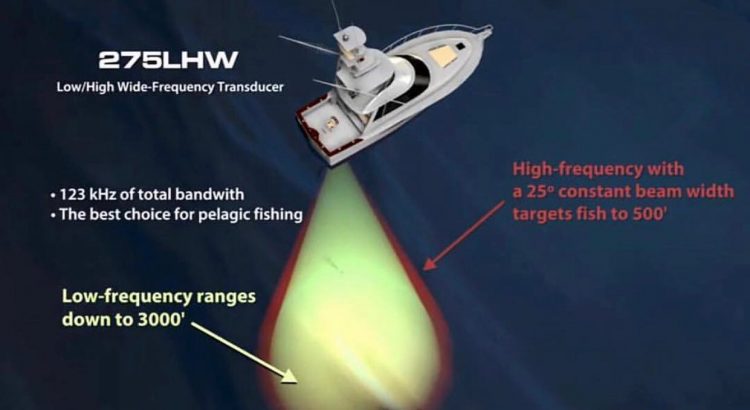
nice fish but the dude looks like a straight up pedophile in that picture
Nice guide about fish finder i was searcing for a portable fish finder too because i am new the field of fishing.