
Looking back at the mountains rising out of the Pacific Ocean, I couldn’t help but think how far I had come with my angling adventures since taming the trout stream out behind the baseball field in the Massachusetts town where I grew up. A cloud forest hung on the tropical skyline, looking like a scene out of King Kong, with a canopy of greenery sloping dramatically to the ocean, where giant swells exploded on patches of sandy shore and inlets carved out from volcanic rock. Some ten miles out beyond our twin-diesel-powered sportfish Strike 33, nimbus clouds had been collecting the day’s energy since the sun first made its way over the mountains and lit up the Pacific’s deep cobalt sea. Costa Rica held many secrets, but it was the ones with dorsal, pectoral and caudal fins that intrigued me most.
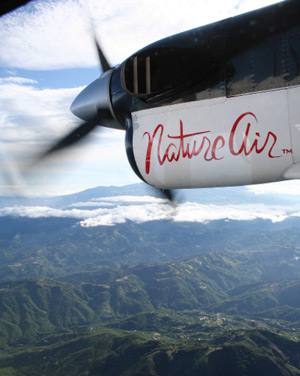
The 45-minute flight from San Jose, the capital of Costa Rica where our group had landed the night before, gave me a better understanding of the expansiveness of the country’s wild terrain. At times I thought I could reach out and touch the green mountaintops as we navigated through the many peaks and valleys in a twin prop Nature Air plane. It wasn’t long before I spotted the Puerto Jimenez landing strip— all 200 yards of it—which was our final stop on the trip to Crocodile Bay Resort.
I’d heard many stories about the world-famous fishing lodge, but it was my first visit to Crocodile Bay, located on the Osa Peninsula in the southernmost Pacific region of Costa Rica. The Osa Peninsula forms one side of the Golfo Dulce, or “Sweet Gulf,” named for the many freshwater streams that empty from one of the few tropical fjords in the world. Over the past eight years, commercial fishing in the Golfo Dulce has been greatly restricted, allowing baitfish to thrive in these rich waters, naturally protected by steep slopes on three sides. Within the Gulf, jagged reefs, formed over a million years ago by erupting volcanoes, offer cover to several species of snapper, including the Cubera, which reaches sizes over 50 pounds. In addition to snapper, amberjack, grouper, African pompano, and trevally are just a few of the inshore fish that can be caught, along with the prized roosterfish.
After a five-minute ride from the Puerto Jimenez airport in the back of an open-bed truck with bench seats, railing and a framed canopy, we arrived at the resort and were greeted by Todd Staley, Fishing Director for Crocodile Bay, Cory Williams, Director of Hotel Operations and Beau Williams, the General Manager. Although Crocodile Bay is a luxury resort with a spa, restaurant and pool, I was pleased to see that the rooms were set up in bungalow fashion, with four rooms to each unit, spaced out across the grounds to preserve a natural look and feel appropriate for Costa Rica. After heading to our rooms to unpack, we met back at the dock, just a short walk across the resort grounds.
The 33-foot Strike I boarded was perfectly laid out for launching plugs, with an open deck allowing for easy casting from any side of the boat. The rod holders were loaded with the latest in quality rods and reels from Penn, the exclusive tackle provider for Crocodile Bay. Overhead, a spacious fiberglass top carried the captain, allowing him to spot fish at a distance and providing anglers room to duck underneath to seek refuge from the sun or shelter from an afternoon shower. The gunnels were low enough for easy jigging and landing fish over the sides, and the swim platform off the stern would prove to be a suitable “fighting chair” later that day, when I hooked into a yellowfin tuna on an inshore spinning outfit equipped with a Penn Spinfisher V 5500 that was never intended to do battle with such a game fish.

Cruising out toward the Pacific with the Osa Peninsula to our starboard, I had to fight the urge to ask the captain to pull up to every fishy-looking rocky structure we passed. After a 25-minute cruise at about 20 knots, we hit the open water of the Pacific and the captain pulled up to ask my fishing buddies, Fred Golofaro and Blair Wickstrom, and me whether we wanted to fish inshore for roosterfish and snapper or head offshore for tuna, sailfish, and a possible shot at a marlin. Hmmm…. tough choices! We all figured that the tuna would be waiting for us later in the day, and we had been told that the sailfish and marlin bite can be slow in June. With the decision made to target roosterfish, our captain positioned us just outside of the swells building near the beach and we drifted back live baits that had been jigged up at the dock. The live baits were fished on lightweight Penn Legion rods matched with new Penn Spinfisher V 4500 and 5500 reels spooled with 20-pound-test Berkley braided line and a 60-pound-test fluorocarbon leader.
It wasn’t long after we began our slow troll, with the captain bumping the engine in and out of gear, that one of our baits started dancing on the surface and then disappeared to the sound of drag pulling. We all looked for a roosterfish dorsal fin, but to no avail as Fred reeled up one of the biggest needlefish I had ever seen. These needlefish looked prehistoric; when I pulled one of the toothy critters myself I could see why they had no problem making short work out of our 6-inch live baits.
With our live baits swimming off the stern, I rigged up a second rod for casting and dug out a Sebile Splasher topwater popper that I knew would throw water. I slid to the front of the boat and started casting toward shore and structure. On my second cast, I had the plug popping along when out of nowhere a fish exploded on it and sent it flying! I wanted that fish, as I was sure it was a rooster, but it wasn’t to be. With my heart racing, I continued to work the shoreline from the bow when Blair yelled to me that my sardine was looking panicked and something was about to happen. I couldn’t reel in the topwater plug and get to the stern fast enough, and by the time I picked up the live-lining rod, it was feeding line at a pretty good clip. When I engaged the reel, it was immediately clear what had eaten my bait as a roosterfish launched itself out of the water. The rooster ran with surprising power, switching direction like someone was hitting it with a jolt of electricity, and for the entire fight I could see the fish in the crystal-clear blue water. It was only about 15 pounds—not a trophy for a fish that can grow to 80 pounds—but I didn’t care because I had come to Costa Rica to catch a rooster and I could cross that off my list.
After a few pictures, the fish was back in the water. The rest of the morning was slow, and after breaking off another needlefish, our captain hollered down from above that he could see fish breaking under birds about three or four miles out.

Quickly we stowed away the light gear and readied the Penn Bluewater Carnage jigging sticks. The Carnage rods come in both conventional and spinning, but I was interested in testing the new Penn Spinfisher V, so I claimed a rod rigged with a Spinfisher 7500 rigged with 50-pound test Berkley superline. My plan was to fish live bait on the jigging stick and have an inshore Legion rod rigged with a Spinfisher V 5500 and a “Salt and Sun” (heavy duty) Sebile Splasher in case any fish popped up within range of the boat.
The melee was moving fast, as several massive pods of spinner dolphins were pushing the bait while, in the middle of all the chaos, yellowfin tuna in the 40- to 80-pound class exploded on the surface. The dolphins were clearly the ones driving the bus while the tuna were just along for the ride, ambushing sardines fleeing for their life ahead of the spinners. Like trying to get ahead of bonito and albies back home, the idea was to predict in which direction the dolphins were pushing the bait, circle wide out ahead and let them come to us. Some of the boats already on the scene were running straight through the schools, and Fred and I couldn’t help laughing at the fact that even down in Costa Rica you couldn’t get away from a few knuckleheads. Our captain knew what he was doing, and it paid off with two hook-ups, both on live bait. Blair Wickstrom made quick work of a fish in the 40-pound class on one of the Penn Carnage outfits, but the second fish popped off shortly after it started taking line. With one nice tuna in the boat, we began another run to get ahead of the school, which was already beginning to dissipate. Blair picked up one more tuna in the same class, and Fred and I each came tight but landed only one more between the two of us before the bite died off.
Back at Crocodile Bay that night, we ate like Vikings as all of the boats returned with fish. The staff took care of everything, and after a dip in the pool and a couple of adult beverages at the swim-up bar we convened back at the restaurant where a buffet of every fish you could imagine was waiting for us along with fresh fruit, salads, chicken and some of the best tuna, seared to order, I have ever eaten. At dinner we all shared notes on the day’s fishing, and we planned to forego inshore fishing and get after the tuna first thing the next day. Feeling confident, I vowed that the following day I would hook one of those big yellowfin tuna on an inshore spinning rig to see what kind of punishment those Penn reels could take.

The next morning I was up early, and after a breakfast made to order our crew was off the dock and jigging sardines before most of the other boats had turned over their engines. We headed straight offshore to find the dolphin pods and the tuna while we had the school to ourselves. My first fish came on the surface when our captain positioned the boat perfectly and I picked up a Legion rod, launched a Sebile Splasher 40 yards ahead of the school and started ripping the plug back. Immediately, my plug was slashed at by a 60-pound-class tuna, but it somehow missed the hooks. I had to remind myself to keep the plug moving, and after a few more chugs—BAM—a fish exploded on it and I was on. The drag started screaming, and I made sure it was snug but not so tight that I wouldn’t see this fish finish its first run. I was smiling from ear to ear and began walking the fish to the stern, carefully passing the rod to myself around each pipe of the open structure. Once I was in the open stern, it was time to clamp down. I ratcheted down the drag and quickly found out that the 50-pound tuna attached was one mean fish. Ten minutes into the fight, I could see other boats coming and I wanted to end the fight so we could hook up again before they arrived, but the tuna had other plans. I decided to jump out on the stern and square my feet on the swim platform to set up in a fighting chair position. Once in place, I cranked to the point that I thought the guides on the rod would pop, and to all of our surprise, I started moving that stubborn fish on what would best be described as a striped bass outfit. As the rod bent in a semi-circle, I cringed, but it held up and finally broke the fish’s will before it broke mine. After a few final circles at the side of the boat, we had that night’s dinner.
For the rest of that afternoon and the following two days, the action remained fast and furious. It was hard to consider staying inshore when tremendous schools of spinner dolphins were hanging five to ten miles out past the mouth of Golfo Dulce and the boats out of the Crocodile Bay Resort had the fish all to themselves. Trolling live bait was deadly when we could get the boat positioned with the school off our stern, but most of us preferred the run-and-gun method, which allowed us to cast topwater plugs and poppers to the tuna slashing bait next to the boat.
Finally, on the last day, after I went three-for-three on yellowfin in an hour span, all on the light Penn spinning outfits, I’d had enough. Our arms were hanging, so we asked the captain to head inshore to give us a crack at some snappers and bottom dwellers near a big rock we passed each day at the mouth of the Gulf. On the last day, on the final drift along this massive boulder, I had a big cubera snapper on just long enough for the fish to let me know, with a few flips of its tail, who was boss. That fish left me humbled. All winter long, I’ve been dreaming of getting back to Costa Rica for a rematch.
Northeast Angler Abroad: Golfo Dulce, Costa Rica – excellent article