
From Plymouth to Pine Point in Maine, pilgrim stripers are pleasing anglers and the mixture of sizes from micros to moby linesiders of 45 inches is making it a real gamble whether to go light or stick with the stout stuff. Stellwagen groundfishing for cod and pollock remains superb with the best bite occurring late enough for you to even “sleep-in” should you desire. Farther north in the Gulf Of Maine, the gadoid grab bag leans less toward volume of cod and more to a variety and bigger fish. For sweetwater, the rising temperatures of our freshwater bodies means that the warm-water species are beginning to rule.
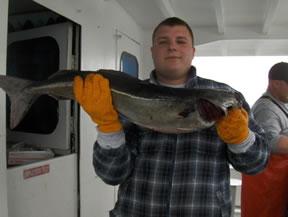
We caught a brief break in the blow on Stellwagen Bank last Saturday as a number of us including OTW contributing writer John D. Silva and Captain Jason Colby of Little Sister Charters finally set sail toward the gadoid grounds of the bank. We were aboard Captain Rob Green’s Elizabeth Marie out of Scituate, but were treated to a special bonus in that legendary Captain Tom King was at the helm. In addition to holding the male mako shark world record, Tom is held in high regard and considered a mentor by numerous charter captains from the South Shore through Cape Ann. While I’m no stranger to the deck, I can’t remember a groundfish outing in which I learned more.
Most importantly Captain King is a staunch steward of the resource and loathes pounding a school of shorts. When he would mark fish and instructed us to drop our lines he would immediately ask of an analysis of size. If we hooked up with a bevy of runts, he’d move in search of a school with larger fish. There are mixed year-classes in the GOM constantly roving around in search of bait; not only do you do a disservice to the stock by jigging up junior and his gang but you’re wasting your time. It took us a few hours to find the larger fish, but once we did, it became a simple matter of cranking up one 24-inch-plus cod after another until we had a sensible fill.
Having been fed a steady diet of “earlier is better” maxims on nearly all that is fishing, I’ve always been of the opinion that if you’re not dropping jigs at sunrise, you’re missing the action. This is not necessarily so. We did not really get into a lode of large fish until noontime, which made many of us who were sporting considerable under-eye baggage wonder what was the point of the wee-hour wakeup. In fact, late in the morning Captain King pointed out a vessel that had just joined the brigade and labeled the captain as the best cod fisherman that he knew – and he never fishes early! Just when most anglers have had enough and are considering steaming back to their slip, this guy begins his day fresh on seas that are soon devoid of other anglers and are often reloaded with less-harried cod. Think of that one the next time you’re setting the clock for 3:00 a.m.
And don’t forget your spinning rod, the pollock have been consistently driving sand eels toward the surface and these fierce fighters, which are ranging up to 15 pounds, will wallop all manner of spoons, jigs and plugs (even topwater offerings!). And if you are someone that dismisses pollock as paling compared to cod in the culinary category, do as Captain Rob Green does: bleed them fresh and throw them immediately on ice. While this protocol should be employed with most species, it is essential with pollock. I gave family and friends what I creatively called “haddock” the following day and all remarked how delicious that “haddock” was, although I do have a suspicion that my credibility may take a hit now.
Last week I expected my friend Captain Russ Burgess to provide me with fodder about that first 30-pound striper of the year and he did – sort of. While like many, Russ is still waiting for the seas to subside before he sets sail, he did get a reliable report of a 45-incher that was bested from the North End Bridge! The mouth of the Charles River locks is always one of the better big bass spots thanks to the river herring and the impediment of the locks. Of course not all fish here are big. OTW contributor Willy Goldsmith told me that he and a pal were having a ball on schoolies between the “balcony” and the Harborwalk on the ocean side of the bridge. Hearing of 20-inch fish is great news, because while the season is fresh I’ve been hearing of a lot of concern about the lack of small fish.
While Willy wears more than a few hats, he’s very proud of his status as a “deck ape” aboard the Yankee Captains fleet out of Gloucester. When I asked about his take on cod on Jeffreys Ledge, he told me that while there may be less of them compared to Stellwagen, on average the cod are larger and there’s more of a mixed bag. A few years ago, I accompanied Willy on a crappie cast-fest on his home waters of the Charles and it was a blast. If you’re a member of the working-wounded anywhere near the Charles River and looking for a lunchtime diversion from Wi-Fi, consider this. Take along a light panfish or trout rod a few small Beetle Spins, Road Runners or curly-tail grubs and roam the area by the confluence of the Muddy River and the Charles River. You’re likely to catch crappie, largemouth and smallmouth bass and maybe even a tilapia! But regardless of what you catch, you’re bound to return to your office digs significantly more pumped than your co-workers, even if they’re caffeinated on lattes.
Wachusett Reservoir is beginning to transition from laker town to smallie central. The last couple of outings has been short on forktails, but has featured 4-pound class smallmouth bass. I took Russ Eastman of Monahan Marine to the ‘chu the other day and when I looked in his bait bucket and spied yellow perch fry I knew that we would be catching some serious smallmouth bass. The first rod was set for only a few seconds when the Gut A Bite strike indicator went off and I was soon tied to a tail-walking 18-inch specimen and a short while later, another smallie slammed a 5/8-ounce firetiger Krocodile. If you’re serious about landing the largest smallmouth bass of the season and just maybe your personal best, then spend some time tossing bass wares around Wachusett Reservoir over the next few weeks; those big females are moving into casting range right now. Incidentally, those much sought after Gut A Bites that went out of production for years are available once again and both B&A in West Boylston and Arlington Bait and Tackle have them in stock.
Russ Eastman told me that they are finding some nice bass in the Weymouth Back River as the stripers seek out the river herring. The winning formula is a nighttime flooding tide combined with structure that inhibits the herring from escaping upstream. Monahan Marine is the first shop that I know of that has in stock two of the most longed for linesider lures in a long time – the Sebile 6 ¼” and 8” soft Magic Swimmer. This lure should be a killer for this sort of fishing. The soft Swimmer has all the moves of the hard plastic Magic Swimmer but is virtually snag-proof and it is a joy to have to contend with just one hook in a thrashing striper’s maw on a dark night.
Kay from Surfland said that North Shore anglers are catching stripers at the mouth of the Merrimack River. The most reliable lures have been 1/8- and ¼-ounce white bucktail jigs and the fish are ranging from the mid-twenties to the mid-thirty inch range. I’d focus on the last two hours of the ebbing tide up until the first hour of the flood. Bigger shad have moved upstream into the Merrimack River as larger females have joined the male scouts. While there hasn’t been any confirmation on flounder yet, considering that they are already being taken in New Hampshire, I’d say it’s a safe bet that you’ll find them between the mouth of the Merrimack River and off Plum Island beach.
Jason of Suds ‘N Soda in Greenland, New Hampshire confirmed that stripers are in Great Bay. The mouth of the Lamprey River is perennially the hot spot, but within about two weeks, the Exeter and Oyster will have them also. The fact that these fish have an appetite for alewives and a mouth big enough to make a meal out of 11-inch forage should indicate that these fish are not schoolies! Since there is no river herring moratorium in New Hampshire, most anglers are snagging or catching alewives with a light rod and live-lining them with a heavier stick; after all you can’t beat fishing with the “hatch.” The shop carries Shad Flutters, which are great at catching alewives. They have been catching winter flounder in Rye Harbor, but beware of the New Hampshire regulations that prohibit flounder fishing between May 15th and May 24th.
“Yes, we have them too!” proclaimed Peter from Saco Bay in Maine. Outgoing tide on the Saco River, Spurwink River and at Scarborough Marsh has been giving up slot-size fish (20” to 26”) stripers for those drifting sandworms and cranking in Yo-Zuri Crystal Minnows. I suspect that most rivers in Southern Maine are yielding similar results. The first shad are beginning to move upstream of the Saco River. When there’s a break in the wind, cod crazies that set sail for the Scantums are limiting out on market-sized cod with the occasional steaker figuring into the mix.
Best Bets
Suddenly there are options popping up everywhere, like those dandelions in your lawn. Seek out most any river on an outgoing tide, especially in the evening, and chances are you’ll find striped bass. After sundown, the bigger fish will be on the prowl because they lose their fear of the shallows and their superior nighttime faculties gives them the edge on river herring. On the south shore check out Eel River, Town River in Plymouth, South River and North River. The fabulous-four rivers from the Weir in Hingham to the Neponset in Dorchester all have herring and stripers. Big bass should not be far from the Charles and Mystic River in Boston. And on the North Shore, the Essex, Ipswich, Rowley, Little and Annisquam Rivers all have fish. For a mixed bag seek shad and stripers in the Merrimack River. And if fun and flounder are more to your liking, you can find them in 20 to 35-feet of water from Hull through Quincy to Boston. Up north the bass fishing is good in Great Bay and finally hitting its stride in Maine rivers such as the Saco, Spurwink, Mousam, and Kennebec. But if groundfishing is more your game, drop a jig on Stellwagen or Jeffreys before cod and their kin slink off to deeper water.