
Believe It or Not… Still Striper Strong!
We’re still catching stripers in Greater Boston and points north folks, and the outings are not micro-marathons but jousts with fish that will pull drag! When not preoccupied with linesider longing, we’re finding jack smelt big enough to rival a stocked trout. And for sweetwater pursuits, there’s fine fishing for salmon and rainbows in Wachusett Reservoir and its tributaries.
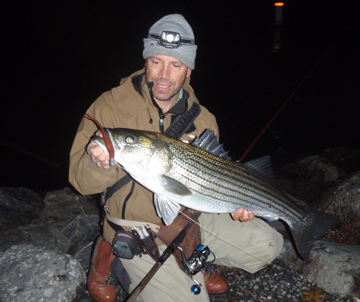
Not unlike Michael in Godfather III, I feel as if just when I’m breaking free, “…they pull me back in”; the “they” in this case being striped bass, of course. This is a year for the books. Striper fever kicked in earlier than in memory with blitzes taking place in Boston Harbor in April, and in some capacity cow cravings shows no signs of relenting. With herring, smelt, silversides and swarms of grass shrimp, there is no reason for pockets of bass not to remain. While striped bass prefer water temperatures between 55 and 65 degrees, we know that they can survive far chillier environs provided that there is a reliable forage base and there is no shortage of bait out and about.
As always, whether you’re fishing July or January, you will fare better fishing for stripers from sun down to sun up – that’s just the nature of the beast. Target rivers, estuaries and marshes where languid-by-day linesiders will become active once the sun sets, and opt for slim-profiled offerings that more closely mimic what the fish are eating. My go-to lure has been a ¾-ounce Kalin jighead shorn with a rootbeer or new penny 7-inch Gulp! Jerk Shad. At first glance this stiff bait certainly fills the bill of a stick bait, but at night you want something that tracks straight and is easy for the bass to get a bead on before it hits. The only rhythm I give the lure is to periodically (every 2 or 3 cranks) “pull” the lure forward; no jerks, contrary to the lure’s name. It’s that steady movement that gets them. Now go get them for yourself.
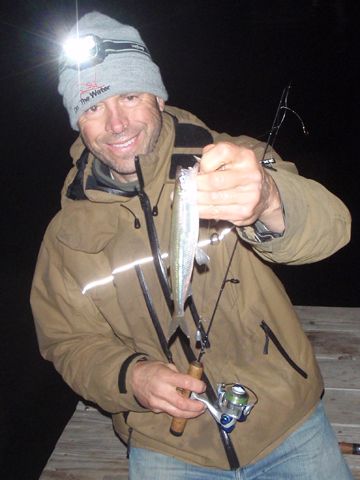
Some of those smelt are awfully big this year. While eyeballing a jack swimming around in a pail recently, the shoulders on this fish made it look like a stocked trout! Hook one of these with a spindly ice-fishing stick tapered for sunnies and you’ll have a hoot bringing it in. Rick from Fore River in Quincy told me he’ll have plenty of smelt candy – grass shrimp – on hand for the weekend. Hot spots change, but in the past, the piers of Hull and Hingham have been hot. As has the Town River behind the CVS in Quincy and the Summer Street Bridge, and while I haven’t heard much about Nut Island, last year it was steady into February. Marina Bay has been a generational favorite. The locks at the Charles River deserve a look-see, and if you can access most any marina from Charlestown through Winthrop and into East Boston, odds are if you put in the time you’ll catch them. A dock light or lantern is essential; I prefer a Sabiki rig, while some old salts will employ a spreader bar with a short lead and an Aberdeen hook. They often paint or tape the ends of the spreader white or chartreuse so that they can see the faint bite of a smelt; this step becomes moot when you’re using a sensitive ice-fishing rod that almost instantaneously transmits the lightest tap.
On the North Shore, Noel from Darts Bridge Street B&T is still stocking seaworms for the diehards who are picking off smelt from piers in Beverly and Salem. He also told me that some are still getting stripers up there. The late Pete Koutrakis, who owned Pete’s Bait and Tackle in Beverly for nearly 30 years, used to tell me that some would pick up smelt throughout Marblehead as well and he would often emphasize the public landings in Marblehead Harbor near Commercial Street.
With the condition of remaining anonymous, a North Shore bait shop owner said that some get smelt throughout the Parker River from the Governor Dummer Academy to the “haystack.” That same gentleman and I talked about the burgeoning northern pike numbers throughout the Merrimack River. There are a few taciturn toothie takers that are tossing big spinnerbaits and picking up yardstick-long northerns upstream of the Lawrence Dam; there is even a holdover striped bass population that lives here that now and then will fall for a lure worked specifically for a bass or for a pike. A few years ago, an angler named Steve Previte sent me a photo and an account of a double-digit toothy he took here while fishing for smallies; there are a lot more pike in the Merrimack than most realize.
Eddie of B&A in West Boylston told me that landlocked salmon, lakers and rainbow trout are being consistently taken with flies, hardware and worms throughout the Quinapoxet and Stillwater rivers. The bows are especially beautiful. Rainbow trout get scant attention with so many sweetwater all stars in Wachusett Reservoir, but in my opinion they are among the healthiest and most colorful of any you’ll find in New England; after all, the Bay State bow came out of here. And November is the best time to get them as they cruise within casting distance of many shoreline spots in the ‘chu. I would target the Rte. 70 side and take along a bucket of small shiners and fish them just under a spinning bubble, which you can fill with water for casting distance. While you’re ogling that bobber (and it can by hypnotic), take a casting stick and bounce the bottom with spoons for lake trout.
Fishing Forecast
It’s hard to top sticking a striper in November, especially one that you can measure in pounds as opposed to inches—and they are still here! Layer up, trade the baseball cap for a stocking cap, keep gloves handy and hunt for hungry linesiders which are lurking among marshes, rivers and estuaries. You will have failed attempts and you will feel the chill and wonder if you’re crazy, but when you get that hit and you’re on, you’ll never view mid-November the same again. I prefer slim-profiled baits such as the previously mentioned Gulp! Jerk Shad, but a buddy last night met a guy who has been doing quite well fishing similar waters with a slowly crawled Rebel Jumpin’ Minnow and tiny needlefish plugs; you have to match the small bait. Smelt remain the only other viable saltwater option, but you may have to search a bit among my erstwhile picks until you find them. Just make sure you’re keeping your bait as close to the bottom as possible. And then there’s the sweetwater thing: you’ll find bows and lakers in the ‘chu and pike in the Merrimack big enough to scare you.