
Tochterman’s Fishing Tackle Report — Baltimore, MD
The Tochterman’s Fishing Tackle Fishing Report is written by Tochterman’s team member, Kevin Trupia.
Striped bass action has been good in the Susquehanna, up at the Conowingo Dam and also on the Susquehanna Flats. Soft plastics, jerk baits, and paddle tails have worked well.
Live-lining spot has been working well around the Key Bridge and also areas around the Bay Bridge from Love Point to Swan Point.
Sandy Point has been improving with catches of spot here and there, and of course white perch are all over the bay and its tributaries. The best methods for both is bottom fishing in 10 to 15 feet of water with lug worms or blood worms.
Blue cats and channel cats are in abundance all over the bay with cut bait being the best method. We hope all the dads get out on the water this weekend and enjoy Father’s Day with their sons and daughters making memories.

The Tochterman’s Fishing Tackle Fishing Report is written by Tochterman’s team member, Kevin Trupia.
Maryland DNR Fishing Report
Maryland Fishing Report is written and compiled by Keith Lockwood, fisheries biologist with the Maryland Department of Natural Resources.
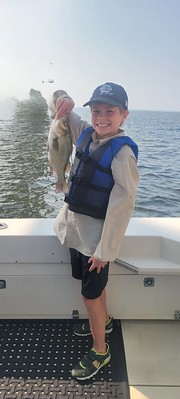
This weekend, fathers across Maryland will be celebrated and many will choose to go fishing with their sons and daughters on this special day. Parents who take their children fishing share the kind of intimate experience together that few other activities offer. Lifelong bonds are formed that will stand the test of time and help set an example for the time when they become parents in later years.
Upper Chesapeake Bay
Anglers are finding some good fishing for striped bass at the edges of the Susquehanna Flats and the mouth of the Susquehanna River. There was a large water release at the dam on June 13, so there should be plenty of cool water flowing down the Susquehanna and out into the Bay, which is good for fishing. The best action for anglers casting paddletails, jerkbaits, and various soft plastics is occurring during the morning and evening hours.
The striped bass action has been very good at the mouth of the Patapsco River and Hart-Miller Island, and the charter fleet has been working there for the second week now. Most anglers onboard are getting good results by live-lining spot; there has also been action at Swan Point and the Love Point rocks. The piers at the Key Bridge are also a great place for live-lining or jigging with soft plastics. The east side of the Bay Bridge at the 30-foot contour, where it drops off to 70 feet, has been a good place to drift with live spot or soft crab baits back to the bridge pier bases, or to cast jigs during the morning and evening hours.
White perch fishing is good in the lower Susquehanna River and all the tidal rivers and creeks within the upper Bay. They can be caught on pieces of bloodworm on bottom rigs when fishing deep water. Most anglers are casting small spinners and spinnerbaits along the shallower waters near bottom or shoreline structure and catching a nicely sized white perch. Dropper rigs used in deeper waters are also effective with small jigs that can be tipped with pieces of bloodworm or left bare.
Spot are available now in the upper Bay and are being caught in about 15 feet of water at several locations. The mouth of the Magothy River, near Sandy Point State Park and the western end of the Bay Bridge are good places to find them. Pieces of bloodworm on a bottom rig will catch the spot and white perch that are holding in the same areas.
A mix of channel and blue catfish can be found from the Conowingo Dam Pool south to encompass all the region’s tidal rivers. Water temperatures are cool enough that they are very active and will take most any type of bait. They are also being caught in the rivers and bay along channel edges and deeper waters.
The Conowingo Dam pool is often the end of the road for northern snakeheads; they tend to gather up there and anglers are taking advantage. Paddletails are one of the most popular lures being used to catch these invasives at the dam pool and along the edges of the Susquehanna Flats. The snakeheads generally spawn during June and anglers may find them holding in the grassy Susquehanna Flats.
Middle Bay
Striped bass anglers in the middle Bay are finding some of the best opportunities in the tidal rivers this week. The water temperatures in the tidal rivers are cooler than the bay and seems to be to the liking of the striped bass. Topwater lures, jerkbaits, and paddletails are popular lures to cast and the morning and evening hours along promising-looking shorelines provide the best fishing. A portion of the striped bass being caught in the shallows may measure short of the legal size limit but there is plenty of action. The rocks around Poplar Island and Thomas Point are two locations in the Bay where anglers are doing well.

Trolling along the deeper edges of the tidal rivers with medium-sized bucktails dressed with sassy shads or twister-tails is also a productive way to catch striped bass in the lower sections of the tidal rivers. Others are trolling a mix of small spoons behind planers or umbrella rigs and tandem rigged bucktails behind inline weights to get down where striped bass are suspended along the shipping channel edges. The action has been reported to be a slow pick.
Live-lining spot along the steeper edges of the shipping channel is a good option this week. Thomas Point, the steep edge from the Brick House Bar south to the Gum Thickets, and the edge at Buoy 83 are a few locations worth checking. Depth finders are an important tool when trying to locate suspended striped bass.
Spot can be found in waters about 15 feet deep at the entrance to Whitehall Bay, Eastern Bay, the inside waters of Black Walnut Point, and out in front of Chesapeake Beach. Expect to find a mix of white perch in some of these locations.
White perch fishing is always a summertime delight – there are plenty of opportunities for young and old for this tasty Chesapeake Bay treat. Most any dock over water with some depth will hold white perch, which makes for easy fishing with the right gear. It is hard to beat fresh grass shrimp on a small jig head or one-hook bottom rig fished close to the dock piers. Oyster reefs are another good place to look for white perch when fishing on the bottom. Casting small jigs, spinners, and spinnerbaits along shorelines during the morning and evening hours is hard to beat for fun on light tackle. A 4-weight fly rod with a sinking tip line and chartreuse Clousers also provides fun fishing for white perch.
Lower Bay
Some of the best striped bass fishing in the lower Bay is occurring along the shorelines and in the lower sections of the region’s tidal rivers. Anglers are enjoying good fishing in the morning and evening hours by casting a mix of paddletails, jerkbaits, and topwater lures. Anglers are also enjoying speckled trout being mixed in with the striped bass. The cuts through Hoopers Island and the shorelines of Tangier Sound are excellent places to cast paddletails, soft plastic swimbaits, and soft plastic jigs. Stump fields and grassy flats are great places to target with topwater lures. Anglers fishing the tidal Potomac are working the tributaries and the Point Lookout area and finding a mix of striped bass and speckled trout.
Live-lining spot is an option on the 30-foot channel edges at Cove Point, Point No Point, the Point Lookout Rocks and the channel edge from St. Georges Island and Piney Point. Spot can be found in Cornfield Harbor, the lower Patuxent, the Little Choptank, Honga River, and Tangier Sound. In many areas white perch and small croakers can be mixed in with the spot. No matter where you go, cownose rays can be a problem whether you are fishing bait, trolling, or jigging.
Trolling small spoons behind planers or umbrella rigs and bucktails behind inline weights is an option for those searching the shipping channel edges for striped bass. Anglers are reporting success can be sparse at times.
Fishing for white perch in the tidal rivers and creeks of the lower Bay is in full swing this week. The perch are holding in their typical summer haunts near structure along shorelines and oyster reefs. Casting a variety of small lures in the morning and evening hours along shorelines is always a fun summertime treat. Fishing oyster reefs and other bottom structure is an effective method to be enjoyed from docks, piers, or boats.
Cobia season opens June 15 and anglers searching for them can cast live eels or large soft plastics. Others might try chumming and with a live eel at the back of the chum slick and hope the cownose rays stay away. Large red drum are moving up the Bay and there are reports of them being spotted at the Middle Grounds and the Mud Leads near the Target Ship. Jigging or dropping soft crab baits to them can be effective.
Recreational crabbers are having mixed results in all regions of the Bay this week. There are mixed reports of light crabs, plenty of sooks and heavy crabs that are just legal size, and large crabs in some areas. Most crabbers can put together a catch of a half-bushel to a full bushel per outing. Two things most crabbers can agree on is that the best crabs tend to be shallow and razor clams are twice as effective as chicken necks. Recreational crabbers in the upper Bay are doing reasonably well in the Patapsco River and success extends down through the middle and lower Bay. The limit of one bushel of crabs per boat, regardless of how many licensed crabbers are aboard, continues through June 30.
Atlantic Ocean and Coastal Bays
Surf fishing is beginning to settle into a summer variety of species. Fishing for kingfish has been good in the surf and spot are also being caught by those fishing with pieces of bloodworm. Small bluefish and a few striped bass are being caught on cut spot.
Inshore sharks are also being caught and anglers are reminded that sharks need to be released in the water, and not dragged up on the beach for pictures. Remember, if you don’t know, let it go. To learn more about shark identification there is an awesome shark ID guide on the NOAA Fisheries website. Maryland regulations require in-water release of any shark that is not being kept; corrodible circle hooks are required except when fishing with artificial flies or lures, and you must possess at least one device capable of quickly cutting either the leader or the hook.
At the inlet and Route 50 Bridge area, a mix of striped bass and large bluefish are being caught by anglers casting soft plastic jigs and Got-Cha lures.
The back bay waters have been churned up by strong winds for quite some time and these conditions are making flounder fishing difficult. It would seem that when drifting baits, you’d just about have to smack them in the face before they see it. Water clarity is showing some promise of clearing up this week. The channels leading towards the inlet with an incoming tide tends to offer clearer water conditions.
Fishing for sea bass at the offshore wreck and reef sites is alive and well when wind conditions lay down enough to allow boats to venture out of the inlet. Large bluefish are being caught along the 30-fathom lumps this week. Farther offshore at the canyons, a mix of yellowfin tuna, bigeye tuna, dolphin, white marlin, and blue marlin are being found.

Freshwater Opportunities
It is vacation time at Deep Creek Lake and there is plenty of good fishing for anyone spending time there. There are plenty of bluegill sunfish to entertain younger anglers near floating docks and rocky shores. Largemouth and smallmouth bass can be found near or under floating docks, and casting wacky rigged stick worms or your favorite lure might entice one to strike. Smallmouth bass can be found on rocky points, trout are deep near the dam face, and a mix of large yellow perch and smallmouth bass are holding near deep grass edges and can be caught by drifting minnows.
Trout anglers and particularly fly-casters are enjoying summertime fishing on uncrowded trout waters in Western Maryland. This is the time of the year when terrestrials come into play, nymphs are always a good bet, and Sulfurs should be emerging. Fly fishing in the summer when flows are low is like hunting, careful stalks and stealth are very important.
The large reservoirs of central Maryland offer a variety of exciting fishing opportunities, including largemouth and smallmouth bass, various species of sunfish, and the occasional surprise crappie.
This is a great time of the year to be fishing for largemouth bass, as the oppressive summer heat has not kicked water temperatures too far yet and the largemouth are active, often till mid-morning and starting up again in the early evening hours. During the height of the day, they will be holding in the shade of thick grass, lily pad or spatterdock fields, docks, overhanging brush, fallen treetops, and deep sunken wood. When largemouth bass are active, spinnerbaits and jerkbaits worked around the outside of cover is a good bet, topwater lures are a good choice over shallow grass and wacky rigged worms worked slowly in areas where bass may be loafing during the day usually works well.
Alabama bass are being found near our Maryland borders – they are considered invasive and very harmful to our largemouth bass populations. More information on Alabama bass can be found in a video on the Department of Natural Resources website.
Fishing for northern snakeheads usually slows down during the month of June as they spawn and protect their fry balls. They will usually be found back in the thickest grass. Casting buzzbaits and frogs might attract their attention enough to strike.
With financial support from the Maryland Department of Disabilities and the Maryland Department of Natural Resources, the Project Access Area at the Morgan Run Natural Environment Area is being renovated to provide ADA-compliant parking and a path to the stream, as well as to improve instream habitat for trout. Closure of the area through about October 15, 2023. We apologize for any inconvenience. Please contact the park at 410-461-5005 or email patapsco.statepark@maryland.gov with any questions.
Maryland Fishing Report is written and compiled by Keith Lockwood, fisheries biologist with the Maryland Department of Natural Resources.
Angler’s Sport Center Fishing Report – Annapolis, MD
The Angler’s Sport Center fishing report is compiled and written by Anglers Team Member, A.J. Lewis.

Upper and Middle Bay
Spot are regularly showing up all over the bay now. Anglers at Sandy Point and around the Bay Bridge are reporting especially high numbers of spot as well as white perch! Anglers are catching them with simple bottom rigs rigged with bloodworms or lugworms.
The white perch are fully moved into their regular summer spots. You can find them in deeper water during the day, and more shallow water towards the evening. Anglers are reporting success with small spinners around structure for the evenings, and bottom rigs tipped with bloodworms or lugworms for the deeper perch.
Sandy Point continues to be a favored hot spot when it comes to fishing for perch, spot and catfish. Anglers are finding great success using cut alewife for targeting catfish. Other alternative baits would include soft crab or bloodworms. Areas like the upper Susquehanna around the Conowingo Dam are also packed full of blue cats and a decent amount of snakehead as well!
Anglers are reporting that the striped bass bite is especially tough, however, live-lining spot around channel edges as well as jigging with soft plastics seems to be the most successful method currently. Captain Travis of Schooled Up Fishing Charters says the fishing in the shallow water inside rivers early in the morning is a very effective way to get on some rockfish!
South Bay
Captain LJ of G-Eye Jigs says sea trout and bluefish are starting to show up in decent numbers in the southern part of the bay. Anglers are reporting great success using jigs with paddletails or Gotcha plugs!
White perch and spot are being found all around the South Bay, mixed in with one another. Anywhere with structure, and a depth of around 10 to 15 feet will be full of them. Towards the evening, anglers are finding the best success fishing around more shallow waters with spinners and shad darts.
The Potomac and the Wicomico rivers are continuing to be great spots for catching blue catfish. Anglers are reporting great success with the usual cut alewife, soft crabs, or even jigs with plastics! Hotspots like Fletcher’s Cove are absolutely full of blue cats that range anywhere from 10 to 50 pounds! Remember that blue catfish are invasive and don’t have a size restriction or a creel limit!
The Bay Bridge Tunnel is a great place to start if you’re looking for black drum. Anglers are having a ton of luck drifting soft crabs!
Additional Info.
Crabbing is really picking up with the warming of the water. Most crabbers are finding success with chicken necks and razor clams in 5 to 8 feet of water. The rivers of the bay continue to pick up in productivity for crabbing! Just keep in mind that crabbers with a recreational license may only keep 1 bushel regardless of how many licensed crabbers are on the boat for recreational crabbing.
Reel Chesapeake Fishing Report – Annapolis, MD
The Reel Chesapeake Fishing Report is written and compiled by writer and media professional, James Houck. Find the full report here, at reelchesapeake.com.
A mini-drought kept water conditions stable and surface temperatures increasing at a moderate pace. We’re at about 73F in the middle Chesapeake Bay with increased salinity, and fairly clear water in most tributaries. Finally, a burst of showers last Tuesday offered some relief and much needed fresh water to the region. The fishing has been challenging in some areas/fisheries, but quite stable in others. As always, having a backup plan when preparing for your next angling trip can pay dividends.
For the past two weeks, north of the Bay Bridge has been option No. 1 for many anglers seeking striped bass. The Patapsco River, from its mouth to the Key Bridge, has held schools of keeper-size fish. Mostly 19 to 27 inches. Because this is well-known, however, the area has been hammered by charter vessels and recs. How long the area will hold these schools is to be determined.
For now, reports continue filtering in—try casting topwater plugs around Fort Carroll at sunrise or sunset if you want to avoid the midday crowds. By noon, locating fish on down/side-scan and jigging for them with 5- to 7-inch soft plastics on 1/2- to 2-ounce jigheads is your light tackle option. If you want to try trolling, cruise the channel edges with a mix of large, diamondback drone spoons and/or 2-ounce bucktails with twister tails in tandem about 75 feet behind the boat. White, chartreuse, and silver colors have been getting lots of hits.

This also has been the daily recipe throughout the middle Chesapeake when seeking stripers. From the Bay Bridge to the Choptank vicinity, anglers have been targeting the massive bridge pilings, Thomas Point lighthouse/rocks, Poplar Island’s riprap, major points/sandbars, and just about any visible structure possible for the morning topwater bite. Then plan to move off the structure to deeper water when the sun gets high. Maybe try trolling or live lining spot, especially in Eastern Bay. If you’re in it for a full day, return to your topwater spots for the evening bite.
In the tributaries, including the Magothy, Severn, South, and West/Rhode rivers on the western side and the Chester, Wye, Miles, Tred Avon, and lower Choptank on the eastern, small schools of striped bass are continuing to fill in their summer haunts. Fish in the 15 to 22 inches are reliably being caught around deep water docks, drop-offs from grassbeds and sandbars, and over oyster substrate. We’ve had three increasingly better outings in the past week, with notable drifts along stretches of docks. Casting 3/8-ounce bucktails (undressed) and 1/4-ounce jigs with 4-inch paddletails around them, and retrieving with the current produced the strikes. Most fish that we caught pushed 22 inches or smaller.
Likewise, summer’s tasty treat—the white perch—are equally accessible around this same structure. Just downsize the offerings to 1 to 2-inch lures, soft plastics, and the like to produce hits. For fun action—especially with budding anglers—bring earthworms or net some grass shrimp off pilings (also available at your local tackle shop) and bait a small #4 or 6 size hook. Add a bb split shot and drop to the bottom. The perch can’t resist.
In the lower Bay, off Point Lookout and the mouth of the Potomac, speckled trout are exciting anglers. Most fish are in the 16- to 20-inch range. Blue catfish are in spawn mode, but also being caught on bottom rigs. So are cownose rays (also spawning) and anglers are reporting accidental catches of them. Be careful when handling a ray. You may find it best to cut the line as close as possible to the fish versus attempting to land it. Directly across the Bay, bull reds and black drum are running in the Tangier Sound region.
And further south in Virginia, the first cobia catches are now being reported around the mouth of the Chesapeake Bay in the Kiptopeke/Tunnel area. Cobia will continue to move into the Bay proper and with them, anglers in pursuit, doing the run-and-gun game of sight-casting to them. Summer is nearing full swing. Good luck!
View the full Reel Chesapeake Fishing Report, written and compiled by writer and media professional James Houck, at reelchesapeake.com.