
Maryland DNR Fishing Report
Maryland Fishing Report is written and compiled by Keith Lockwood, fisheries biologist with the Maryland Department of Natural Resources.
There is plenty of fishing to entertain anglers during these hot summer days. As a reminder, all areas of the Chesapeake Bay will be closed to any targeting of striped bass from July 16 through July 31 to protect the species during this hottest part of the year.
Upper Chesapeake Bay
While striped bass are off the table through July 31, anglers are focusing their attention on blue catfish, northern snakeheads, and white perch. The blue catfish can be found in the lower Susquehanna River and the tidal rivers within the upper Bay. Fresh cut bait of oily fish such as menhaden and gizzard shad are the standard bait but most any cut fish, chicken liver. or scented bait will work.
Northern snakeheads can be found in the grassy shallows of the Susquehanna Flats and in the tidal rivers; the Bush, Middle, and Gunpowder rivers hold large numbers of northern snakeheads. Target them with noisy surface lures such as soft frogs, chatterbaits, and buzzbaits to get their attention. If they are protecting fry balls it may take several attempts to upset them enough to strike.
White perch always entertain anglers of all ages during the summer and they can be found in all upper Bay tidal rivers and creeks. They can be targeted in waters more than 10 feet deep with a bottom rig baited with pieces of bloodworm or an artificial version. Small minnows are a great bait, especially when targeting larger white perch. Peeler crabs work well and if you can catch your own fresh grass shrimp, they are hard to beat. Structure such as dock piers, oyster reefs, rocks, and bridge piers are good places to target. Casting small spinnerbaits, beetle-spins, spinners, and ultra-small soft plastic jigs near shoreline structure during the morning and evening is a fun way to fish for white perch.
Middle Bay
Water temperatures in the middle Bay are now in the mid 80s and salinity values are favorable for bluefish and Spanish mackerel. Anglers are finding these two species working together to harass schools of bay anchovies along the shipping channel edges. A keen eye for diving seagulls can guide you to breaking fish. An upwind and careful approach to get within casting distance can treat you to one of the most exciting and fun ways to fish for the Spanish mackerel. The tactic is to cast a small but heavy metal jig or Got-Cha type lure as deep into the surface action as possible, allow it some time to sink a bit, and then speed-reel as fast as you can. A slower retrieve will often reward you with a bluefish.
Trolling is a popular option to fish for a mix of bluefish and Spanish mackerel. Small Drone and Clark spoons with gold being the most popular color in the Bay. The Drone spoons can also be purchased with a splash of chartreuse which some angler’s favor. The spoons are pulled behind No. 1 planers or inline weights to cover all depths. The favored trolling speed for Spanish mackerel is about 6 to 7 knots, and slower speeds will allow the bluefish to catch up to your lures.
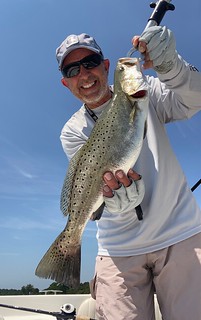
With striped bass off limits until August 1, a few anglers are fishing the bayside and the lower tidal river shorelines of the Eastern Shore for speckled trout, also called spotted seatrout. This is typically a dawn to early morning event and casting Zara Sooks over grass beds and in stump fields is one of the best tactics. If you do hook a striped bass by accident, do your best to retrieve it quickly and release it while it is still in the water. Most anglers are reporting that they have turned their focus to northern snakeheads.
White perch are a summertime delight for anglers of all ages. They can be caught off any dock or pier that has water of some depth under it and a perfect match up for our youngest anglers. A simple one-hook bottom rig with a No. 4 hook dangling about 4 inches to 6 inches off the bottom and a 1-ounce sinker will often do. It is hard to beat fresh grass shrimp for bait if you can catch them, but pieces of bloodworm will do just fine. When fishing deeper oyster reefs, a slightly heavier bottom rig will serve you well.
In the morning and evening when light conditions are low, white perch will come into the shallower areas around structure. Casting small spinnerbaits, beetle-spin type lures, spinners, and small soft plastic jigs are all good choices when fishing with light spinning gear. If there is a 5-weight fly rod in your quiver, a sinking tip fly line and chartreuse and silver Clouser minnows are one heck of a good time.
There are channel catfish to be found in the region’s tidal rivers and the Choptank has a large population of blue catfish. The blue catfish tend to be in the lower part of the river this time of the year, from the town of Choptank to Cambridge. Most any cut bait will do but fresh menhaden tends to top the list.
Lower Bay
As a reminder to lower Bay anglers, striped bass fishing is closed everywhere this to protect the species from water temperatures. The Potomac River is closed until August 20, Virginia waters are closed until October 4 and all Maryland waters are closed to targeting striped bass through July 31. Lower Bay anglers are fortunate that they have several other species to fish for this week.
Bluefish and Spanish mackerel can be found in good numbers this week making life miserable for schools of bay anchovies. The action tends to be best when a strong tide is running, and the baitfish are being swept along the edges of channels throughout the region. Diving seagulls will often lead the way to breaking fish. Casting small heavy and flashy jigs or Got-Cha type lures into the fray, allowing them to sink, and then speed reeling is a great way to catch Spanish mackerel. Slower retrieves will get you bluefish. It pays to look for slicks that are telltale signs that some baitfish were being chomped nearby, and jigging deep often will provide results.
Trolling is a popular option and a great way to cover a lot of water when in search of Spanish mackerel and bluefish. Small Drone spoons in gold or with chartreuse coloring added are an excellent choice for Spanish mackerel. Small gold Clark spoons are another good choice. Both are usually pulled behind No. 1 planers at about 6 to 7 knots. Bluefish will hit at slower speeds. Putting out a couple of lines with inline weights to fish closer to the surface is always a good addition to any trolling spread.
Fishing for a mix of spot and white perch with a few small croakers tossed in has been exceptionally good lately. The spot are getting larger and there are a lot of them to be found in the lower Bay. Pieces of bloodworm or the artificial version are the baits of choice. The mouth of the Patuxent River and Tangier Sound are two of the best places to get in on the action.
There are plenty of white perch to be found in the tidal rivers and creeks as well as Tangier Sound. Pieces of bloodworm, small minnows, peeler crab, and grass shrimp are just a few of the bait choices that will serve you well. Shoal areas in the rivers and sounds are good places to look for white perch. The shorelines always hold good numbers of white perch around docks, rocks, bridge piers, and prominent points. Fishing with bait or small lures is a wonderful way to fish for them.
Speckled trout are being found along the marsh edges of the Eastern Shore in stump fields and over grass beds along with the occasional slot size red drum. Large red drum are being encountered near the Middle Grounds and the Target Ship, anglers are jigging at them when troubled water can be spotted or by drifting soft crab baits to them and trolling large silver spoons. Cobia fishing tends to be slow this week, but it only takes one legal-sized fish to make your day. Smith Point has been one of the better places to set up a chum slick.

Recreational crabbers are doing well this week in all regions of the Bay. In most areas crabbers are finding the best success in waters less than 12 feet on a good moving tide. In some areas small crabs have been chewing up baits but in many locations crabbers are finding a bounty of 7-inch and 8-inch crabs that are full of meat. Many are reporting culling crabs under 6 inches and tossing them back into the water in favor of the larger crabs. Nettles have been pesky lately and if you are pulling a trotline, net rings, or collapsible crab traps into the wind, the stinging nematocysts can really be bothersome.
Atlantic Ocean and Coastal Bays
Surf anglers continue to catch a mix of kingfish, spot, and croaker this week on bloodworms and artificial bloodworm baits in the surf. Flounder are being caught on squid strips and northern blowfish are showing up as well. A few large red drum are being caught and released on large baits of cut mullet, menhaden, and clams. Stingrays and inshore sharks are also part of the mix when fishing large cut baits.
At the South Jetty and inside the inlet to the Route 50 Bridge piers, sheepshead are being caught on sand fleas. Large bluefish are being caught by casting bucktails and soft plastic jigs, striped bass are also part of the mix, and some fall into that magic range of 28-31 inches.
The back bay channels leading towards the inlet are providing good flounder fishing this week. The channel out in front of the Ocean City Airport has been another great place to fish for flounder with a lot less boat traffic. Anglers targeting larger flounder are using Gulp baits and live spot, finger mullet, and small menhaden.

Outside the inlet, anglers who are trolling a mix of Clark and Drone spoons behind planers and inline weights are catching Spanish mackerel on some of the inshore lump and shoals. The anglers headed out to the offshore wreck and reef sites continue to enjoy excellent fishing for sea bass with a mix of triggerfish and flounder. Farther offshore at the canyons a mix of bigeye tuna and yellowfin tuna are entertaining anglers who are trolling.

Freshwater Opportunities
Freshwater biologists have been busy in recent weeks surveying and studying some of the freshwater sites in Maryland. In the North Branch of the Potomac River, biologists have been outfitting trout with passive integrated transponders, known as PIT tags. These are small radio transponders that contain a specific code that allows each individual fish to be assigned a unique identification number. They are often used in fisheries studies to track movement, survival, and growth over time. Department of Natural Resources biologists tagged 225 trout this year and recaptured five that were tagged last year. The multi-year study is focused on determining growth and mortality in the study area.
The upper Potomac River continues to exhibit typical low summer flows and very clear water. Light lines and long casts are in order when fishing for smallmouth bass during the morning and evening. At dawn, topwater lures are an exciting way to catch smallmouth and as the morning wears on, tubes and small crankbaits can be a good choice. Recently the Department of Natural Resources stocked 15,000 juvenile smallmouth bass in the Potomac at Brunswick, Point of Rocks, and White’s Ferry to bolster smallmouth bass populations.
Largemouth bass are holding to a typical summer mode of activity, feeding close to shallow cover during the night and retreating to cool shade during the day. Some of the best largemouth bass action can occur in the early morning and late evening low light conditions near shallow cover like grass, where baitfish and other prey can be found. Topwater frogs, poppers, buzzbaits, and chatterbaits are great choices to work the grass cover for largemouth bass.
Once the largemouth bass retreat to cool shade, a variety of tactics can be used. If they are holding under thick grass matts in deeper water, dropping wacky rigged worms with a heavy weight can entice them to pick up a bait. If they are holding under the shade of a dock or overhanging brush flipping soft plastic worms or creature baits to them can work well.
Invasive northern snakeheads are found In tidal waters and unfortunately have spread to some nontidal lakes and ponds, often in the same cover as largemouth bass.
Maryland Fishing Report is written and compiled by Keith Lockwood, fisheries biologist with the Maryland Department of Natural Resources.
Angler’s Sport Center Fishing Report – Annapolis, MD

The Angler’s Sport Center fishing report is compiled and written by Anglers Team Member, A.J. Lewis.
Upper and Middle Bay
With Striped Bass being closed to fishing until August, Anglers have moved to targeting Snakehead and Blue Catfish mainly. The Conowingo Dam Pool offers plenty of opportunities to get both! More shallow areas along the shore of the Susquehanna are home to grass beds provide excellent opportunities for Snakehead. Anglers are catching them on anything from Minnows to paddle tails!
The mouth of the Susquehanna is providing tons of opportunities to get lots of Blue Catfish. Anglers are reporting success using cut bait such as Soft Crabs and Bunker. Blue Catfish are invasive, so there’s no creel limit or closed season for them. They also put up a fantastic fight, so they make the perfect substitute for Rockfish.
Spot, White Perch, and Croaker are being caught all around the Chesapeake Bay Bridge. Anglers are finding luck jigging with Chesapeake Sibiki Rigs tipped with either Bloodworms or Lugworms around the pilings and at Dropoffs!
The Bluefish and Spanish Mackerel bite is red hot this week! Bluefish and Spanish Mackerel have been seen breaking the surface in large numbers! Anglers Pro Staff Ben reports that he found the best success casting a 1oz Rainminnow or Trolling a 1/30 oz G-Eye Jighead with a Chartreus Zman Minnowz!
Captain LJ of G-Eye Jigs reports Spot, White Perch and Speckled Trout are being caught all up and down the Chesapeake Beach area!
South Bay
White Perch are being found all around the shallow waters inside the Southern Bay tidal rivers! The key is to pull spinners past underwater structure such as docks, fallen trees or oyster beds! For deeper waters around structure, a Chesapeake Sibiki Rig tipped with either Bloodworms or Lugworms will net you bigger perch!
Anglers are finding Speckled Trout all along the shore of the Eastern South Bay! Areas around grass beds or stump fields are key to getting on some good sized Specks! You may even find a good sized Reddrum or Striped Bass mixed in with the Specks as well! DNR reminds Anglers to release any Striped Bass caught as quickly as possible as fishing for them is closed.
The mouth of the Potomac River is home to some of the best Blue Catfishing in the bay! Areas around Fletcher’s Boathouse are also home to catching some huge Blue Cats as well! Anglers are finding success on anything from small paddle tails to cut bait such as chunked bunker or soft crabs!
Additional Info.
Remember Anglers, fishing for Striped Bass is closed until August 1st! Then they’ll return to their normal 19-31 inch slot with a limit of 1 Rockfish per day, per Angler.
The Angler’s Sport Center fishing report is compiled and written by Anglers Team Member, A.J. Lewis.
Reel Chesapeake Fishing Report – Annapolis, MD
The Reel Chesapeake Fishing Report is written and compiled by writer and media professional, James Houck. Find the full report here, at reelchesapeake.com.
With the two-week striped bass moratorium in effect throughout Maryland’s portion of the Chesapeake Bay (through 7/31), anglers are focused on other species…or working on their vessels…or taking a midsummer break altogether.
White perch are one of the great species abundant throughout the Bay and all its tributaries. If taking home a stringer of these delectable beauties—known for their firm, clean, white filets—is appealing to you, then now is a perfect time to do so. Summer is peak season to load up on them, and even fill the freezer. Finding and catching them should be predictable and fairly easy.
In many rivers, especially the mid-Bay tribs, expect to find white perch picking off tiny minnows and insects off the topwater at sunrise and sunset in feeder creeks. Ambitious anglers may try their hand at fly casting to them with creatures and insects on light, 3-weight outfits. Or, perhaps, with an indicator and a tiny feather fly tied 12 to 18 inches below it (basically a float/fly-type setup). The action could be nonstop if you find a feeding school.

Light, fast-action spinning outfits will undoubtedly be in many anglers hands and are especially effective at catching perch when casting a variety of 1/16- to 1/4-ounce lures along shaded shorelines, around docks, or any type of structure in moving water. On Tuesday morning, I visited a Severn River creek with a particular eastern shoreline that remained shaded all morning. The stretch was littered with laydowns in a 3- to 7-foot zone. Perch were everywhere, and picking off a stringer of 10-inchers made for an exciting morning (and tasty dinner). I used a 1/8-ounce jighead tipped with a 2-inch micropaddletail. And the bycatch was very interesting—several juvie bluefish, a pickerel, and a couple striped bass up to 17 inches (released in water).
If you’re aiming for white perch in the Bay proper, try structure areas like the bridge, Sandy Point jetties, Thomas Point Lighthouse, the Choptank airplane wreck, Calvert Cliffs Nuclear Power Plant, the Gas Docks, and any oyster bars/reefs mapped out. Check for historical oyster reefs at Maryland Department of Natural Resources, here. Artificial reefs, many created in partnership with Coastal Conservation Association Maryland, also attract the fish. Learn about the Living Reef Action campaign, here.
We’re also hearing more reports of bluefish working their way toward the middle Chesapeake. If the juvies that we recently caught are any indication, this week into next should see more anglers targeting the fish from the Bay Bridge south to Poplar Island and beyond. Ditto for the mid-bay Spanish mackerel run, which seems to be a week or so behind schedule. Regardless, now is the time to give both a shot by speed-trolling #1 or #2 planers with metallic spoons at 7 to 9 m.p.h. You can also try casting those same spoons or rain minnow lures and retrieving them as fast as you can to attract strikes.
For a bigger fish bite, largemouth bass and northern snakehead offer excellent action and can be found in many Chesapeake bodies. The Marshyhope on Maryland’s Eastern Shore—a branch of the Nanticoke River—has a healthy population of 2 to 3 pounders. Big, 7- or 9-inch ribbon tail worms rigged Tex-style have been pulling them in. Similarly, the Pocomoke has offered bassmasters consistent action.
The Potomac watershed and its many creeks—particularly the Mattawoman, Pomonkey, and Piscataway—also hold bass upwards of 6 pounds, plus plenty of northern snakehead, including dragons. Topwater frogs and chatter-style baits are two primary lures to try. The Jug Bay vicinity within the Patuxent River is also prime territory for both species.
Smallmouth bass fishing has also been gaining attention of anglers in the northern and central regions of the watershed. Fast flowing creeks and rivers in the northern Potomac, Middle and Little Patuxent, and upper Patapsco offer shallow, boulder strewn runs and holes where smallmouth will readily pounce on small grubs, stingers, and the like. The Susquehanna River, north of Conowingo Dam, also offers excellent smallmouth fishing (and in the dam pool below, try chunking for blue catfish!).
And, of course, the biggest bay bites of all are bull reds and cobia in the southern waters from Point Lookout to the mouth of the Chesapeake near Cape Charles. Savvy anglers are targeting shallow grass flats in Tangier Sound for reds with jig/paddletail combos, while running, gunning, and sight-fishing for cobia in more open water is what it takes to hunt the bigguns. Good luck!
View the full Reel Chesapeake Fishing Report, written and compiled by writer and media professional James Houck, at reelchesapeake.com.