
Maryland & Chesapeake Bay Fishing Report
Reel Chesapeake Fishing Report – Annapolis, MD
The Reel Chesapeake Fishing Report is written and compiled by writer and media professional, James Houck. Find the full report here, at reelchesapeake.com.
Happy Thanksgiving! Autumn fishing has reached a zenith, save for a day here or there when the heavens opened up with rains or gusty wind. Recreational anglers and charters have been on the water with abandon and are catching a wide variety of species, from crappie and largemouth bass to the striped variety, and toothy species from pickerel to tautog. It’s been an amazing week!
In the middle Chesapeake Bay region, from the Bay Bridge down toward Chesapeake Beach and beyond to Solomons, larger stripers in the 30-inch class continue to be jigged up among lots of teens and 20s. Boats working the Bay with electronics are finding the fish over reefs and along the shipping channel edges. Popular regions are Eastern Bay, the Choptank’s mouth, between Calvert Cliffs Nuclear Power Plant and Taylor’s Island, and the Cove Point Hollow. They’re scattered and it takes time and effort to find them, but when you do, the rewards are worth it.
Sometimes, you’ll luck into a sea of birds and blitzing fish, and we’ve seen a few videos from charters captains as such. Most folks are tossing 1 to 2-ounce jig heads tipped with 5 to 7-inch plastics on light tackle gear and enticing bites with snap-jigging. Others more inclined to the fly, are using 9wt outfits with big, sinking Clousers or Deceivers to get down in the water column.
Trolling remains popular among larger vessels and we’re seeing more success with umbrellas than tandems, but the approach still remains a “flavor of the day” type of deal. Most boats troll both.
And we’re still seeing reports of anglers working baited bottom rigs (bloodworms or Fishbites) around structure (Bay Bridge pilings) and reefs for black sea bass. Amazing that this bite has reached the middle Bay with such consistency this season!
When the weather made the Bay a bit more hazardous than comfortable, as it did on Sunday and Monday, anglers ventured into the mid-Chesapeake rivers, like the Severn or Magothy, to fish for pickerel. The pickerel bite is hot right now and will remain so through winter. Surface water temperatures in the region are hovering around the 55F mark and continue to dip, which is ideal for the fall bite. Personally, I’ve found spinners most effective right now to entice bites; quarter-ounce Mepps Aglia Streamers (single hook). Others have used tail spinners screwed into soft-plastics. And still others have had great success on the fly. Similar deal as the stripers but on lighter outfits in the 5–7wt range.
The key is catching the tide at its peak, which has been a bit challenging the past several days with low slack falling in the middle of the morning. Afternoons can be good, however, especially along south-facing shorelines warmed by the sun. Look for grassbeds and structure and fish the edges. Bonus–you’ll likely hook into yellow perch which are feeding hard right now and balling up ahead of their early-winter spawn.
In fresher, feeder waters—like the way upper Patapsco, Gunpowder, Little and Middle Patuxent, and many of the region’s reservoirs and small lakes—large and smallmouth bass, crappie, and a mix of other panfish and trout are being caught. Sizes have been excellent too, with larger specimens feeding hard. Folks are using micro-finesse techniques for the crappie and trout, and upsizing to larger plastics, chatterbaits, and crankbaits to work around laydowns, points, and significant depth changes for bass. Jig ‘n pig or, even, a Ned rig can be effective when the fish are hugging bottom.

View the full Reel Chesapeake Fishing Report, written and compiled by writer and media professional James Houck, at reelchesapeake.com.
Angler’s Sport Center Fishing Report – Annapolis, MD
The Angler’s Sport Center fishing report is compiled and written by Anglers Team Member, A.J. Lewis.
Upper and Middle Bay
It can be challenging to pinpoint the location of striped bass as they have dispersed across the upper Bay. A reliable strategy at the moment involves keeping an eye out for birds on or near the surface that are flying and diving on baitfish. This behavior serves as a valuable indicator, signaling the presence of striped bass that are actively chasing the migrating baitfish as they move south. Observing and following these avian cues can significantly enhance the chances of locating and engaging with the striped bass during their seasonal migration. For anglers looking to catch a significant number of striped bass, specific areas that prove fruitful include Love Point, the Key Bridge, and the mouths of rivers such as the Severn or Magothy River. Anglers have been employing a diverse range of tactics, with trolling and jigging emerging as favorites. Trolling offers the advantage of covering a larger area, while jigging allows for a more targeted and interactive approach. These versatile strategies have proven effective in enticing striped bass in the aforementioned areas, providing anglers with a variety of options to enhance their chances of a successful catch.
White perch have undergone a significant migration to deeper and warmer areas, venturing beyond most tidal rivers. While a few native ones may still linger within certain river systems, the majority are transitioning to channel edges. Anglers are effectively targeting white perch using bottom rigs, specifically favoring the Chesapeake Sabiki Rig, which is often tipped with either live or artificial bait. Among the preferred baits, bloodworms have proven to be particularly enticing. To optimize your chances of success, casting near deep water structures or drop-offs in deeper water is crucial. This strategic approach aligns with the white perch’s movement pattern and increases the likelihood of a productive angling experience.
As the striped bass bite continues to slow down, anglers are adapting their focus to catfish, with blue catfish becoming more prominent in colder waters. The increased activity of blue cats in these conditions offers anglers an opportunity for a fruitful alternative. To target smaller catfish, worm-type baits like bloodworms prove effective, while those seeking larger catches are turning to cut bait such as soft crabs or cut bunker. This transition in fishing strategy aligns with the changing dynamics of the season and allows anglers to make the most of the changing conditions, ensuring an enjoyable and productive fishing experience.
South Bay
In the lower bay area, striped bass can often be spotted chasing baitfish near the mouths of tidal rivers. Prominent hotspots include the mouths of the Potomac, Patuxent, and Cedar Point. Anglers are employing a diverse array of methods to catch striped bass, with trolling emerging as a favorite technique. Tandem or Umbrella rigs are particularly popular choices for this purpose. A key strategy involves targeting areas with diving gulls, as these birds indicate the presence of baitfish and, subsequently, striped bass. It is important for anglers to troll the perimeter outside of the gull-populated zones, demonstrating courtesy to fellow anglers and ensuring a more considerate fishing experience for everyone involved. This approach increases the chances of success while respecting the shared space on the water. While trolling remains the favored method for catching striped bass in the lower bay area, many anglers are turning to jigging with soft plastics as an alternative technique. Surprisingly, the success rates with jigging are almost comparable to those achieved through trolling.
White perch fishing in the lower Bay has undergone a complete transition to deepwater environments. The majority of white perch are now located in deeper and warmer water structures, such as drop-offs or oyster beds. Anglers targeting white perch are advised to focus their efforts in these deeper areas to maximize their chances of a successful and rewarding fishing experience. For anglers targeting white perch in the lower bay area, bottom rigs with an appropriately sized sinker have proven to be the most effective method. Given the tendency of these fish to school up in large numbers, success with this approach often translates into multiple catches. When you hook into one white perch, you’re likely to reel in numerous others, making bottom rigs a highly efficient and rewarding strategy for anglers pursuing perch in these deep water environments. Anglers have reported significant success in the Patuxent River, Potomac River, and the Wicomico Rivers when targeting white perch. These rivers have proven to be highly productive with many perch enthusiasts enjoying plentiful and rewarding fishing experiences in these particular waterways.
As the water temperature drops, catfish have become more energetic and productive, offering anglers exciting opportunities for successful fishing. Key areas to find these fish include throughout the Potomac River and Patuxent River. Anglers targeting smaller catfish are using smaller cut bait and worm-type baits, while those chasing the larger specimens are opting for bigger cut bait such as alewife or gizzard shad. Blue catfish, being invasive and with no creel limit, make for a perfect target as they provide ample meat for anglers. The combination of favorable fishing conditions, strategic bait choices, and the potential for a plentiful catch makes pursuing blue catfish an appealing and rewarding experience for anglers when the striped bass bite slows down!
The Angler’s Sport Center fishing report is compiled and written by Anglers Team Member, A.J. Lewis.
Maryland DNR Fishing Report
Maryland DNR Fishing Report is written and compiled by Keith Lockwood, fisheries biologist with the Maryland Department of Natural Resources.
Freshwater
Anglers at Deep Creek Lake and nearby impoundments in the western region are enjoying good fishing for coldwater species. Walleye fishing at Deep Creek Lake is good in the evenings along steep rocky shores, casting diving jerkbaits or crankbaits is a good tactic.
Walleye can also be found in the upper Potomac River and the waters are cold enough now that they are active. Soft plastic jigs and swimbaits as well as live minnows are a great way to target them. The waters around Dam Four offer the best walleye fishing opportunities on the upper Potomac.

Fishing for smallmouth bass is very good this month in the upper Potomac, Deep Creek Lake in the western region and Prettyboy and Liberty reservoirs in the central region. Tubes, soft plastic craw jigs and crankbaits are all good choices for baits. Northern pike are waiting for anglers in Deep Creek Lake as well as yellow perch and crappie.
Largemouth bass are very active and can be found in a variety of water depths this week. The afternoon sun can warm up shallower waters and largemouth bass will take advantage of it while looking for a snack. Medium-depth waters are good places where largemouth bass are roaming and looking for baitfish and crayfish. Sunken wood or similar structure located in deeper waters is a great place for a largemouth bass to hold.
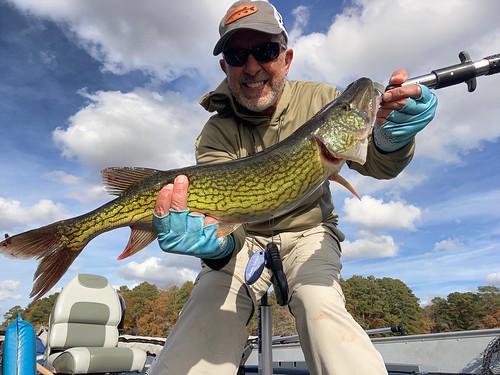
Cold weather and seasonally reduced grass cover means an opportunity to fish for chain pickerel. It is a fun fish to pursue, often in quiet places in the upper regions of tidal rivers, ponds, or reservoirs. Chain pickerel will look for cover to lay in ambush, often in the form of shoreline sunken wood. Usually the medium-sized chain pickerel will be found along the shorelines and the real lunkers out in deeper waters and holding tight to some kind of structure.
Fall is also a great time to fish for crappie; they can be found schooled up near deep structure like marina docks, bridge piers, and sunken wood. Slowly working these areas with a slip bobber rigged with a small minnow or marabou jig is a great way to catch them.
Atlantic Ocean and Coastal Bays
Surf anglers are picking away at what may be the last of the kingfish, blowfish, and flounder this week. Reports are that there are plenty of dogfish and clearnose skates to keep anglers busy, as they patiently await a southern migration of large coastal striped bass to pass along the beaches of Maryland. No one wants to hear, “You should have been here yesterday!”
Anglers at the inlet are experiencing no shortage of striped bass this week and are having a ball catching and releasing striped bass. Every once and a while a nice striped bass measuring over 28 inches allows an angler to take a fish home for dinner. Casting soft plastic jigs near the jetty rocks and the Route 50 Bridge is the best way to enjoy this fun fishery. In the back bay waters the Route 90 and Verrazano bridges are also offering plenty of catch-and-release striped bass fishing.
Flounder are still being caught in the channels leading towards the inlet as they head out to offshore waters. The throwback ratio is very high but there are legal size fish being caught. This fishery will not last long, it is time for the flounder to leave.
Fishing for black sea bass continues to be excellent this week at the offshore wreck and reef sites, as limit catches are very common. Anglers also report a few triggerfish, flounder and bluefish being caught in the mix. Those heading out to the canyons are in search of swordfish, as well as golden and blueline tilefish.
Maryland DNR Fishing Report is written and compiled by Keith Lockwood, fisheries biologist with the Maryland Department of Natural Resources.