
Maryland & Chesapeake Bay Fishing Report
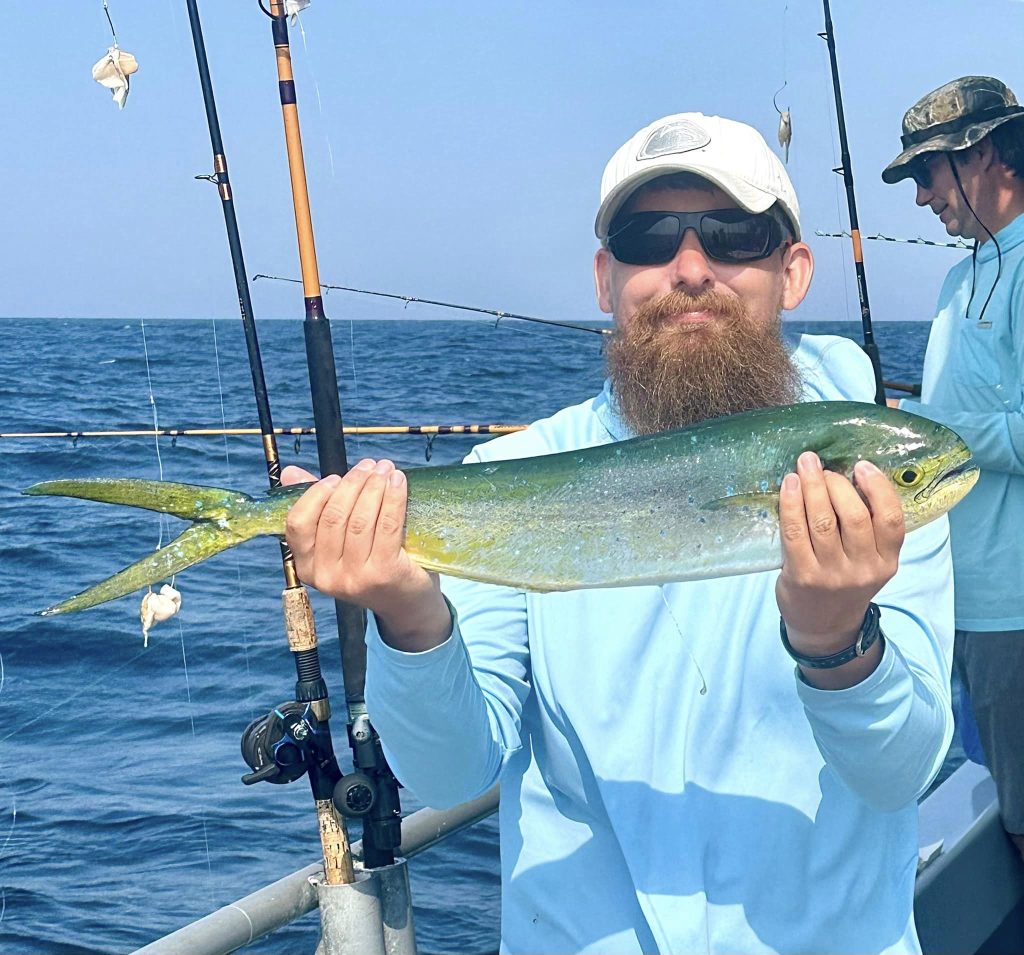
Sailing out of West Ocean City, Captain Monty Hawkins of Morning Star Fishing has been out on the sea bass grounds this week, and during their travels, they’ve been able to pick off some mahi-mahi for a little extra meat and a bit of variation from the usual bottom fishing. On Monday, they headed out to mostly calms seas but according to the captain, they had to work for each fish, whereas on Sunday, the fishing was steady and one angler even had a limit on jigs—a somewhat rare occurrence on the Morning Star. The mahi they ran into were very small, too small to keep, so they were all thrown back. The skipper referred to them in a Facebook post as “micro mahi”, which indicates that they were likely only a few weeks old. Tuesday’s sea bass fishing was better with calm enough seas to fish comfortably and blue skies, however, after finding only a few keeper-size mahi—including a decent one pulled from a cluster of floating grass— they went back to sea bass fishing. He said the sea bass preferred the jig on Tuesday, but not by much. Then, on Wednesday, the skipper received conflicting weather forecasts and, with a light crowd, headed out to find deteriorating conditions. The first few stops they made found more small mahi, several of which were keepers. When the mahi fishing slowed, they dropped anchor on a solid sea bass bite with double headers coming over the rail continuously until the captain noticed winds climbing to nearly 30 knots and a 240-degree shift in wind direction that would find building seas. As the bite slowed, he pulled anchor and their group got a rocky ride back to port with plenty of meat for dinner. Plenty of action to be had out there and better weather ahead!
From Ocean City, Taylor Bakke at Always Bent Fishing OC reported on the 37th Annual Ocean City Tuna Tournament this past weekend. Taylor said there was an inshore bluefin bite over Massey’s Canyon along with several other nameless lumps in the 15- to 30-fathom range, which led to quite a few bluefin being weighed in for the tournament. A couple of those bluefin, he said, hit spreader bars, but most of the fish were taken with skirted ballyhoo. Taylor was out with Mark Montgomery on the Bad Habit and they managed a 125-pound bluefin on Friday, the first day of the tourney, which was later knocked out of 1st place. He mentioned that only yellowfin tuna were caught at Wilmington on Friday which is why they stuck to their inshore bluefin plan, but by Sunday things had shifted. “On Sunday,” he said, “the bigeye bite turned on in Wilmington Canyon and that’s what ended up bumping us out of first and winning the tournament.” Taylor said their 125lb bluefin was bested by a 191-pound bigeye caught by Don Steadman of Wrecker Sportfishing, so congrats to the Wrecker crew on a securing the W with a big bigeye.
Taylor also mentioned that his buddy Remo, who was not in the tournament, caught wind of the bigeye bite, ran out on Sunday afternoon, and was wolf-packed by 5 bigeye tuna in their spread. Luckily for their crew, they managed to land all 5 on his 37-foot Sea Hunter.
Taylor said this week they’re planning to try fishing around those inshore lumps for yellowfin and bluefin, noting that they’ll most likely stick to trolling since that’s what’s been working, but they’re also planning to try chunking.

Anglers Sport Center Fishing Report – Annapolis, MD
The Anglers Sport Center fishing report is written by Anglers Fishing Manager & OTW Columnist, Alex Gallardo-Perez.
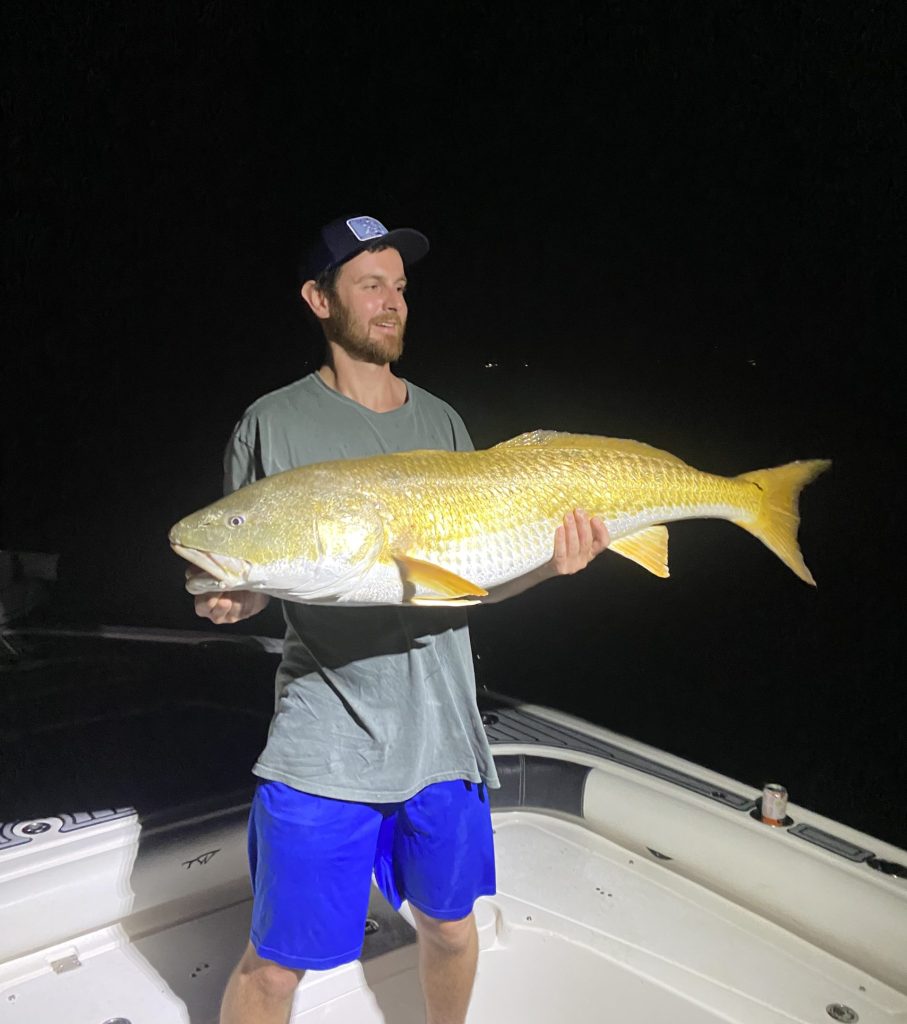
We’ve been seeing more and more of the summer species show up in the lower portion of the Chesapeake Bay (in Maryland waters). Cobia, bull red drum and some large bluefish have been the name of the game for anglers this past week. Anglers targeting cobia have been chumming with bunker around Smith Point and the Target Ship area, with most boats catching at least one keeper for their efforts. Sight fishing for cobia has also been effective, but most sight fishers tend to head south into Virginia waters around the shipping channels. Live eels, bucktails, and twitchbaits have been the best things to cast at surface-cruising cobia.
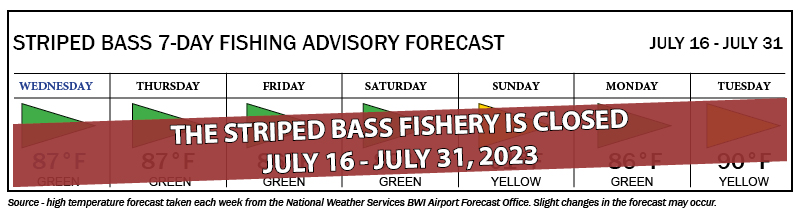
Striped bass fishing has officially closed in Chesapeake Bay for Maryland’s summer closure, which lasts from July 16 to the 31st. Anglers are not allowed to target or keep them for that 2-week time frame. Most anglers in our region will be fishing the southern portion of the Bay, chasing bluefish and hoping to run into a school of bull reds while scanning the shipping channel edges from Solomon’s to the Point Lookout area.
Fishing for white perch around the shorelines can be fun this time of year since you can get a mix of species as bycatch, like slot-size red drum, speckled trout, and catfish in some areas of the Upper Bay.
The Anglers Sport Center fishing report is written by Anglers Fishing Manager & OTW Columnist, Alex Gallardo-Perez.
Maryland DNR Fishing Report
Maryland DNR Fishing Report is written and compiled by Keith Lockwood, fisheries biologist with the Maryland Department of Natural Resources.
The striped bass season in Maryland waters of the Chesapeake Bay is now closed and will reopen August 1. The purpose of this annual summer closure is to reduce striped bass catch-and-release mortalities. Water temperatures in the Bay are generally running in the 86-degree range and are rising due to the continued heat. Striped bass suffer in these warm water conditions and the added stress of catch and release can be too much for them to recuperate.
The extremely warm water also fuels bacterial and fungal growth in Bay waters that are burdened with too many nutrients. The slime layer on fish is their protection from bacteria and fungi, and any disturbance of that layer can invite infections in warm water conditions.
A common summer bacterial infection is called mycobacteriosis. These infections can manifest themselves as one or two red lesions or sometimes an entire fish covered with them. Anglers should release diseased fish when caught, and take precautions when handling fish to avoid infection. In many cases these fish can recuperate when water temperatures cool in the fall, at which time anglers may notice scrambled lines on a striped bass indicating an area that has healed. More information on Mycobacteriosis is found on the Department of Natural Resources website.
Lower Bay
During the early morning and late evening, anglers are finding speckled trout and puppy drum in the shallower waters of the lower Potomac near Point Lookout, the Hoopers Island area, Tangier Sound, and Pocomoke Sound. Casting a variety of topwater lures over grass beds and paddletails and soft plastic jigs in deeper waters near promising looking shoreline structure areas.
Flounder are being caught near Point Lookout, Tangier Sound and Pocomoke Sound in hard-bottom shoal waters near channels. Drifting and working Gulp baits in white and pink with a strip of squid has been a popular tactic.
Large red drum are being caught and released in the Tangier Sound area and near the Target Ship. Many schools are being spotted by depth finders or by slicks. Jigging with large soft plastics has been the most popular way to fish for them. Dropping soft crab baits to spotted fish is also a good tactic. Black drum are also being found along the eastern side of the Bay.
Large sheepshead are being caught near the Target Ship on peeler crab baits. Bluefish are being found out in the main channels and caught by trolling a mix of Drone spoons and surgical tube lures behind inline weights and planers. Black sea bass can be found near reef sites and although many are undersized, with a few exceeding the minimum length of 13 inches.
Fishing for cobia is improving with better catches each week. Anglers are having the best success by anchoring up and chumming near the Middle Grounds, Smith Point, the Target Ship, and Mud Leads. Many are drifting cut menhaden baits or live eels to the back of the chum slick. Cownose rays are keeping anglers drifting baits in their chum slicks busy and they will always be attracted to chum slicks and a few anglers have reported medium-sized bull sharks in the region.
Atlantic Ocean and Coastal Bays
Surf anglers are reporting good fishing for a mix of kingfish and spot in the surf. Morning hours tend to produce the best catches. A few bluefish are being caught on finger mullet and anglers casting Gulp soft plastic jigs tipped with a piece of squid can catch a flounder in the troughs between sand bars.
At the inlet there is plenty of action with bluefish, which are being caught by casting jigs or Got-Cha lures, or by drifting cut bait during the morning and evening. Sheepshead and tautog are being caught near the jetty rocks and Route 50 bridge piers. The sheepshead are being caught on peeler crab and sand flea baits and the tautog on crab or sand fleas.
The back bay channels are providing good flounder fishing for those drifting with traditional minnow/squid baits or white or pink Gulp soft plastic baits on a jig head. Bluefish are part of the mix in the back bay areas as are striped bass during the early morning and late evening hours.
Fishing for black sea bass continues to be good at the offshore wreck and reef sites. Anglers are using traditional squid or clam baits, and many are also jigging with butterfly jigs with good success. The Department has published a new public notice which includes a drawing on how to properly measure a black sea bass. The tassel-like filament on the caudal fin is not included when measuring total length. The minimum size is 13 inches (again, excluding the tail filament) and the bag limit is 15 sea bass per person per day.
The boats and anglers heading out to the canyons are bringing a mix of yellowfin, bluefin, and bigeye tuna to the docks this week along with dolphin and flags indicating white marlin releases. Deep drop fishing is supplying anglers with good catches of blueline and golden tilefish.
Maryland DNR Fishing Report is written and compiled by Keith Lockwood, fisheries biologist with the Maryland Department of Natural Resources.