
Maryland and Chesapeake Bay Fishing Report
Despite a week of snotty weather conditions, there’s good fishing to be had from the reaches of the Upper Bay to the ocean front.
Anglers in the upper Bay are catching channa (snakeheads) on paddletails, chatterbaits and frogs as lily pads begin to provide some cover in shallow backwater environs. However, blue catfish are the main draw in the upper Bay tidal rivers, with anglers finding steady action on everything from cut bait and chicken parts to paddletails and crankbaits. It’s a similar story in the middle Bay tributaries, however, white perch are also in the mix as they begin to move downstream to wrap up their spawning run.
In the lower Bay, black drum action is picking up along the eastern side of the bay. But as a solid run of hickory and American shad continues, most anglers are turning their attention to places like the Potomac River.
Out by Assateague Island and Ocean City, the black drum fishing has been good with fish up to 30 pounds reported on sand fleas. Meanwhile, tautog and striped bass continue to be caught in and around Ocean City Inlet. Anglers are finding more keeper tog with each passing week, but a majority of the stripers remain under the minimum slot size. Swim shads and paddletails on jigheads are proving most productive for bass from the inlet to the marshes and creeks. Additionally, the first flounder of the year were caught in the channels on the inside of the inlet, while out front, the reef sites continue to produce tautog well over keeper size.
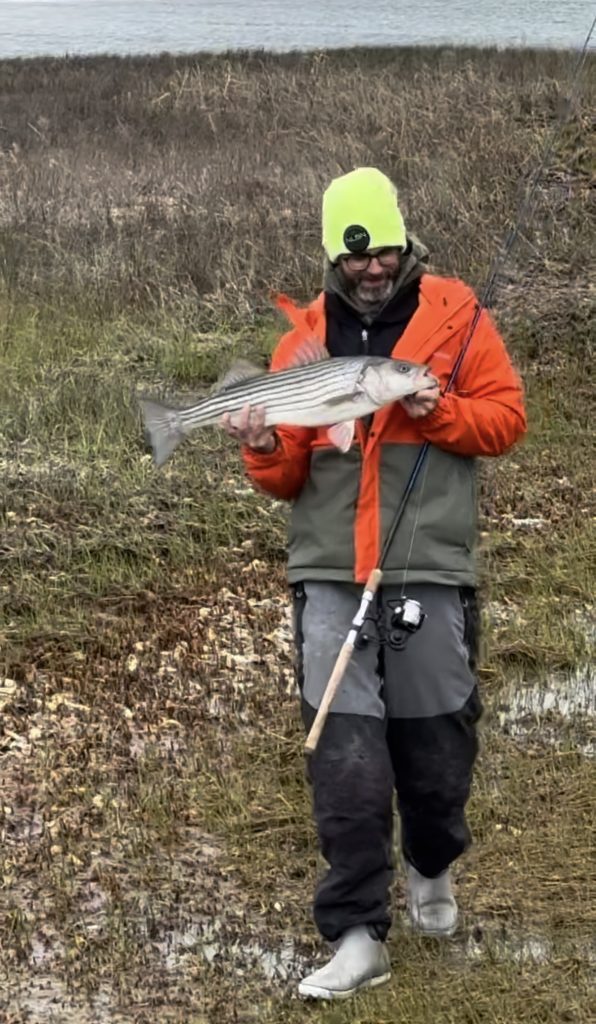
From Ocean City, Taylor Bakke of Always Bent Fishing OC reported that after picking away at fish for the past couple weeks, he and Capt. Jeff Rosenkilde finally got on a solid striper bite in the marshes following the full moon. There were a couple of slot fish in the mix but they caught and released about 25 bass in short order. Of the two slot fish they kept, their bellies were full of crabs and mantis shrimp, which means they’re likely holding tight to bottom. Bakke said 4-inch Z-Man paddletails got the job done.

Anglers Sport Center Fishing Report – Annapolis, MD
The Anglers Sport Center fishing report is written by Anglers Fishing Manager & OTW Columnist, Alex Gallardo-Perez.
The wind and rain have been nasty these past few days, but anglers have kept busy around the region by fishing for shad, perch and some catfish, mainly in the head waters of the rivers. In the Patuxent and Choptank rivers, white perch are almost done with their annual spawning run, and hickory and American shad have begun to show up in good numbers. The Potomac and Susquehanna River have been producing some great shad fishing with a few more reported catches of some good size American shad.
Catfishing from the shore has been hit or miss around the Bay Bridge area with most reports coming from the north side of the Patapsco River around Fort Howard and North Point State Park all on chunked mud shad.
Maryland DNR Fishing Report
Maryland DNR Fishing Report is written and compiled by Keith Lockwood, fisheries biologist with the Maryland Department of Natural Resources.
Another streak of unstable weather is expected, with general warming conditions of Chesapeake Bay waters for fish moving to spawn. Main Bay surface water temperatures are holding in the low 50s as blue crabs begin to emerge from the mud after their winter sleep. River temperatures are slowly warming to the low to mid 50s.
Upper Bay
Cooler temperatures and stained waters from recent rains will most likely have a detrimental effect of catch-and-release fishing for hickory shad in the lower Susquehanna River, Deer Creek, and Octoraro Creek. Switching from small silver spoons to gold spoons and pink and chartreuse colored shad darts will work often better in stained waters.
Blue catfish tend to dominate the fishing scene in the upper Bay this week. The lower Susquehanna River and the Chester near Crumpton top the list for tidal rivers, but they are present in every tidal river of the upper Bay. There are plenty of them and they are eating and reproducing machines, so it is good to catch as many as we can. Any type of cut bait works well, and many anglers have good luck with chicken parts, shrimp, nightcrawlers, and even (so we’ve heard) cheese snacks. Blue catfish are also famous for chasing down crankbaits and soft plastic jigs.
Middle Bay
Blue catfish can be found in many sections of the middle Bay and there are a number of blue catfish every tidal river. The Choptank holds the greatest number of blue catfish at this time, and they can be found from below the Dover Bridge to Denton. Most anglers are anchoring up along a channel edge and fishing down current with sliding sinker rigs using a circle hook with a small float to keep the bait off the bottom.
White perch are making their way down river from the spawning sites far upriver, so they’ll be moving through the channel waters this month. Fishing bottom rigs baited with pieces of bloodworm will be one of the more popular ways to fish for them. A lot of anglers are also catching small blue catfish less than 10 inches long when fishing with bait. Please keep them and do not toss them back in the water; it would seem the bottom of the Choptank River is paved with small blue catfish.
Fishing for Chesapeake Channa (northern snakeheads) is alive and well in the tidal backwaters of Dorchester County this week. Casting white paddletails is a tried-and-true way to catch them but fishing large minnows under a bobber is another good way to catch them.

Lower Bay
Black drum are beginning to provide some fishing action on the eastern side of the Bay near the Middle Grounds, the Target Ship, and the Mud Leads. The preferred bait is fresh soft crab, which is a little difficult to come by right now, but frozen soft crab or clams will work. Usually, black drum are found by watching depth finders and dropping bait to them; because of their large air bladders, they give a very solid signal.
The spawning runs of hickory shad are presenting a lot of fun catch and release opportunities in Mattawoman Creek and the Potomac River within the boundaries of the District of Columbia. Brightly colored flies, small flashy spoons and shad darts are the most popular lures used by anglers. American shad can be found in the Potomac, and they are being caught and released from Fletchers Landing to below Little Falls. Fishing larger and heavier shad darts than those used for hickory shad work well for American shad, and fishing from a boat to reach the main channel is often needed to access the shad.
Atlantic Ocean and Coastal Bays
Surf anglers are happy this week to see a solid run of black drum along the beaches of Assateague. These are medium-sized black drum in the 15- to 30-pound size range, the daily limit is one black drum larger than 16 inches in length per day. The most popular bait this week has been sand fleas, but clams also work well.
At the Ocean City Inlet and Route 50 Bridge area, anglers are catching some tautog on sand fleas near bulkheads, rocks and piers. The change of the tide has been providing some of the best action, the minimum size for tautog is 16 inches and catch limit is four per day. Striped bass are also being caught in the inlet and nearby areas by anglers casting soft plastic jigs and paddletails. Most fall a little short of the 28-inch minimum but they are providing fun catch-and-release action with a keeper now and then.
In the channels leading from the inlet the first flounder of the season were reported to be caught recently, as water temperatures warm, anglers will see more flounder moving through the inlet into the back bay waters. At the Verrazzano and Route 90 bridges anglers are enjoying good to excellent catch and release fishing for striped bass. Most of the striped bass are measuring under 28 inches and must be released. Casting paddletails near the bridge piers has been the most effective way to join in on the fun in the early morning or late evening hours.
Fishing for tautog at the offshore wreck and reef sites continues to be very good. Captains report that sometimes they must move from wreck to wreck or reef site to find a good bite. When the bite is on, limit catches of four fish per angler are not uncommon and anglers have been releasing extra-large tautog.
Maryland DNR Fishing Report is written and compiled by Keith Lockwood, fisheries biologist with the Maryland Department of Natural Resources.
Maryland Fishing Forecast
In the Bay and its tributaries, the best opportunities to bend a rod this week come from hickory and American shad, blue catfish, white perch, and—depending on your location—Chesapeake channa (snakeheads). In open water, around places like the Target Ship, soft crab and clams fished on bottom are catching quality black drum. The drum bite is just beginning to form, so expect bigger fish to show over the next week or two.
For anglers closer to the coastal bays and ocean beaches, tautog, black drum, and striped bass are all viable options. Sand fleas fished around hard structure like bridge abutments and jetties work best for keeper tautog, while fishing the same baits off sod banks and in the ocean surf should yield some black drum in the 15- to 30-pound range. Striped bass can also be caught in the ocean surf, but the best action seems to be reserved to the marshes and the Ocean City Inlet. Pack paddletails in the 4- to 6-inch range and a handful of swimming plugs like Rapala X-Raps to play catch and release with those under-slot schoolies.
It’s still early for reliable flatfish action in the coastal bays, but flounder fanatics may find a few short fish by swimming Gulp baits with teasers in the channels.