
Maryland and Chesapeake Bay Fishing Report
From Ocean City, Taylor Bakke of Always Bent Fishing OC reported that the striper bite continues to improve locally with bigger fish in the mix. Speckled trout and bluefish are now in the back bays in numbers. Bakke and Capt. Jeff Rosenkilde have been sight casting on the flats for stripers and blues in addition to fishing local bridges at night, where he bass have been more than cooperative. Out in the surf, the black drum bite is still going strong and flounder fishing is picking up steam in the bays. There are plenty of opportunities for inshore and shore-based anglers to get out and wet a line this week, from the ocean beaches to the inlet, or the bridges and marshes.

Captain Jamie Clough of Eastern Shore Light Tackle Charters has taken some time away from Maryland waters to continue chasing striped bass down south in Virginia. According to the skipper, when it comes to targeting post-spawn stripers it is simply a matter of finding the bait (menhaden) and the fish will be biting. He’ll be back to running charters in May and is booking trips for bull red drum in July. Give him a shout to lock down a future date!
Anglers Sport Center Fishing Report – Annapolis, MD
The Anglers Sport Center fishing report is written by Anglers Fishing Manager & OTW Columnist, Alex Gallardo-Perez.
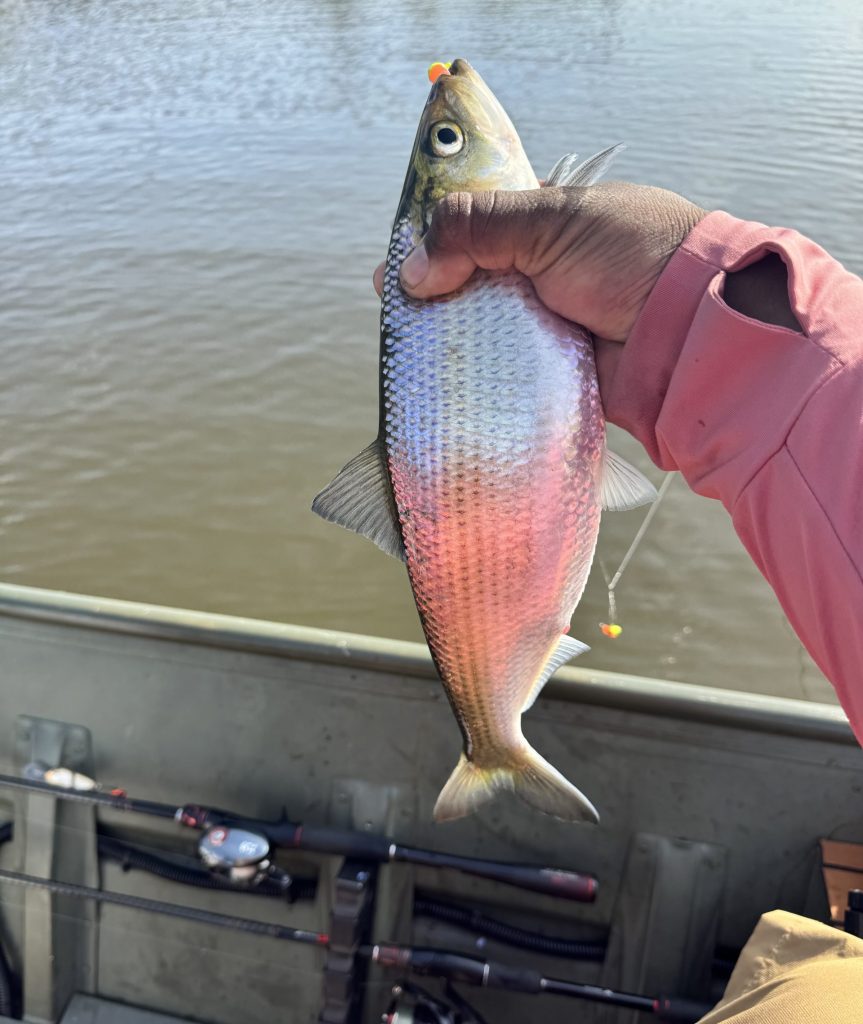
Anglers are still focused on the shad run as we head into what is probably the tail end of it. Most are fishing the Susquehanna, Potomac, and Choptank rivers where the action is mainly all hickory shad with a few Americans mixed in. Bass fishing has been great on most of the local reservoirs with some good quality fish coming out of Lock Raven, Liberty and Triadelphia reservoirs. A majority of anglers are still fishing pre-spawn areas, but they have begun to see a few fish move in shallow toward spawning beds.
Out in the bay, the catfish bite has not been great in the middle section but there are some reports of decent blue cats being caught just on the north side of the Patapsco River around North Point and Middle River.

Maryland DNR Fishing Report
Maryland DNR Fishing Report is written and compiled by Keith Lockwood, fisheries biologist with the Maryland Department of Natural Resources.
Middle Bay
Water temperatures are holding around 63 degrees in the middle Bay and 66 degrees in the Choptank River; most tidal rivers are holding approximately the same water temperatures. The striped bass spawn in the Choptank River is about over, all we can do now is wait for the young of year survey results. The same applies to white perch, yellow perch, and river herring which were all spawning in the rivers. So many factors enter into the success of a spawn, including weather and water conditions.
White perch have been moving down the tidal rivers where they spawned and usually, they reach their summer habitats by the middle of May. At that time, they provide lots of fun fishing off a dock or over oyster beds with grass shrimp or pieces of bloodworm on a bottom rig. Casting spinners and small soft plastic jigs near shoreline structure is always a favorite evening pastime.
Anglers can find plenty of action this week fishing for a mix of blue and channel catfish. They can be found in every tidal river within the middle bay region. The Choptank River holds the greatest number of blue catfish which can be found from the town of Choptank to Denton. Blue catfish are responding to warmer water temperatures and moving freely along channel edges and flat shelves alongside channel areas.
Cut bait is usually the first choice for most anglers and fresh white perch are readily available at this time. Many tackle shops carry frozen menhaden or gizzard shad and anglers also report good luck with chicken parts and scented baits. A Santee type catfish rig is a popular option with a circle hook with a small float nearby and a sliding sinker. It is important to keep baits off the bottom for the best success.
Fishing for Chesapeake Channa, (northern snakeheads) is good this month in the backwaters of Dorchester County. The most popular way to fish for them is casting white paddletails, chatterbaits rigged with white soft plastic baits and soft plastic frogs. Shoreline sunken brush and emerging grass beds are good places to target.
There are still some hickory shad being caught in the upper Choptank River near Red Bridges, and likely the action will not last more than a week. For this catch-and-release fishery, bright colored flies, shad darts, and gold or chrome spoons are often rigged in tandem.
Lower Bay
Catch-and-release fishing for hickory and American shad is an option in the Potomac River within the confines of the District of Columbia up to Little Falls. Anglers are catching and releasing American shad on large shad darts while fishing from small boats and kayaks that allow them to reach the main channel. There is still a spawning run of hickory shad in Mattawoman Creek, but the run is slowing down. Shad darts and small chrome spoons rigged in tandem are a popular presentation with spinning gear.
White perch are filtering down to the lower sections of the tidal rivers and creeks. Fishing with bottom rigs baited with grass shrimp or pieces of bloodworms works well. The deeper areas near bridge piers, docks and channels are some of the best places to fish for white perch currently.
Anglers have been targeting black drum in Pocomoke and Tangier sounds as well as near the Target Ship and Mud Leads. Most are slowly surveying waters with their depth finders and once fish are spotted dropping soft crab baits to the fish is a good tactic. Water temperatures in the lower Bay are currently 63 degrees and anglers are anticipating large red drum and speckled trout to arrive soon in the shallower waters of Tangier and Pocomoke sounds.
The tidal Potomac River from the Route 301 Bridge to the Wilson Bridge continues to provide plenty of fishing opportunities for blue catfish this week. The tidal Potomac holds the greatest numbers of blue catfish in the Maryland portion of the Chesapeake Bay’s tidal rivers. The Patuxent above Benedict and the Nanticoke near Sharptown also hold large populations of blue catfish.
Chesapeake channa (northern snakehead) are very abundant in the tidal rivers of the lower Bay. The creeks that flow into the Potomac and Patuxent on the western shore and to the Nanticoke, Wicomico, and the Pocomoke on the Eastern Shore are the places to find them. Grass beds are filling out and the fish can be found close to those emerging grass beds. Casting chatterbaits rigged with white soft plastic baits, white Paddletails and soft plastic frogs over or near the grass beds is an excellent way to target them.
Atlantic Ocean and Coastal Bays
Fishing for black drum in the surf at Assateague has been good and promises to continue through this week. Sand fleas have been the bait of choice. Anglers are also catching and releasing a few striped bass that measure outside of the required slot.
At the inlet, fishing for tautog has been good with a pleasant amount of fish measuring above over the required minimum of 16 inches. The jetty rocks and bulkheads in the inlet and Route 50 Bridge are being targeted and sand fleas are the most popular bait, with pieces of green crab a close second.

Striped bass are being caught in the early morning and evening hours in the inlet by anglers casting soft plastic jigs and paddletails; a few small bluefish are also occasionally being caught.
Flounder are moving through the inlet and headed for the back bay waters, so the inlet is a good place to intercept them. As they become more common in the back bays, the best fishing tends to be on an ebb tide which brings warmer water from the bay shallows. The Thorofare and similar channels leading towards the inlet tend to offer some of the best fishing success.
Fishing for striped bass at the bridge piers of the Route 90 and Verrazano bridges continues to be a fun catch-and-release event during the early morning and late evening. Casting paddletails near the bridge piers and marsh banks has been the most popular way to fish.
Tautog fishing at the offshore wreck and reef sites continues to be very good this week. Limit catches of eating size tautog are common for anglers. Anglers are catching some very large tautog weighing in the double-digit category and many anglers are choosing to return them to the water in favor of filling out their limit with smaller fish.
Maryland DNR Fishing Report is written and compiled by Keith Lockwood, fisheries biologist with the Maryland Department of Natural Resources.