
Maryland and Chesapeake Bay Fishing Report
From Ocean City, Taylor Bakke of Always Bent Fishing OC reported that giant bluefin tuna have moved in off Ocean City just in time for the December commercial season, which will remain open until the quota of 16.5 metric tons is reached. He cited one catch by Foolish Pleasures Big Game Fishing, who caught a 96-inch bluefin this week out of Ocean City. There are sure to be a few extra boats out there playing catch and release, as well. Bakke said they are gearing up today to head out on a friend’s boat on Friday in search of a commercial fish (which must be 73 inches plus). The tautog bite, he added, is still on fire. Inshore anglers are weeding through shorts but finding a fair amount of keepers, while at the wrecks, there are better quality fish being landed regularly. Striper fishing locally has been hit or miss; the best bet is to hit the inlet or nearby jetties at sunrise, or fishing the bridges after dark. The boat crowd, he said, is starting to see big schools of migratory bass under birds. However, the fish have been hanging beyond the 3-mile line between 4 and 8 miles from shore, where they cannot be targeted even for catch and release. A few boats have been lucky enough to find bass inside of 3 miles, but until the bulk of those migratory fish push in closer, they’ll be off-limits. The best bet right now is to target bass in the surf at first light or in the backwaters after dark. For detailed local reports, videos and more, check out Always Bent’s website and social pages.
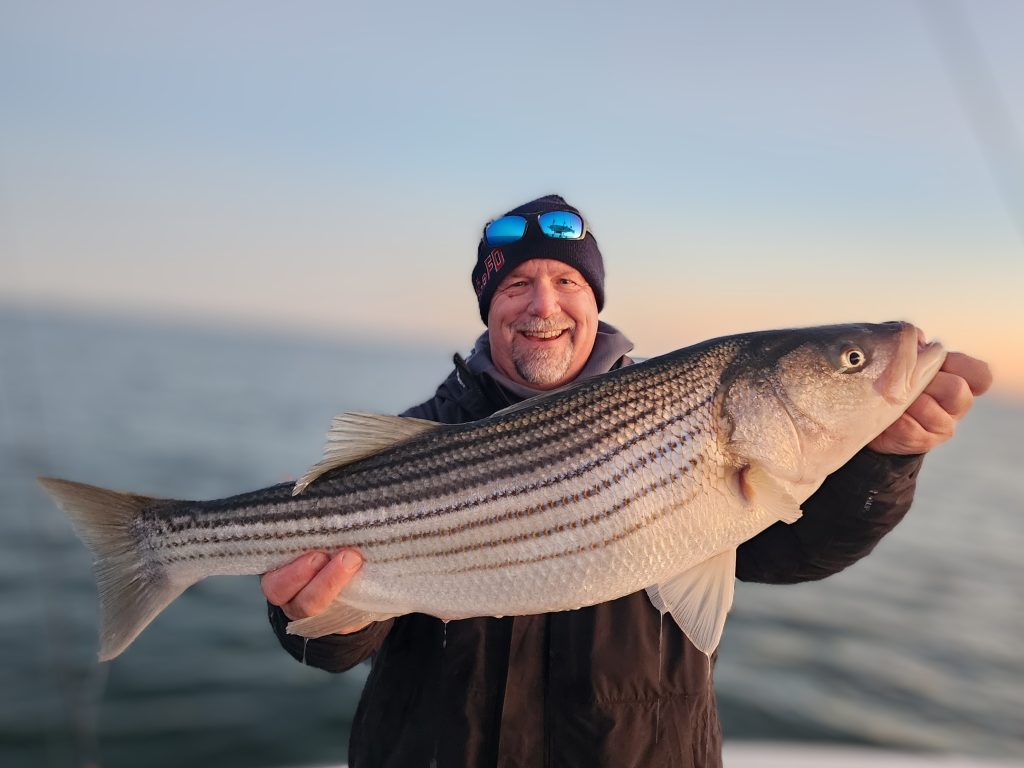
Captain Jamie Clough of Eastern Shore Light Tackle Charters said the striped bass bite in the Bay is currently on fire. Bigger fish are showing up daily, and the skipper said they’re feeding on acres and acres of bunker in the area. The trick to finding concentrations of bass is finding the bait, which shouldn’t be too difficult due to loads of birds working overhead and guiding anglers to the bite. Keep jigs and paddletails of various sizes at the ready. It’s a fantastic time of year to be striped bass fishing, and with more fish coming from up north and hooking into Chesapeake Bay, the skipper is certain that the bite is only going to get better. Capt. Jamie has limited availability for the next few weeks, so head over to his Facebook page for trip rates and contact info. to inquire about open dates to get in on the action.
Maryland DNR Fishing Report
Maryland DNR Fishing Report is written and compiled by Keith Lockwood, fisheries biologist with the Maryland Department of Natural Resources. Read the full DNR report here.
Middle Bay
When the winds are not blowing anglers are exploring the water depths around the Bay Bridge. The striped bass that are holding there are deep, trying to find slightly warmer water. The striped bass at the shorter end of the slot will stop feeding as water temperatures descend further into the 40s. As water even gets colder, anglers may find striped bass stacked up on the bottom refusing to take a jig. When this happens, anglers jigging for them will often accidently snag them. The larger fish, often those more than 24 inches long, can still feed and digest their food for a while longer. Thin braid and a fast action fishing rod are a real asset when attempting to jig in depths of 40 feet or more and keeping the weight of jigs suitable.
The mouth of the Choptank, the False Channel, and the Gooses have been good places to jig and troll for striped bass in the past couple of weeks. The mouth of Eastern Bay, Breezy Point, and Chesapeake Beach are also locations to check, which can also include scattered bird action. Water temperatures in the lower Choptank River are now in the low 40s and slightly higher out in the Bay. Striped bass can be spotted on depth finders holding close to the bottom in waters as deep as 50 feet.
Lower Bay
In the lower Bay, the lower Potomac and Patuxent rivers tend to be the places to be for the best striped bass fishing. On the lower Potomac River the waters below the Route 301 Bridge are holding good numbers of striped bass. The steep channel edges from about St. Georges Island to Piney Point has been one of the best places to jig and troll for striped bass. The deeper waters of the lower Patuxent River below the Route 4 Bridge are a good place to jig for striped bass this week. Anglers are having equal luck with both metal jigs and soft plastic jigs. Thin braid and a fast action rod make the job of jigging in deep water more efficient.
The main channel edges near Cove Point and from Buoy 72 to Buoy 76 as well as the top of Tangier Sound have been good places to explore while trolling and monitoring depth finders. The deepest edges tend to be where striped bass are holding close to the bottom.
There have been reports of fall migrant striped bass at the mouth of the Chesapeake in the past week. The main body of fall migrants has been staged at the mouth of the Raritan Bay lately and seen 25 miles off Atlantic City on their way south. A few large striped bass have been reported to be caught and released lately in the lower Bay, and anglers hope we may see more.
One misconception by some anglers is that the presence of gill lice indicates that striped bass have recently arrived from the ocean. Striped bass anglers can learn more on the DNR website in this informative article about gill lice.
Atlantic Ocean and Coastal Bays
Surf anglers are keeping a constant vigil on cut mullet and menhaden baits waiting for large fall migrant striped bass to be moving along the beaches on their southern migration. Clearnose skates and spiny dogfish are doing their best to keep anglers on their toes.
Inside the inlet there is a lot of fun catch and release fishing for striped bass that don’t measure up to the 28-inch minimum, and occasionally one does. Casting soft plastic jigs and paddletails near jetty rocks, docks and bulkheads and working them deep is providing a lot of fun action. Tautog are being caught in good numbers in the same areas on sand fleas and pieces of crab.
Striped bass are being caught in the back bay waters near the bridge piers of the Route 90 and Verrazzano bridges. Casting a mix of soft plastic jigs and paddletails is the most popular way to fish. The sedge banks that drop off to moderately deep waters are also a good place to cast paddletails.
Outside the inlet, the anglers headed out to the offshore wreck and reef sites are catching good quantities of black sea bass and a mix of flounder and porgies. Flounder are being caught on offshore lumps and reef sites by those who target them. Fishing for tautog is very good this week on the inshore and offshore wreck and reef sites. Anglers heading out to the canyons are deep dropping and finding success with blueline and golden tilefish.
Maryland DNR Fishing Report is written and compiled by Keith Lockwood, fisheries biologist with the Maryland Department of Natural Resources. Read the full DNR report here.