
Maryland and Chesapeake Bay Fishing Report
Captain Jamie Clough of Eastern Shore Light Tackle Charters said the topwater striper bite continues to impress for their charters. He and Captain Mike Gardner are running the same program they have all summer: find cool, shady, shallow water and bait, and the bass won’t be far behind. Spooks in the 4- to 5-inch range remain the most productive baits. The rivers, Captain Jamie said, are loaded with peanut bunker, so consider spending some time casting around the river mouths and nearby shallow structure. More recently, he added, they have been catching 8- to 10-pound bluefish further south, where they blues are feeding on silverside. For the bluefish, their charters are having the most success casting a 1-ounce jighead paired with a 5-inch Z-Man paddletail, which holds up well against those razor-sharp teeth. The skipper said that he adds a little glue behind the jighead to keep the paddletail in position, which makes those baits nearly invincible and saves them from constantly re-rigging. Captain Jamie went on to mention that he is beginning to see some speckled trout in the mix on their recent charters, and the 3-inch Z-Man Kicker CrabZ in the blue crab pattern is their go-to offering for those fish. Visit the ES Light Tackle Charters Facebook page for trip rates and contact info to inquire about their upcoming availability.

From Ocean City, Taylor Bakke of Always Bent Fishing OC said the inshore scene remained status quo this week. Flounder and sheepshead are the most popular targets right now for fishermen staying inside the inlet. Flounder are being caught in the back bay channels and some quality sheeps are coming from jetty and bridge structure, so if you’re fishing this weekend, those are probably your safest bets. That said, there are cocktail bluefish in the area and they can be caught on topwater, metals, or durable soft plastics alongside under-slot striped bass in the early mornings or evening when the tide lines up with low-light conditions. Out in the ocean, the boats that are trolling the shoals for Spanish mackerel are seeing some larger bluefish mixed in. This weekend, he added, is the 13th annual HUK Big Fish Classic, which is a unique tournament because top honors goes to the heaviest, biggest fish caught, which could be a tuna, shark, marlin, or swordfish. Although it’s typically tuna that make up the bulk of the catch, locals are eager to see the variety of fish brought back to the scales. Additionally, the Big Fish Classic is a different format than most other tournaments operating out of Ocean City. Registered boats can fish for 36 hours straight, including overnight, which adds an interesting twist that could pay off big time for anglers targeting bigeye tuna.
Captain Monty Hawkins of Morning Star Fishing out of West Ocean City ran both sea bass and mahi trips this past week with good results on both fronts. Friday’s sea bass trip yielded a whole lot of throwback flounder (fluke) along with a handful of keepers and a steady pick of sea bass until the current switched and the bite temporarily shut off. Once they were back on drift, though, the action picked up again and the few anglers at the rail enjoyed a consistent bite until the skipper faced the bow toward port. Back on the grounds a bit closer to home on Saturday—due to a forecast of stiff wind and rougher seas—Captain Monty reported that the fluke were mostly missing in action but they managed a solid haul of sea bass to send everyone home with dinner, despite heading in early to avoid building sea conditions. Sunday was the Morning Star’s first time targeting mahi; the crew headed out late in the morning to scout some spots and they wound up boxing 10 mahi. Finally, on Monday’s first official dedicated mahi outing, the first three stops were, in the captain’s words “a bust”. But they continued on and managed to land a handful of mahi and a few sea bass. Just about every angler on board finished the day with a pair of mahi—plenty for the table. The Morning Star will continue to sail for mahi every week, Tuesday through Thursday, until early September. Sea bass trips (with flounder in the mix) will be offered Friday through Monday going forward. Call 443-235-5577 to reserve your spot on the rail and head to their website for more trip information.

Maryland DNR Fishing Report
Maryland DNR Fishing Report is written and compiled by Keith Lockwood, fisheries biologist with the Maryland Department of Natural Resources. Read the full DNR report here.
As a reminder, the Chesapeake Bay recreational striped bass fishery is open to harvest through July 31 and then closed the entire month of August, reopening Sept. 1. This is to help protect our iconic species from the stress of being targeted during times of high temperatures and low oxygen levels.
Middle Bay
Anglers fishing at the Bay Bridge may experience some low dissolved oxygen situations below 20 feet or so, depending on the tide. Live-lining spot back to the bridge pier bases is a popular tactic at the 30-foot channel edge on the eastern side of the bridge. Casting soft plastic jigs at bridge pier bases in shallower waters is also a good tactic. Both methods of fishing are best done during the early morning or evening hours on a moving tide. The shallower waters on the west side of the bridge has been a good place to catch spot, croaker, and white perch.
The shallower waters of the middle Bay, where currents are moving and there is structure, are good places to cast a variety of lures during the early morning and late evening hours. Anglers are reporting a few speckled trout and bluefish in the mix. Locations such as the Kent Narrows are also a good place to fish for striped bass by live lining spot, jigging or casting paddletails, depending on the time of day. The Kent Narrows is also a good place to fish for white perch.
Water temperatures in the middle Bay are holding around 83 degrees this week and hopefully will stay in the low 80s for the rest of the month. Hot weather will most likely descend on Maryland again and water temperatures could rise to critical levels. This is the reason for the striped bass closure from August 1 through August 31, due to high mortality rates from released striped bass. In the meantime, anglers are urged to release fish in the water and not expose them to the air. Catch-and-release of striped bass should be minimized and fish brought to release quickly with stout tackle. The DNR website offers best practices for catch-and-release fishing.
Live-lining spot is a very popular way to fish for striped bass this week. Good locations include the east side of the shipping channel from Buoy 83, south past Sharps Island, and the False Channel down to the CP Buoy. Thomas Point is another good location to explore. Bluefish are a major part of the mix anglers will see, especially around Sharps Island. Saving pieces of spot and drifting cut pieces is a great way to catch the bluefish.
Trolling is another good option. A mixed spread of Drone spoons, umbrella rigs, bucktails and surge tubes lures can work for striped bass and bluefish. The spoons, umbrella rigs, and surge tubes lures will need to be pulled behind inline weights.
The blue catfish in the Choptank River and Tuckahoe Creek have moved upriver near Denton and above the Route 328 bridge on the creek, and are providing some of the best fishing this week. Cut bait of menhaden, gizzard shad, or even white perch will work well and a variety of scented baits will do the job.
Lower Bay
There are a lot of varied fishing opportunities this week in the lower Bay for anglers fishing in boats or from shore. Striped bass, bluefish, cobia, red drum, speckled trout, spot, croaker, and blue catfish are all on an anglers play list this week. Spanish mackerel may show up soon.
Striped bass, speckled trout, and bluefish are entertaining anglers who are casting a mix of poppers, paddletails and soft plastic jigs during the early morning and late evening hours along the shorelines of the tidal rivers, bay and Tangier Sound. The mouth of the St. Marys River, Point Lookout, Cedar Point, Hoopers Island, and the shores and creek mouths of Tangier Sound are all good places to explore and fish.
Striped bass are also being caught along channel edges by live-lining or drifting cut spot. Finding the fish suspended along channel edges with depth finders is a key to success. The steep channel edge from St. George Island to Piney Point, Cedar Point, Cove Point, the HS Buoy, and the Target Ship are locations worth exploring.
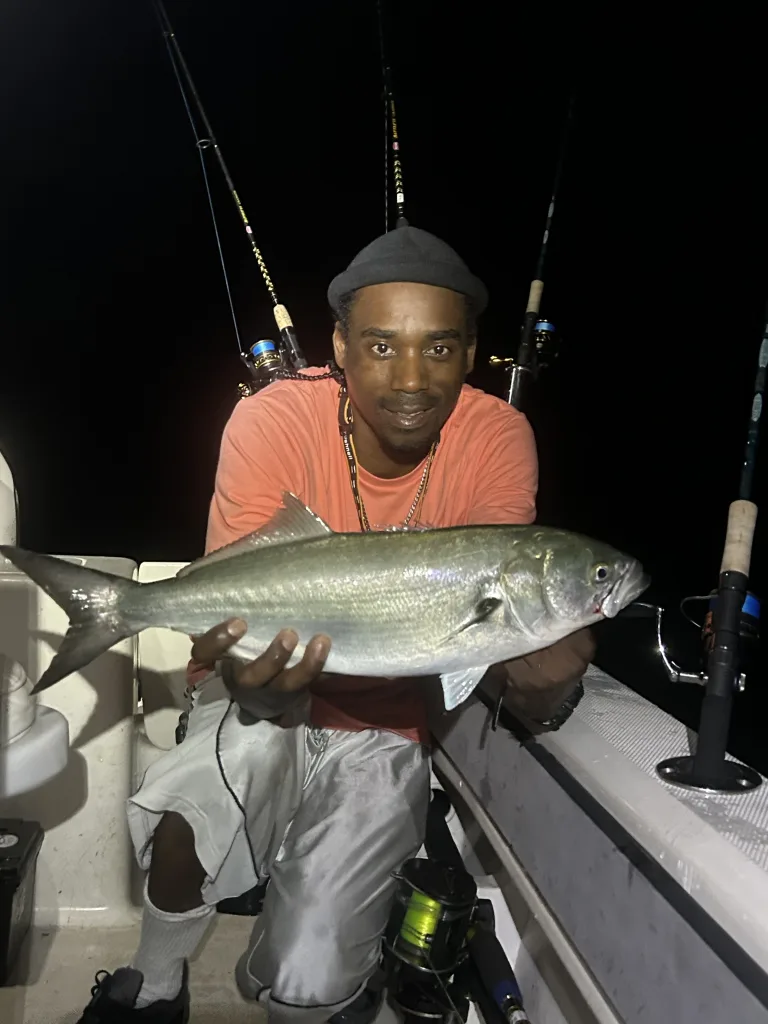
Bluefish are available throughout the region from the shallower waters to the edges of the deep channels. They range in size from 3 pounds to a whopping 10 pounds! They will come barging in on anglers who are live-lining spot or chumming for cobia, and they can be caught by drifting cut bait along channel edges. Trolling is a good option with spoons or surge tubes lures, which have been very popular lately in a variety of colors including red, green, white, pink, and orange. When trolling with surge tubes lures, one might be lucky enough to pick up a cobia.
Fishing for cobia is good near Smith Point, the Target Ship area, and Point Lookout. Anglers are chumming and drifting live eels to the back of their chum slicks. They are also able to sight-cast cobia swimming near the surface on calm days. A large percentage of the cobia being caught are a little short of the required 43-inch total length.
Large red drum are moving about in the lower Bay and can often be located near Point Lookout, the Target Ship area, and the Middle Grounds. Slicks, troubled water, and marks on depth finders can help locate schools. Jigging with soft plastics is popular but soft crab baits are a welcomed treat to large red drum. At times the large red drum can be caught by trolling large chrome spoons.
Drifting soft crab baits is a favored way to fish for speckled trout at the mouths of the creeks coming from the marshes of Tangier and Pocomoke sounds during the outgoing tide. Casting Zara Spooks and paddletails over grass beds and stump fields during the morning and evening hours is also a good way to fish for speckled trout.
Atlantic Ocean and Coastal Bays
Surf anglers that are fishing with small baits of bloodworms, artificial bloodworm baits, shrimp or squid are catching kingfish, spot, northern puffers and flounder. Those fishing larger baits of cut mullet or menhaden are catching large bluefish, sandbar sharks, and large red drum.
Dredging operations at the Ocean City Inlet has begun and will continue till the end of the month, just in time for the White Marlin Open. More information on the impacts for inlet mariners is available online.
At the inlet and Route 50 Bridge area, a mix of striped bass and bluefish are being caught during the early morning and late evening or nighttime hours. Casting soft plastic jigs or drifting cut bait is a popular way to fish for them near jetty rocks, piers and bridge piers. Sheepshead are being caught on sand fleas and flounder are always present.
Flounder fishing in the channels leading from the inlet and back bay areas is very good this month. Drifting the channel waters with various baits, skirted baits, and Gulp baits continues to be good if the bay waters continue to be clear.
Outside the inlet in the nearshore waters, trolling a mix of Drone spoons, surge tubes lures and Clark spoons is a good way to target bluefish and occasional schools of Spanish mackerel. The inshore lumps and reef sites are holding some large flounder, sea bass and triggerfish.
The wreck and reef sites found farther offshore are providing catches of black sea bass, and a mix of triggerfish, flounder, and hake. The areas with lobster buoys are now holding schools of small dolphin, which are fun to catch on light spinning tackle.
Farther offshore anglers are finding additional numbers of the small dolphin near commercial fishing and lobstering buoys. The boats trolling are catching a mix of yellowfin tuna and white marlin at the canyons. Those stopping to do some deep drop fishing are catching blueline and golden tilefish and a few large snowy grouper have also been brought into the docks. Anglers and boat captains are reminded that they must report tilefish catches electronically. The NOAA website contains the information anglers and boat captains need.
Maryland DNR Fishing Report is written and compiled by Keith Lockwood, fisheries biologist with the Maryland Department of Natural Resources. Read the full DNR report here.