
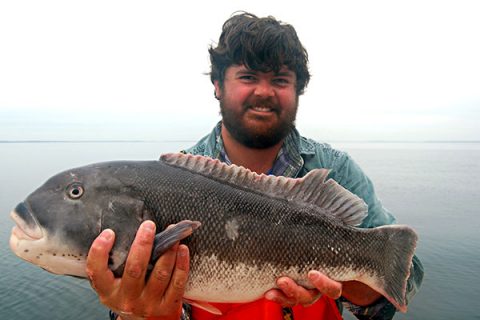
The waters of Vineyard Sound and Buzzards Bay are chock full of wrecks, reefs and rockpiles that hold hefty tautog and tasty sea bass in the spring.
A dense fog, typical of early spring mornings on Cape Cod, greeted us as we left the Woods Hole boat ramp just after sunrise. Even with the reduced visibility, the ride to the fishing grounds was comfortable and quick, and within 15 minutes, we had lines in and rods bent.
The calendar had just turned to May, and most New England boaters were still a few weeks away from dusting off their equipment and splashing their boats to pursue their first striped bass or bluefish of the season. What many New Englanders don’t realize, is that there is a good reason to launch the boat and get the lines wet long before bass and blues arrive for the season, and it’s the hard-fighting and remarkably tasty tautog.
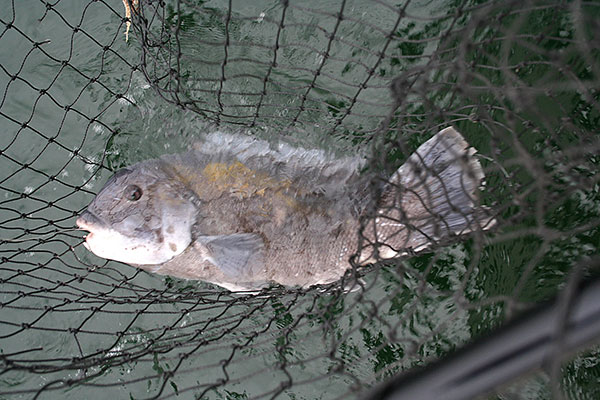
Tautog range from Nova Scotia to South Carolina, but are most commonly caught in the waters between Massachusetts and North Carolina. They are a member of the wrasse family, and like most of their wrasse relatives, which live in and around tropical coral reefs, tautog are structure-oriented fish. In the waters of southern New England, any form of structure, from rockpiles and mussel beds to shipwrecks and pilings, can hold tautog.
I was fishing with my good friend Captain Nat Chalkley aboard the Annie P, a restored 1973 Seacraft with a custom pilothouse. The first fish to come over the rail was a fat-lipped 4-pound fish, shortly followed by a fish of similar size.

Nat and I had started our morning fishing on a wreck, and before long we had five healthy ‘togs gracing the fish box. Tautog fishing is all about location. “If they aren’t biting, then you’re not in the right place,” says Chalkley. “Don’t be afraid to drive around watching the depth sounder and checking for life at the wrecks.” When the bite slowed, we picked up and ran to another spot, looking for signs of life. At one point, we cruised around a small area for 20 minutes before Nat settled on a rockpile in about 48 feet of water. One look at the fishfinder display made it obvious that we had found the beehive. Once anchored, our rigs would barely reach the bottom before we were both locked into hard-fighting ‘togs.
Where Vineyard Sound is squeezed between the south shore of Cape Cod and the north shore of Martha’s Vineyard, sandy shoals have claimed many ships over the years, and these wrecks provide strucutre that brings in good numbers of tautog. Sitting on the bottom near the Hedge Fence shoal off Oak Bluffs are two wrecks that are perennial hotspots for tautog. Look for wrecks marked on your chartplotter and then search the area with your fishfinder to find the structure. The rocky shores of the Elizabeth Islands offer piles of cobblestones, boulders, and rocky ledges that will hold tautog. Where the current flows fast between Robinsons and Quicks holes, you’ll find plenty of rockpiles to choose from. The rock structure surrounding Gay Head is a tautog utopia, with massive boulders and large piles of rock that give the fish plenty of nooks to hide in.

In Buzzards Bay, Cleveland Ledge is a well-known spot but it can host large crowds of fishermen, and keeper-size tautog can be tough to find if the ledge has been fished hard. Branch out and search along the coast, targeting rocky points of land that drop sharply into deeper water. In general, the more structure the better, but occasionally a small mussel bed or rockpile will hold a surprising number of large fish.
When searching for structure, you can use charts as a starting point, but the majority of structure will not be charted. Once you’re in the general area of a wreck or rockpile, your fishfinder will become your best friend. Slowly idle along likely areas while watching for sudden rises, drops, and signs of hard bottom to appear on the screen. Many of the best rockpiles are not marked on charts, so it’s often necessary to do some searching to discover your own honey hole. The spots that you find with your electronics will often be more productive than the well-known locations because they don’t experience any fishing pressure. The best structure is often found in areas that have little or no changes in bottom contour. These isolated structures can be magnets for tautog looking for shelter and crustaceans to munch on.
To fish a rockpile or shipwreck effectively, you’ll want to anchor. Anchoring is the most effective way to fish structure when chasing tautog because it allows you to maintain position over the wreck. When anchoring on structure, deploy the anchor upcurrent or upwind of the target so the boat will slide down and position you directly over the wreck. A matter of a couple yards can make a big difference when tautog fishing. One side of the boat may be producing while the other is not; pay attention, and concentrate your efforts in the most productive area. If the boat begins to swing on the anchor line, be prepared to reset the anchor so that you stay directly over productive structure. Captain Chalkley carries two anchors with him so he can precisely hold over a productive location. One is what he calls the “overkill” anchor; it’s an oversized anchor with lots of chain. His second anchor is a smaller danforth, or wreck anchor that he’ll often use to fine-tune his position and hold the boat as the tide changes.
Sometimes you will mark fish. However, tautog like to hide in the nooks of structure so usually you will have to make a few drops to find out if there is anyone home. If you drop a bait and don’t get a bite within a few minutes, or if the quality of the fish is not what you’re looking for, pick up and move around.
To find a productive area, focus on different combinations of three variables: structure, depth and current. In general, look for structure, be it rockpiles or wrecks, situated in 40 to 50 feet of water during the spring. While moving, you can zigzag from shallower to deeper water, but generally you don’t want to go much shallower than 30 feet or much deeper than 60. Once you’ve marked a number of good spots at different depths, you can move quickly from one to the next to determine where the fish are holding. Current can also play an important role. Captain Chalkley targets areas with moving water, and will move as the current slows. “The water doesn’t need to be moving fast, but it has to be moving,” he says. “During slack tide the bite will die, so that’s a good time to pick up and try a spot where the tide has already turned.”
As a general rule, tautog will start biting when the water temperatures reach the mid- to upper 40s. In the springtime, the tautog average in size around 2 to 3 pounds, however 5- to 8- pounders are not uncommon, and there is always the chance of a real bruiser of 10 pounds or more. On the particular day that I was fishing with Nat, the water temperature was 48 degrees and our average keeper was about 4 pounds, although one of the fish weighed in at 10 pounds. At many of the wrecks, you have to work your way through the smaller juvenile fish, but that is the case with any form of bottom or wreck fishing.

Tautog are one of the more unique-looking species of fish. Fat, rubbery lips, teeth that look shockingly human, and a short, stumpy body keep tautog from gracing many fishing magazine covers. Whatever points they lose in the style category, though, they make up for in pound-for-pound fighting strength. That stocky body houses strong shoulders and a muscular tail that allows the fish to dig hard for the safety of a wreck or rockpile. Don’t expect the acrobatics or screaming runs of a bonito or bluefish, instead, gear up for a hard-pulling tug-of-war as you attempt to keep a hooked tog from returning to the bottom and cutting your line.
Because of the down-and-dirty way that tautog fight, non-stretch braided line is a necessity. Nat prefers rods that have a light, flexible tip for detecting the subtle bites of a tautog, but the rod must have plenty of backbone to pull bigger fish off the bottom. His rods are custom-made 8-footers, each paired with a Shimano Torium 16 spooled with 65-pound-test PowerPro braided line. These set-ups are perfect for pulling Tonka-truck tautog from the bottom.

The standard rig for tautog is a chicken rig, also called a Christmas rig. Captain Chalkley makes his own rigs using 40-pound-test Seaguar fluorocarbon, 1/0 to 4/0 Eagle Claw Live Bait hooks, and standard bank sinkers. The weight is wholly dependent upon the depth and the amount of current. Use the ligthest weight capable of holding bottom. The hooks are affixed to the leader via dropper loops that position the each hook abount 2 inches away from the running line of the rig. Weights are attached via a surgeons loop at the bottom of the rig, allowing for easy weight changes as conditions warrant. The entire rig is approximately 3 feet in length.
Fiddler crabs, green crabs, clams, shrimp and seaworms will all work as tautog bait, but the fiddlers and green crabs work the best. Fiddler crabs are hard to come by here in New England unless you catch your own, however most tackle shops carry green crabs. Cut the crabs in half and place one half on each hook. Be sure to bring more crabs than you think you’ll need, as tautog are expert bait stealers. For my trip with Nat, we had two 5-gallon buckets full of green crabs and kept a healthy heap of cut crabs on the cutting board for rapid re-baiting.
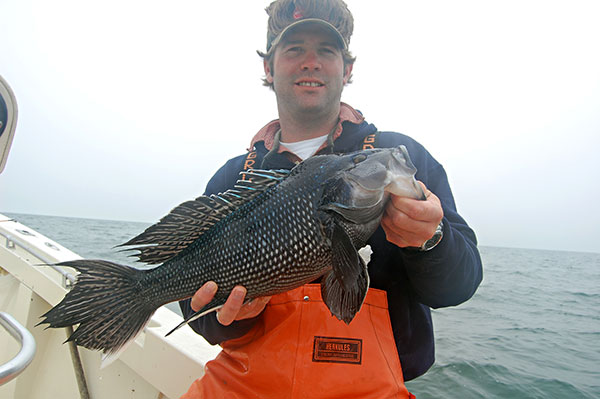
During this time year black sea bass will begin to show themselves on the same structure as tautog, so it shouldn’t be a surprise when a sea bass comes up from the depth. As the month of May progresses, more big sea a bass will take up residence on the wrecks and reefs. Bring along some fresh or frozen cut squid to target the seabass when in season and you can add some variety to your cooler.
On top of a fantastic fight, tautog are hands-down one of the finest-eating fish swimming in the ocean. Although their firm flesh makes them a favorite for fish chowder, this is not the only way to prepare them. Treat them as you would any white-fleshed fish, and bake or broil them to enjoy their delicate, sweet flavor. Or you can try Captain Chalkley’s favorite tog recipe: Cut the fillets into sticks, dip them in a basic Japanese tempura batter, and deep-fry in hot oil until they are golden-brown and crispy. Serve hot with a soy-based dipping sauce and enjoy a perfect ending to an early-spring day on the water.
I was out kayaking on 5/11 in Newport. My usual Tog honey hole was empty! Wish I read this sooner, when does the population return to shallower water? I usually fish the shallow rock ledges in 10-30ft. Of water.
I have found that Seabass and Tautog will make a presents in 46 to 54 degree water into waters 20′ to 40′ depths and they prefer soft baits like clams, mussels and sand worms. I have found the Tautog move into the 10 to 30′ water in mid-May. The shallows I look for is mussel or oyster beds (oyster bed that are being worked by oyster boats. Keep your distance from the oyster boats. One last tip, use mussels for chum. Hope this helps!